

.png)

ST Microelectronics Ready for Approval Testing of European Galileo-Compatible Satellite Chip for Emergency Call Systems
 Published2014.02.19 12:01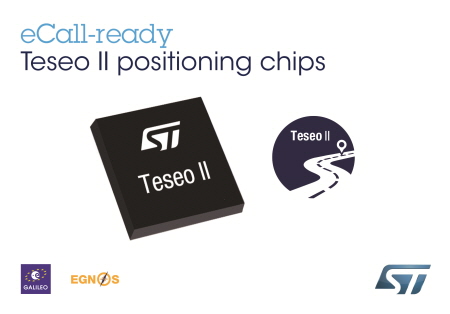
February 18, 2014, Seoul – STMicroelectronics (hereafter ST), a leading semiconductor company contributing to customers across diverse electronic applications, announced the release of its Teseo II single-chip satellite tracking IC product to the European Space Agency (ESA) and the European Commission's Joint Research Centre (JRC) for approval testing of the Emergency Call (eCall) system. This testing was planned by the European Satellite Navigation System (GNSS) Agency (GSA) to accelerate the adoption of the European Galileo satellite system.
According to the European Satellite Navigation System Agency's testing plan, the Galileo testing will be conducted over several months by the European Space Agency and the European Commission's Joint Research Centre, with ST's latest firmware as the subject of validation. The in-vehicle emergency call system automatically transmits accident information via message when an accident occurs, and through this testing, the compatibility of the Teseo II chip between EGNOS (European Geostationary Navigation Overlay Service) and Galileo can also be evaluated. Based on the testing plan, not only static and dynamic testing but also the utilization of three constellation systems (GPS/Galileo/GLONASS) in single, dual, and triple configurations is expected to be verified.
In March 2013, ST and the European Space Agency (ESA) conducted the first positioning test using Galileo in-orbit validation satellites. Since then, ST has implemented firmware suitable for Galileo for additional constellations of the Teseo II chip. Since the Teseo II chip was developed specifically for Galileo from the outset, it is capable of firmware updates through the Galileo navigation system. There is no need to modify hardware, and updates can provide consumers with greater benefits.
The Teseo II chip is an outstanding product capable of receiving signals from multiple satellite navigation systems, including the Galileo satellite, so as more satellites are launched in the future, it will continue to provide this functionality, ultimately enabling simultaneous use of signals from the entire satellite constellation. As a leading company in the multi-constellation receiver field, ST enables immediate utilization of Galileo satellites already in orbit, shortens the initial positioning time in challenging environments such as urban canyons, and improves the accuracy of continuous position tracking.
Antonio Radaelli, Senior Vice President of ST's Infotainment Business Unit, stated, "This experiment conducted with the European Commission's Joint Research Centre (JRC) will be an important milestone that underscores our role in supporting Galileo with ST's satellite navigation platform. The superior capabilities of the Teseo II chip, which combine long-standing validation and experience in multi-constellation firmware development, have become an important foundation for successfully conducting testing across a wide range from single constellation based on GPS, GLONASS, and Galileo to triple multi-constellation." He added, "Based on our strength in the multi-satellite navigation system market and our long-held commitment to the automotive sector, we were able to create unique products for Emergency Call (eCall) applications, and have also been able to build stronger technologies in automotive communication fields such as Digital Tachographs, Tolling, Telematics, and Navigation."

Related news

Intel Unveils Next-Generation 'Core Ultra Series 3' and vPro Platform for Enterprise PCs
Intel has officially unveiled the "Intel Core Ultra Series 3" for next-generation enterprise PCs and the latest vPro platform, addressing a wide range of demands from enterprise notebooks to high-performance workstations.
2026.03.26by 배종인 기자

ROHM Launches ESD Protection Diode Compatible with High-Speed Interfaces of 10Gbps or Higher
Semiconductor specialist ROHM has developed the 'RESDxVx series' of ESD (electrostatic discharge) protection diodes capable of responding to next-generation high-speed data communication environments exceeding 10Gbps, simultaneously enhancing both signal quality maintenance required in high-speed interfaces and IC protection performance.
2026.03.26by 배종인 기자
ST Launches 75V Drive IC Targeting 48V Industrial Motor Driving
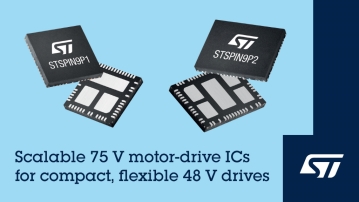
ST Microelectronics has unveiled the 'STSPIN9P' series of 75V motor drive ICs tailored for 48V-class industrial drive system design. The new product family is characterized by half-bridge and full-bridge configurations that enable design scalability according to motor type and output conditions. Power supply circuits, protection functions, and current sensing circuits are integrated on-chip to simplify system configuration, and the devices are designed to support applications up to 500W maximum. The company plans to provide reference designs and demo boards to support development and evaluation in industrial automation, robotics, pumps, fans, lighting, and textile machinery.
2026.03.26by 배종인 기자
Nordic supports security updates for the entire lifecycle of IoT devices at a single fixed cost
Nordic Semiconductor, a global leader in low-power wireless connectivity solutions, has unveiled a single fixed-cost licensing model that delivers FOTA (Firmware Over-the-Air) and device management capabilities throughout the device lifecycle via nRF Cloud, and introduced a new firmware update solution to prepare for the enforcement of the European Union's Cyber Resilience Act (CRA).
2026.03.26by 배종인 기자
Practical Training in Low-Noise, Low-Power Circuit Design All in One Place… Training Fee Support
The "2026 Advanced Engineer Practical Masterclass" to strengthen competencies in high-sensitivity analog circuit and sensor-based system design will be held on April 16 at the e4ds Conference Center in Gasan-dong, Seoul. This program will be conducted as an offline paid hands-on training session, not online, and is targeted at engineers seeking on-site intensive learning. Texas Instruments will provide educational support for this training, allowing participation at 150,000 won, a 100,000 won discount from the original price of 250,000 won.
2026.03.26by 배종인 기자











