



Producing clean hydrogen from seawater
 Published2023.02.22 16:48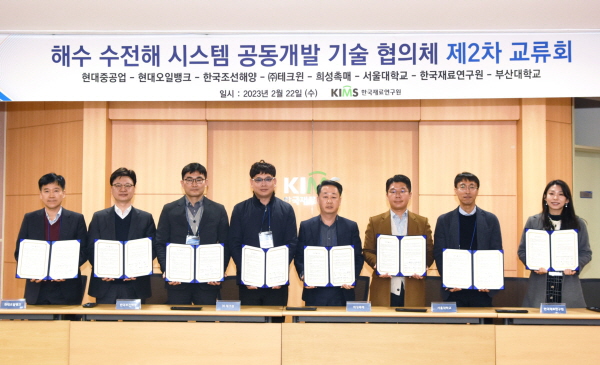
Officials from the Korea Institute of Materials Science, Hyundai Heavy Industries, Korea Shipbuilding & Marine Engineering, Hyundai Oilbank, Seoul National University, Pusan National University, Techwin Co., Ltd., and Heesung Catalyst Co., Ltd. are posing for a commemorative photo after signing the MOU.
Eight organizations have joined hands to obtain clean hydrogen using seawater.
The Korea Institute of Materials Science (KIMS, President Lee Jeong-hwan), a government-funded research institute under the Ministry of Science and ICT, signed a "Multilateral Agreement for the Joint Development of Core Technologies for Seawater Electrolysis Systems" on the 22nd at the seminar room of Research Building 1 of the KIMS in Changwon, Gyeongsangnam-do.
The institutions participating in this agreement are the Korea Institute of Materials Science, Hyundai Heavy Industries, Korea Shipbuilding & Offshore Engineering, Hyundai Oilbank, Seoul National University, Pusan National University, Techwin, and Heesung Catalyst, totaling eight institutions.
In 2021, the Korea Institute of Materials Science developed the nation's first "anion exchange membrane seawater electrolysis technology," which utilizes seawater, the most abundant water resource on Earth, to directly produce green hydrogen and drastically reduce hydrogen production costs.
'Anion exchange membrane water electrolysis' is a technology that produces high-purity hydrogen using inexpensive non-precious metal catalysts, but because it requires the use of purified water (ultrapure water), it has acted as a cause that not only increases the cost of hydrogen production but also hinders the expansion of water electrolysis.
The research team suppresses the chlorine generation reaction by controlling the pH (hydrogen ion concentration index of a solution) of seawater, and This problem was solved by reducing the overpotential through the developed high-activity catalyst and thereby enabling the oxygen evolution reaction to be driven, which allows the use of non-precious metal catalyst materials.
Based on this agreement, participating institutions will be able to jointly identify and carry out future research and technology development projects, develop workforce training programs, and actively propose necessary educational courses.
In addition, each institution pledged to work together by mutually exchanging materials and information necessary for industry-academia collaboration and holding regular technology exchange meetings.
The '2nd Exchange Meeting of the Joint Development Technology Council for Seawater Electrolysis Systems' was also held during the event. Key representatives from each institution attended to introduce the current status of their respective research.
Kim Dong-ho, Head of the Nano Surface Materials Research Division at the Korea Institute of Materials Science, stated, “The day is not far off when we can produce high-purity hydrogen at a low cost using seawater,” adding, “I look forward to the realization of a scenario where green hydrogen produced in conjunction with offshore renewable energy (such as offshore wind power) can be directly charged and used in hydrogen-powered ships.”

관련뉴스
KIMS Accelerates the Era of Green Hydrogen Production
국내 연구팀이 비귀금속 기반의 장수명·고효율 음이온교환막 수전해 스택 기술을 국내 최초로 개발하는 데 성공했다.
2022.08.11by 성유창 기자
.jpg)
KIMS, “Producing Hydrogen from Waste Water”
과학기술정보통신부 산하 정부출연연구기관인 한국재료연구원(KIMS, 원장 이정환)가 버려지는 물로 고순도의 수소를 생산할 수 있는 시스템을 개발해 향후 그린수소 생산 전망을 밝게 했다.
2022.12.05by 배종인 기자
Schneider Aims for Building Energy Savings and Operational Stability with Next-Generation HVAC Drives
슈나이더 일렉트릭이 차세대 HVAC 드라이브 제품군 ‘Altivar HVAC’를 공개했다. 새 제품군은 에너지 절감, 시스템 가동 안정성, 빌딩 관리 시스템 연동을 강화한 것이 핵심이다. 제품은 OEM 및 소형 장비용 ‘ATH200’과 연속 운전·고급 제어가 필요한 환경용 ‘ATH600’으로 나뉜다. 회사는 상업용 건물은 물론 병원, 공항, 데이터센터 등 공조 설비의 안정성이 중요한 시설까지 적용 범위를 넓히겠다는 구상이다. 발표 내용에는 30% 이상 에너지 절감, 영하 10도~영상 60도 운전, Modbus·BACnet 지원, 저지구온난화지수 냉매 대응 등이 포함됐다.
2026.03.26by 명세환 기자
Ecolab Expands AI Data Center Cooling Business Through Acquisition of CoolIT
Ecolab has agreed to acquire CoolIT Systems, a liquid cooling company for AI data centers, for approximately $4.75 billion. The transaction is expected to close by Q3 2026, subject to regulatory approvals. CoolIT has been supplying direct-to-chip cooling-based coolant distribution units, cold plates, and manifolds, serving hyperscale data centers and colocation operators as customers. This acquisition is a measure to address the high-heat and high-density server environments created by AI proliferation. Ecolab plans to combine its water management and digital monitoring capabilities with CoolIT's hardware technology to expand its data center cooling business.
2026.03.26by 명세환 기자

AI Semiconductor Era, Key is 'Materials Technology'… KIEC Holds Seminar on High-Performance Semiconductor Materials
AI 데이터센터 투자 확대와 고대역폭메모리(HBM) 수요 증가로 글로벌 반도체 시장이 빠르게 성장하는 가운데, 차세대 반도체 소재와 패키징 기술을 조망하는 전문 세미나가 열린다. 화학경제연구원이 오는 4월24일 서울 여의도 한국경제인협회 FKI타워에서 ‘고기능성 반도체 소재 기술 세미나’를 개최한다. 세미나 참가 신청은 화학경제연구원 공식 홈페이지를 통해 선착순으로 접수 중이며, 얼리버드 할인은 3월27일까지, 사전 등록은 4월22일까지 가능하다.
2026.03.25by 배종인 기자











