


NXP Unveils Ultra-Small DSP-Based 5V Qi Wireless Charger
 Published2014.03.06 12:30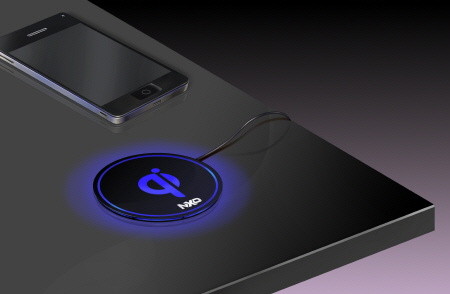
February 28, 2014, Seoul — NXP Semiconductors (NASDAQ: NXPI) announced that it demonstrated a new innovative Qi wireless charging transmitter at the Mobile World Congress. This product integrates all the circuitry required for a 5V mobile phone charger into an ultra-small package measuring just 5 square millimeters. Powered by NXP's solution, a low-power 5V Qi A5/A11 wireless charging transmitter can be fully implemented with Qi coils and resonant capacitors using fewer than 10 external components. NXP's NXQ1TXA5 system-on-chip is so compact that the entire transmitter fits onto a PCB smaller than 1.5 square centimeters. Furthermore, components are positioned on only one side of this PCB. This opens up various possibilities for designing wireless charger pads in innovative ways, such as placing the transmitter inside the center of the Qi coil. The demonstration video can be viewed here: http://youtu.be/ehGBI4blOtU
In addition, NXP is demonstrating two 'smart' wireless charging reference designs equipped with NFC technology for 12V and 19V Qi transmitters. The addition of NFC technology to wireless chargers can provide a variety of additional features. Consumers can set up the wireless charging pad regardless of the type of NFC-enabled phone or tablet, and since the wireless charger can be 'wake-up' via NFC, standby power consumption can be completely cut off when not in use. In addition, it offers smart features such as automatic Bluetooth pairing and launching applications and websites when an NFC-enabled phone is placed on the charging pad.
Rick Dumont, Marketing Director of Wireless Charging Solutions at NXP Semiconductors, explained, “NXP’s new wireless charging solution for 5V Qi transmitters enables our key customers to manufacture ultra-small Qi transmitters, allowing them to significantly reduce system costs and design portable wireless chargers with great freedom. Thanks to the substantial reduction in the size and cost of Qi transmitters, the possibility has also opened up for mobile phone manufacturers to offer wireless charging pads as a standard feature. In addition, 'smart' wireless charging solutions utilizing NFC are receiving a tremendous response in the market. Using next-generation Qi wireless charging pads equipped with NFC allows users to play music through Bluetooth speakers and transfer useful content to mobile devices while the device is charging, while overall power consumption will be reduced.”
The NXQ1TXA5 system-on-chip integrates a power controller, digital signal processing (DSP), voltage regulation, foreign object detection (FOD), a full-bridge power stage to drive the transmitter coil, and circuitry for on-chip current and voltage measurement, so only a very small number of external components are required to fully configure this solution. This device utilizes NXP's CoolFlux™ DSP technology and boasts very high power efficiency, such as achieving standby power of less than 2mW.
The reference design of the NXQ1TXA5 consists of a complete wireless charger designed to meet the low-power Qi A5/A11 specifications of a 5V charger, and can use a universal USB outlet charger or a USB port for a PC as a power source. In addition, this low-power reference design can be complemented with NXP's high-efficiency GreenChip™ TEA1720 SMPS controller to achieve overall low-power standby performance.
Other reference designs included in the NXP wireless charging transmitter family are the NXQ1TXA6 and NXQ1TXA1. The NXQ1TXA6 is designed to comply with the Qi A6 standard for 12V, while the NXQ1TXA1 is designed to comply with the Qi A1/A10 standard for 19V charging transmitters. Both of these reference designs feature 32 pins spaced 0.5 millimeters apart in a small 7 square millimeter package, facilitating PCB design. NXP fully implements low component count reference designs based on the NXQ1TXA1 and NXQ1TXA6, and also provides other high-performance components from the NXP family, such as the GreenChip NWP2081 half-bridge driver and the NX2020N2 low RDS(on) trench MOSFET for coil-driving power bridges.
NXP's reference design for wireless charging transmitters is scheduled to be provided to some customers in the second quarter, and the component is expected to pass verification for mass production in the third quarter.

관련뉴스

Intel Unveils Next-Generation 'Core Ultra Series 3' and vPro Platform for Enterprise PCs
인텔이 차세대 기업용 PC를 위한 ‘인텔 코어 Ultra 시리즈 3’와 최신 vPro 플랫폼을 공식 발표하며, 기업용 노트북부터 고성능 워크스테이션까지 폭넓은 수요 충족에 나섰다.
2026.03.26by 배종인 기자

ROHM Launches ESD Protection Diode Compatible with High-Speed Interfaces of 10Gbps or Higher
반도체 전문 기업 로옴(ROHM)이 10Gbps를 넘어서는 차세대 고속 데이터 통신 환경에 대응할 수 있는 ESD(정전기 방전) 보호 다이오드 ‘RESDxVx 시리즈’를 개발하며, 고속 인터페이스에서 요구되는 신호 품질 유지와 IC 보호 성능을 동시에 끌어올렸다.
2026.03.26by 배종인 기자
ST Launches 75V Drive IC Targeting 48V Industrial Motor Driving
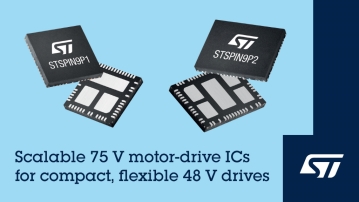
ST마이크로일렉트로닉스가 48V급 산업용 구동 시스템 설계에 맞춘 75V 모터 드라이브 IC ‘STSPIN9P’ 시리즈를 공개했다. 새 제품군은 하프 브리지와 풀 브리지 구조로 구성돼 모터 종류와 출력 조건에 따라 설계를 확장할 수 있도록 한 것이 특징이다. 전원 회로와 보호 기능, 전류 감지 회로를 칩에 통합해 시스템 구성을 단순화했으며, 최대 500W급 애플리케이션까지 대응하도록 설계됐다. 회사는 레퍼런스 디자인과 데모 보드도 함께 제공해 산업 자동화, 로보틱스, 펌프, 팬, 조명, 섬유 기계 등에서 개발과 평가를 지원할 계획이다.
2026.03.26by 배종인 기자

Nordic supports security updates for the entire lifecycle of IoT devices at a single fixed cost
Nordic Semiconductor, a global leader in low-power wireless connectivity solutions, has unveiled a single fixed-cost licensing model that delivers FOTA (Firmware Over-the-Air) and device management capabilities throughout the device lifecycle via nRF Cloud, and introduced a new firmware update solution to prepare for the enforcement of the European Union's Cyber Resilience Act (CRA).
2026.03.26by 배종인 기자

Practical Training in Low-Noise, Low-Power Circuit Design All in One Place… Training Fee Support
고감도 아날로그 회로와 센서 기반 시스템 설계 역량을 강화할 수 있는 ‘2026 고급 엔지니어 실무 마스터 클래스’가 오는 4월16일 서울 가산동 e4ds 컨퍼런스 센터에서 열린다. 이번 과정은 온라인이 아닌 오프라인 유료 실습 교육으로 진행되며, 현장 중심의 심화 학습을 원하는 엔지니어를 대상으로 한다. 이번 교육은 텍사스 인스트루먼트(Texas Instruments)가 교육비를 지원해 정가 25만원에서 10만원 할인 된 15만원에 참가할 수 있다.
2026.03.26by 배종인 기자











