



Wearable materials that can charge batteries using only the body's heat are now available.
 Published2023.07.10 11:09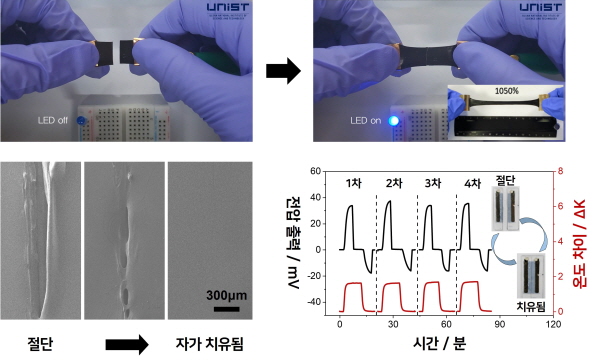
▲ Self-healing ability and elasticity of the developed ionic polymer thermoelectric material (The developed thermoelectric material can stretch more than 10 times its original length and has self-healing ability, allowing it to heal wounds on its own. It also maintained excellent electrical performance even after repeated cutting and healing.)
A material with ultra-high-efficiency thermoelectric properties has been developed that self-heals and stretches like human skin. This material can be recharged solely by the body's own heat, eliminating the need for batteries, and is expected to bring wearable technology a step closer to commercialization.
Professor Jang Seong-yeon's research team from the Department of Energy and Chemical Engineering at UNIST (President Yong-Hoon Lee) recently announced that they have developed a 'high-performance ionic polymer thermoelectric material' with self-healing capabilities for mechanical and electrical errors and problems in collaboration with Professor Jeon Ju-won's research team from the Department of Applied Chemistry at Kookmin University (President Hong-Jae Lim).
Thermoelectric materials are eco-friendly energy sources that convert thermal energy into electricity. The research team utilized a "self-healing thermoelectric material," which maintains both mechanical properties and electrical performance by repairing itself after being torn or cut through the strong attractive forces between its molecules.
In addition, we precisely analyzed and optimized the variables that determine the thermoelectric performance of ionic thermoelectric materials that were not covered in previous studies. Based on this, a material with ultra-high efficiency thermoelectric conversion performance, excellent mechanical properties, and self-healing ability was developed.
Wearable electronic devices, such as Bluetooth earphones and smartwatches, are now a common sight. Most electronic devices use lithium-ion batteries with liquid electrolytes. However, these liquid-containing batteries limit device design due to issues like leakage, and their reliance on external power for charging presents clear limitations.
In contrast, ionic polymer thermoelectric materials are highly anticipated as next-generation independent power sources due to their unique flexibility and ability to generate electricity using surrounding thermal energy.
On the other hand, thermoelectric materials have lower thermal energy conversion performance than conventional lithium-ion batteries, requiring significant improvements for commercialization. Furthermore, systematic scientific analysis for performance improvement is still lacking.
The research team, for the first time in the world, analyzed the ionic thermoelectric effect within a material thermodynamically to optimize its heat energy conversion performance. The developed material achieved an ionic thermoelectric figure of merit of 12.3, exceeding the previous record by over 70%. It also boasted excellent physical properties, including self-healing capabilities, allowing it to stretch to over 10 times its original length and maintaining its mechanical and electrical properties without loss of performance even after over 50 cycles of durability testing.
“We were able to achieve record-breaking performance by maximizing the energy change of ions that diffuse through heat within the material,” said Dong-Hoo Kim, a researcher in the Department of Energy and Chemical Engineering and the first author. “Since it has excellent self-healing and elasticity, it can be applied to self-power generation for wearable electronic devices in the future.”
The research team used the developed material to manufacture ionic thermoelectric supercapacitor elements and even manufactured modules that amplified output by connecting multiple elements in series. The fabricated module demonstrated a very high voltage output (0.37 V/K), demonstrating that the developed thermoelectric material can generate sufficient voltage to power various electronic devices in everyday life. This suggests that if body temperature can be as low as 10 degrees Celsius above room temperature, it can produce a voltage output similar to that of a conventional lithium-ion battery (approximately 3.7 V).
Professor Jang Seong-yeon of the Department of Energy and Chemical Engineering emphasized, “This study presents all the necessary processes, from material design considering mechanical and electrical properties to commercialization demonstration through modules,” and “This is an important study that will serve as a guide for many researchers developing ionic thermoelectric materials in the future.”
This study was published in Nature Communications on June 5th. The research was supported by the National Research Foundation of Korea (NRF) funded by the Ministry of Science and ICT.

Comments
Related news
Schneider Aims for Building Energy Savings and Operational Stability with Next-Generation HVAC Drives
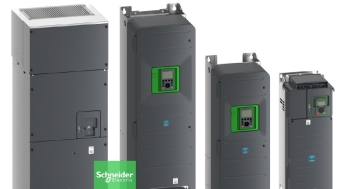
Schneider Electric has unveiled its next-generation HVAC drive product line 'Altivar HVAC'. The new product line's key features center on enhanced energy savings, system operational stability, and building management system integration. The products are divided into 'ATH200' for OEM and small equipment applications, and 'ATH600' for environments requiring continuous operation and advanced control. The company plans to expand the application scope from commercial buildings to facilities where HVAC system stability is critical, such as hospitals, airports, and data centers. The announcement includes over 30% energy savings, operation from -10°C to +60°C, Modbus and BACnet support, and compatibility with low global warming potential refrigerants.
2026.03.26by 명세환 기자

Ecolab Expands AI Data Center Cooling Business Through Acquisition of CoolIT
Ecolab has agreed to acquire CoolIT Systems, a liquid cooling company for AI data centers, for approximately $4.75 billion. The transaction is expected to close by Q3 2026, subject to regulatory approvals. CoolIT has been supplying direct-to-chip cooling-based coolant distribution units, cold plates, and manifolds, serving hyperscale data centers and colocation operators as customers. This acquisition is a measure to address the high-heat and high-density server environments created by AI proliferation. Ecolab plans to combine its water management and digital monitoring capabilities with CoolIT's hardware technology to expand its data center cooling business.
2026.03.26by 명세환 기자

AI Semiconductor Era, Key is 'Materials Technology'… KIEC Holds Seminar on High-Performance Semiconductor Materials
With rapid growth in the global semiconductor market driven by expanded AI data center investments and increased demand for high-bandwidth memory (HBM), a specialized seminar examining next-generation semiconductor materials and packaging technologies will be held. The Korea Chemical Industry Institute will host a "High-Performance Semiconductor Materials Technology Seminar" on April 24 at the FKI Tower of the Korea Economic Association in Yeouido, Seoul. Applications to participate in the seminar are being accepted on a first-come, first-served basis through the Korea Chemical Industry Institute's official website, with early bird discounts available until March 27 and advance registration open until April 22.
2026.03.25by 배종인 기자
.jpg)
KIMS Shares Techniques for Industrial Application of Casting Technology
The Korea Institute of Materials Science held a casting technology seminar at its headquarters in Changwon, South Gyeongsang Province, and introduced core process technologies utilized in industrial applications. The seminar covered fundamental principles of casting processes and defect control methods, lightweight-oriented die-casting technology, and trends in aluminum casting alloys for mobility applications. At the conclusion of the event, consultations on industrial technical challenges were also conducted, providing an opportunity to expand the interface between research institutions and industry.
2026.03.25by 명세환 기자
Keysight Launches 220GHz Optical Component Analyzer… Aims at Verifying Next-Generation Optical Transceivers
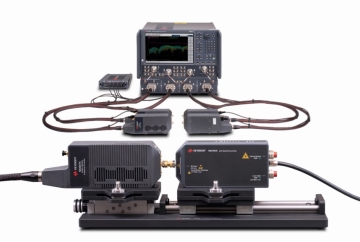
Keysight Technologies has introduced the N4378A optical wave component analyzer, which can measure the characteristics of opto-electronic conversion components up to 220GHz. This equipment is targeted at the rapidly advancing data center optical interconnection market driven by AI and cloud expansion, and supports single-sweep broadband measurements at 1310nm and 1550nm wavelengths. The device focuses on enhancing measurement accuracy and design verification efficiency in the development process of next-generation 1.6T and 3.2T class optical transceivers through optical modulator and photodetector verification, differential measurements for dual-drive optical modulators, and 0.5mm coaxial connector protection structures. Keysight demonstrated this equipment for the first time at OFC 2026.
2026.03.25by 명세환 기자











