



Intel Foundry Secures Boeing and Northrop Grumman as Defense Clients
 Published2023.07.20 09:22
Boeing and Northrop Grumman are participating in a defense industry semiconductor program using Intel Foundry.
Intel Foundry Services announced on the 19th that two new Defense Industry Base (DIB) customers, Boeing and Northrop Grumman, have joined Phase 2 of the U.S. Department of Defense’s RAMP-C program to manufacture advanced semiconductors needed for national security.
Customers can participate in Phase 2 of the RAMP-C program to leverage Intel 18A process technology, industry-standard electronic design and analysis tools, and intellectual property (IP). Additionally, they can design, tape out, and fabricate test chips to prepare for product design tape-out.
Kapil Wadhera, Intel’s Vice President of Foundry Services and General Manager of the Foundry Solutions Business Group, said, “We welcome Boeing and Northrop Grumman to the RAMP-C program.” “We will develop and support leading semiconductor solutions to enable Boeing and Northrop Grumman to successfully achieve the objectives of the U.S. Department of Defense and national security systems by utilizing Intel’s 18A process technology,” he said. “Intel will strengthen the semiconductor supply chain within the United States and strive to help the U.S. maintain its leading position in process technology research and development, advanced manufacturing, and microelectronics systems.”
The RAMP-C program supports the U.S. commercial semiconductor foundry ecosystem in producing leading custom integrated circuits and commercial products required for U.S. Department of Defense systems.
Boeing and Northrop Grumman can leverage cutting-edge technology for the development of U.S. national security-related products by working closely with current RAMP-C customers such as NVIDIA, Qualcomm, Microsoft, and IBM, as well as Intel and ecosystem partners such as Cadence and Synopsys.
The RAMP-C program enables commercial foundry customers and the U.S. Department of Defense to utilize Intel's leading process technologies and supports the establishment of an ecosystem for cutting-edge process technologies, including Intel 18A, for commercial and government customers. Intel 18A process development is proceeding as planned, and RAMP-C program customers are currently developing test chips.
Intel is working to strengthen the U.S. government's microelectronics supply chain and further reinforce the U.S.'s leading position in integrated circuit (IC) design, manufacturing, and packaging. Intel is collaborating with the U.S. Department of Defense on three separate programs: RAMP, RAMP-C, and SHIP.
The U.S. Department of Defense announced the RAMP program in 2020 with the goal of developing the ability to securely utilize cutting-edge microelectronics technology and producing prototypes without relying on closed security architecture manufacturing processes or facilities. The prime contractor is Microsoft, and Intel provides foundry services based on Intel 16 process technology.
Intel signed a Phase 2 contract with the U.S. Department of Defense for the Advanced Heterogeneous Integration Prototype (SHIP) program and delivered the first multi-chip package prototype to BAE Systems in April 2023. The SHIP program supports the U.S. government in developing new approaches to measurable, secure heterogeneous integration and advanced packaging solutions by leveraging Intel's advanced U.S. semiconductor packaging capabilities.

Comments
Related news

Intel Unveils Next-Generation 'Core Ultra Series 3' and vPro Platform for Enterprise PCs
Intel has officially unveiled the "Intel Core Ultra Series 3" for next-generation enterprise PCs and the latest vPro platform, addressing a wide range of demands from enterprise notebooks to high-performance workstations.
2026.03.26by 배종인 기자

ROHM Launches ESD Protection Diode Compatible with High-Speed Interfaces of 10Gbps or Higher
Semiconductor specialist ROHM has developed the 'RESDxVx series' of ESD (electrostatic discharge) protection diodes capable of responding to next-generation high-speed data communication environments exceeding 10Gbps, simultaneously enhancing both signal quality maintenance required in high-speed interfaces and IC protection performance.
2026.03.26by 배종인 기자
ST Launches 75V Drive IC Targeting 48V Industrial Motor Driving
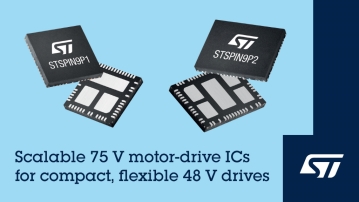
ST Microelectronics has unveiled the 'STSPIN9P' series of 75V motor drive ICs tailored for 48V-class industrial drive system design. The new product family is characterized by half-bridge and full-bridge configurations that enable design scalability according to motor type and output conditions. Power supply circuits, protection functions, and current sensing circuits are integrated on-chip to simplify system configuration, and the devices are designed to support applications up to 500W maximum. The company plans to provide reference designs and demo boards to support development and evaluation in industrial automation, robotics, pumps, fans, lighting, and textile machinery.
2026.03.26by 배종인 기자

Nordic supports security updates for the entire lifecycle of IoT devices at a single fixed cost
Nordic Semiconductor, a global leader in low-power wireless connectivity solutions, has unveiled a single fixed-cost licensing model that delivers FOTA (Firmware Over-the-Air) and device management capabilities throughout the device lifecycle via nRF Cloud, and introduced a new firmware update solution to prepare for the enforcement of the European Union's Cyber Resilience Act (CRA).
2026.03.26by 배종인 기자

Practical Training in Low-Noise, Low-Power Circuit Design All in One Place… Training Fee Support
The "2026 Advanced Engineer Practical Masterclass" to strengthen competencies in high-sensitivity analog circuit and sensor-based system design will be held on April 16 at the e4ds Conference Center in Gasan-dong, Seoul. This program will be conducted as an offline paid hands-on training session, not online, and is targeted at engineers seeking on-site intensive learning. Texas Instruments will provide educational support for this training, allowing participation at 150,000 won, a 100,000 won discount from the original price of 250,000 won.
2026.03.26by 배종인 기자











