


Altera Customers Achieve Industry Milestone with 2x Core Performance Gain on Stratix 10 FPGA and SoC
 Published2014.05.09 09:43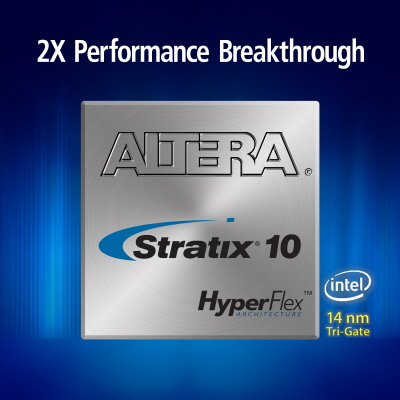
San Jose, California – May 8, 2014 – Altera Corporation (Nasdaq: ALTR) announced today that Stratix® 10 FPGA and SoC customers have successfully achieved an estimated 2x core performance gain compared to previous-generation high-performance programmable devices in their designs. Altera worked closely with early access customers representing diverse industries and performed benchmarking on their next-generation designs using the Stratix 10 FPGA performance evaluation tool. Customers experienced breakthrough performance increases in FPGA core performance through the combination of Intel's 14nm TriGate process technology and the groundbreaking Stratix 10 HyperFlex architecture.
The HyperFlex architecture, the next-generation core fabric architecture for Altera's Stratix 10 devices, represents the most significant advancement in structural innovation in the FPGA industry over the past decade and enables the implementation of applications that cannot be realized with existing FPGA architectures. Stratix 10 FPGA and SoC with HyperFlex architecture can meet the demanding requirements of cutting-edge, performance-critical applications in networking, communications, broadcast, defense, computing, and storage markets.
Early access customers are directly experiencing the tremendous performance gains that Stratix 10 devices provide. Through the Stratix 10 FPGA early access program, Altera collaborated with several customers to execute their existing designs through the performance evaluation tool created for Stratix 10 FPGA. Customer designs employ diverse hardware design methodologies targeting a wide range of applications, including ASIC replacement designs, conventional high-performance FPGA communications designs, and high-throughput data center and computing designs. In all cases, customers experienced a minimum 2x increase in design performance using Stratix 10 FPGA.
Bernd Liebetrau, Chief of Center for Digital Integration at Rohde & Schwarz, stated, "When I first participated in the Stratix 10 FPGA early access program, it was difficult to imagine the 2x performance improvement that Altera claimed. However, once we began working with Altera and received extensive guidance from Altera's technical team, within just a few days we were able to execute one of our existing designs through Altera's design tools and experience more than double the performance we had achieved previously. This level of performance opens up possibilities for new applications that were previously not possible with FPGAs."
In addition to benchmarking customer designs, Altera optimized some soft IP for the Stratix 10 HyperFlex architecture to deliver similar 2x performance gains. Altera's Optical Transport Network (OTN) IP portfolio operated at 350MHz on previous-generation high-performance FPGAs, but achieves over 700MHz performance when using Stratix 10 devices. Altera's 400GbE IP, which currently operates with a 1024-bit wide data path on Stratix V FPGA, operates at 2x performance with a 512-bit wide data path when applying the HyperFlex architecture, achieving the same high throughput while significantly reducing area utilization within the programmable core fabric.
Patrick Dorsey, Vice President of Product Marketing at Altera, stated, "It was a bold claim to assert that we could achieve a breakthrough 2x logic performance through architectural innovation and process technology leadership. By working closely with customers, Altera was able to actually validate what can be achieved with our next-generation Stratix 10 FPGA and SoC platform, and the results were remarkable."
Stratix 10 FPGA and SoC utilizing Intel's 14nm TriGate process and HyperFlex architecture are designed to implement cutting-edge, highest-performance applications in the communications, defense, broadcast, computing, and storage markets while significantly reducing system power consumption. Stratix 10 FPGA and SoC deliver 2x core performance of previous-generation high-performance devices. For high-performance systems with strict power budgets, Stratix 10 devices enable power consumption reduction of up to 70% compared to Stratix V FPGA.
Additionally, Stratix 10 FPGA and SoC offer industry-leading system integration. The devices feature highest-density single-chip implementation with over 4M LE (logic elements), over 10TeraFLOP single-precision enhanced floating-point DSP performance, 28Gbps backplane-supported transceivers and 56Gbps transceiver paths, over 4x serial transceiver bandwidth compared to previous-generation FPGAs, third-generation high-performance quad-core 64-bit ARM Cortex-A53 processor system, and multi-die solutions capable of integrating DRAM, SRAM, ASIC, processor, and analog components in a single package.

Related news
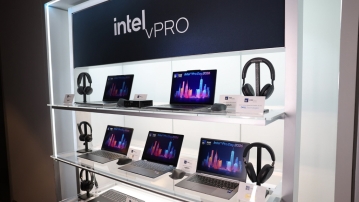
Intel Unveils Next-Generation 'Core Ultra Series 3' and vPro Platform for Enterprise PCs
Intel has officially unveiled the "Intel Core Ultra Series 3" for next-generation enterprise PCs and the latest vPro platform, addressing a wide range of demands from enterprise notebooks to high-performance workstations.
2026.03.26by 배종인 기자
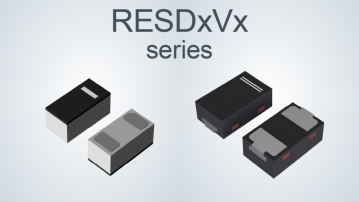
ROHM Launches ESD Protection Diode Compatible with High-Speed Interfaces of 10Gbps or Higher
Semiconductor specialist ROHM has developed the 'RESDxVx series' of ESD (electrostatic discharge) protection diodes capable of responding to next-generation high-speed data communication environments exceeding 10Gbps, simultaneously enhancing both signal quality maintenance required in high-speed interfaces and IC protection performance.
2026.03.26by 배종인 기자
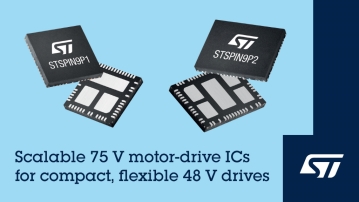
ST Launches 75V Drive IC Targeting 48V Industrial Motor Driving
ST Microelectronics has unveiled the 'STSPIN9P' series of 75V motor drive ICs tailored for 48V-class industrial drive system design. The new product family is characterized by half-bridge and full-bridge configurations that enable design scalability according to motor type and output conditions. Power supply circuits, protection functions, and current sensing circuits are integrated on-chip to simplify system configuration, and the devices are designed to support applications up to 500W maximum. The company plans to provide reference designs and demo boards to support development and evaluation in industrial automation, robotics, pumps, fans, lighting, and textile machinery.
2026.03.26by 배종인 기자

Nordic supports security updates for the entire lifecycle of IoT devices at a single fixed cost
Nordic Semiconductor, a global leader in low-power wireless connectivity solutions, has unveiled a single fixed-cost licensing model that delivers FOTA (Firmware Over-the-Air) and device management capabilities throughout the device lifecycle via nRF Cloud, and introduced a new firmware update solution to prepare for the enforcement of the European Union's Cyber Resilience Act (CRA).
2026.03.26by 배종인 기자

Practical Training in Low-Noise, Low-Power Circuit Design All in One Place… Training Fee Support
The "2026 Advanced Engineer Practical Masterclass" to strengthen competencies in high-sensitivity analog circuit and sensor-based system design will be held on April 16 at the e4ds Conference Center in Gasan-dong, Seoul. This program will be conducted as an offline paid hands-on training session, not online, and is targeted at engineers seeking on-site intensive learning. Texas Instruments will provide educational support for this training, allowing participation at 150,000 won, a 100,000 won discount from the original price of 250,000 won.
2026.03.26by 배종인 기자











