


High-Purity Green Hydrogen, Environment-Friendly and Affordable Production
 Published2024.01.11 15:55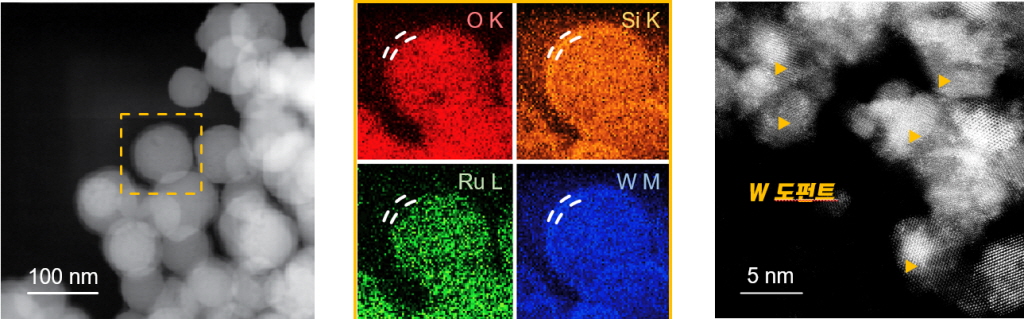
▲Transmission electron microscopy image of RuSiW catalyst (left), elemental mapping image (center), transmission electron microscopy image of tungsten-doped catalyst (right)
A technology has been developed to produce green hydrogen more inexpensively and in an environmentally friendly manner. As a technology that replaces expensive precious metal catalysts, it is expected to bring us one step closer to a carbon-neutral society.
A joint research team led by Professor Ryu Jeong-gi from the Department of Energy Chemical Engineering at UNIST (President Lee Yong-hun) and Professor Seo Dong-hwa from the Department of Materials Science and Engineering at KAIST (President Lee Kwang-hyung) announced on the 11th that they have developed a bifunctional water electrolysis catalyst for producing high-purity green hydrogen with high efficiency and stability.
The developed catalyst can be used for extended periods even in highly corrosive acidic environments. Made based on ruthenium, silicon, and tungsten (RuSiW), it is less expensive compared to conventional platinum (Pt) or iridium (Ir) catalysts. Greenhouse gas emissions are also reduced to one-quarter or less, making it environment-friendly.
Water electrolysis is a technology that produces hydrogen by electrically decomposing water. In the process of producing hydrogen, environmentally friendly hydrogen can be produced without carbon emissions, making it a next-generation technology for a carbon-neutral society.
The research team investigated materials that could replace precious metal electrolytes such as platinum or iridium, which are stable in acidic conditions. Ruthenium has received attention as an environment-friendly metal because its production cost is relatively low and it emits greenhouse gases 1/7 and 1/4 lower than platinum and iridium, respectively.
However, it had lower catalytic reaction promotion ability compared to platinum and lower stability compared to iridium, presenting challenges for commercialization.
The research team developed a catalyst based on a ternary oxide composed of ruthenium, silicon, and tungsten. By simultaneously improving the low hydrogen evolution reaction (HER) and oxygen evolution reaction (OER) stability of ruthenium catalysts, they demonstrated the potential as a bifunctional catalyst.
The developed catalyst has a structure with tungsten and silicon doped around ruthenium atoms. The catalytic reaction promotion ability was enhanced by appropriately increasing the adsorption strength of protons on the catalyst surface. It shows superior activity for hydrogen evolution reaction compared to commercialized platinum catalysts. A thin tungsten film of 5-10 nm protects the catalytic active sites of ruthenium, further enhancing stability.
The research team conducted catalyst stability experiments. In an acidic electrolyte environment (pH 0.3), a current of 10 mA was applied to a 1 cm² electrode. The developed catalyst operated stably even after over 100 hours of operation.
Professor Ryu Jeong-gi from the Department of Energy Chemical Engineering stated, "The significance of the developed ternary element catalyst lies in its ability to simultaneously replace both expensive platinum and iridium," and added, "It is expected to be applicable to proton exchange membrane (PEM) electrolyzers, which are high-purity green hydrogen production systems, as it is stable over long periods even in highly corrosive acidic environments and can be easily synthesized."
This research was conducted with Dr. Jeon Da-som from the Department of Energy Chemical Engineering at UNIST, Dr. Kim Dong-yeon from the Department of Materials Science and Engineering at KAIST, and Dr. candidate Kim Hyun-gu from the Department of Energy Chemical Engineering at UNIST serving as first authors.
The research was supported by the Mid-Career Researcher Support Project and Regional Innovation Leading Research Center (RLRC) Project of the National Research Foundation of Korea under the Ministry of Science and ICT, and the National Supercomputing Center (KISTI). The research results were published in "Advanced Materials," a prestigious international academic journal in the materials field, on January 4th.

Comments
Related news
KIMS Accelerates the Era of Green Hydrogen Production
A domestic research team has successfully developed the nation's first long-lifespan, high-efficiency anion exchange membrane water electrolysis stack technology based on non-precious metals.
2022.08.11by 성유창 기자
KIMM, “Green Ammonia Promising for the Future”
The Korea Institute of Machinery and Materials has analyzed green ammonia-related technologies as a future promising item across various emerging energy industries, including hydrogen energy transportation.
2022.08.18by 배종인 기자
.jpg)
KIMS, “Producing Hydrogen from Waste Water”
The Korea Institute of Materials Science (KIMS, President Lee Jung-hwan), a government-funded research institute under the Ministry of Science and ICT, has developed a system capable of producing high-purity hydrogen from wastewater, brightening the outlook for future green hydrogen production.
2022.12.05by 배종인 기자
.jpg)
KETI succeeds in synthesizing atomic-level water electrolysis catalyst
The Korea Electronics Technology Institute (KETI, Director Shin Hee-dong) has successfully synthesized an atomic-level water electrolysis catalyst, dramatically reducing the use of rare metals while enhancing performance, and is expected to serve as a catalyst for future green hydrogen production.
2023.07.04by 배종인 기자

From green hydrogen to nitrogen and oxygen, we make whatever you want.
A research team led by Professors Ryu Jeong-gi and Lee Dong-wook from the Department of Energy Chemical Engineering at UNIST (President Lee Yong-hoon) has developed a large-area hydrogel thin film technology that can be universally applied to gas-producing electrodes. It is anticipated that this technology will enable easy production of clean gas feedstocks such as green hydrogen.
2023.10.24by 배종인 기자











