

.png)

TI Launches Industry's First High-Current PMBus™ Converter with Integrated MOSFET
 Published2014.06.27 11:11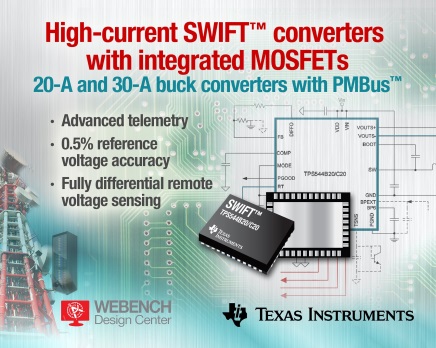
TI Korea (CEO Kent Chon, www.ti.com/ww/kr) June 27, 2014 – TI (CEO Kent Chon) announced the launch of two 18V, 20A and 30A synchronous DC/DC buck converters with PMBus interface. The SWIFT TPS544B20 and TPS544C20 converters are provided in a compact QFN package and feature integrated MOSFETs, enabling them to drive ASICs used in space-constrained, high power density applications across diverse markets including wired/wireless communications, enterprise and cloud computing, and data storage systems. When used with TI's award-winning WEBENCH® online design tool, this product simplifies power conversion and enables faster power supply design.
This highly integrated converter offers 0.5% reference voltage accuracy and fully implements differential remote voltage sensing to meet the voltage requirements of ultra-fine sub-micron processors. The selectable D-CAP™ or D-CAP2™ adaptive on-time control mode is easy to use, achieves very fast load transient response, and reduces the number of external components. Additionally, programmable functions, real-time monitoring of output voltage/current/external temperature, and fault reporting via PMBus simplify power supply design while simultaneously improving reliability and reducing component count and system cost.
For PMBus applications where output voltage, current, and board temperature telemetry are not required, TI provides the 12A SWIFT TPS53915 buck converter product.
The TPS544B20 and TPS544C20 feature integrated power MOSFETs supporting continuous output currents of 20A and 30A respectively, on-chip PMBus interface and non-volatile memory that simplify power supply design, provide voltage/current/temperature monitoring capability, and enable power supply customization.
Thanks to selectable D-CAP or D-CAP2 adaptive on-time control mode, output capacitors and external compensation networks are not required, minimizing the number of external components. Additional features include internal soft start, input under-voltage protection, and thermal shutdown.

Related news

Intel Unveils Next-Generation 'Core Ultra Series 3' and vPro Platform for Enterprise PCs
Intel has officially unveiled the "Intel Core Ultra Series 3" for next-generation enterprise PCs and the latest vPro platform, addressing a wide range of demands from enterprise notebooks to high-performance workstations.
2026.03.26by 배종인 기자
ROHM Launches ESD Protection Diode Compatible with High-Speed Interfaces of 10Gbps or Higher
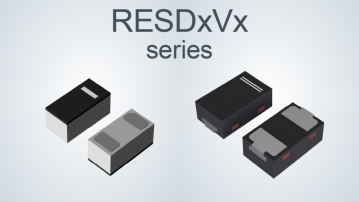
Semiconductor specialist ROHM has developed the 'RESDxVx series' of ESD (electrostatic discharge) protection diodes capable of responding to next-generation high-speed data communication environments exceeding 10Gbps, simultaneously enhancing both signal quality maintenance required in high-speed interfaces and IC protection performance.
2026.03.26by 배종인 기자
ST Launches 75V Drive IC Targeting 48V Industrial Motor Driving
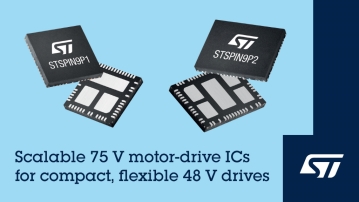
ST Microelectronics has unveiled the 'STSPIN9P' series of 75V motor drive ICs tailored for 48V-class industrial drive system design. The new product family is characterized by half-bridge and full-bridge configurations that enable design scalability according to motor type and output conditions. Power supply circuits, protection functions, and current sensing circuits are integrated on-chip to simplify system configuration, and the devices are designed to support applications up to 500W maximum. The company plans to provide reference designs and demo boards to support development and evaluation in industrial automation, robotics, pumps, fans, lighting, and textile machinery.
2026.03.26by 배종인 기자

Nordic supports security updates for the entire lifecycle of IoT devices at a single fixed cost
Nordic Semiconductor, a global leader in low-power wireless connectivity solutions, has unveiled a single fixed-cost licensing model that delivers FOTA (Firmware Over-the-Air) and device management capabilities throughout the device lifecycle via nRF Cloud, and introduced a new firmware update solution to prepare for the enforcement of the European Union's Cyber Resilience Act (CRA).
2026.03.26by 배종인 기자

Practical Training in Low-Noise, Low-Power Circuit Design All in One Place… Training Fee Support
The "2026 Advanced Engineer Practical Masterclass" to strengthen competencies in high-sensitivity analog circuit and sensor-based system design will be held on April 16 at the e4ds Conference Center in Gasan-dong, Seoul. This program will be conducted as an offline paid hands-on training session, not online, and is targeted at engineers seeking on-site intensive learning. Texas Instruments will provide educational support for this training, allowing participation at 150,000 won, a 100,000 won discount from the original price of 250,000 won.
2026.03.26by 배종인 기자











