



Freescale Kinetis 32-bit Microcontroller Sets New Record in Industry Benchmark Tests
 Published2011.06.16 16:19
Freescale Kinetis 32-bit Microcontroller Sets New Record in Industry Benchmark Tests
ARM® Cortex™-M4 Technology-based Device Achieves Best-Ever EEMBC CoreMark/MHz Results for Cortex-M Class Microcontroller
June 16, 2011, Seoul — A device belonging to Freescale Semiconductor [NYSE: FSL, www.freescale.co.kr ]’s Kinetis 32-bit MCU (microcontroller) family has demonstrated exceptional performance across the entire CPU frequency range in industry-standard benchmark tests. The Kinetis K60N512VMD100 MCU provided the first certified results for an ARM® Cortex™-M4 technology-based MCU, demonstrating superior core architecture performance in benchmarks using EEMBC® (Embedded Microprocessor Benchmark Consortium) CoreMark™.
This Kinetis MCU achieved a maximum test score of 2.119 CoreMarks/MHz when executing code in flash at the device's maximum frequency, which is the best result recorded to date in the ARM Cortex M class. Details of the certification results can be found at www.coremark.org .
The CoreMark benchmark, developed by EEMBC, utilizes commonly used embedded processing functions and is specifically designed to test the capabilities of processor cores. Running CoreMark produces a single numerical score, allowing users to quickly compare multiple processors. CoreMark can test a processor's pipeline structure, read/write operations, and integer and control operations.
"Freescale was the first company to bring ARM Cortex-M4 core-based products to market, and we have now set another important milestone," said Geoff Lees, Senior Vice President of Freescale's Industrial and Mixed Markets MCU business unit. "These benchmark results further definitively prove the capabilities of the Kinetis MCU family."
In June 2010, Freescale announced the Kinetis family of 90-nanometer (nm) 32-bit MCUs based on the ARM Cortex-M4 core, and is currently supplying six product families (K10, K20, K30, K40, K50, and K60) in sample quantities. This family includes a wide range of ultra-low-power MCUs with rich analog, human-to-machine interface, and safety and security features. Furthermore, Kinetis-linked systems are steadily expanding through comprehensive hardware and software support packages from Freescale and key ARM-linked system partners.
Achieve excellent results
The Kinetis platform architecture is designed to operate energy-efficiently, allowing users to maximize the amount of work performed per unit of energy consumed. Fast and reliable memory access is essential for efficient processing. The Kinetis FMC (Flash Memory Controller) manages the interface between the 32-bit bus master and multi-bank flash. Furthermore, the Kinetis product family incorporates numerous advanced architectural features to minimize exposed flash access time in the system. These architectural features are becoming an increasingly critical factor in system performance as operating frequencies increase.
Performance results by frequency
The figure below shows the efficiency of the Kinetis platform architecture, which maintains excellent performance across the entire frequency range.

One-stop shopping support
All five Kinetis product families come with a powerful software and toolset, such as Freescale’s fully featured, free MQX real-time operating system (including integrated Ethernet and USB stacks), and support for cost-effective graphic LCDs and encryption plugins. Additionally, Kinetis MCUs come with the Eclipse™-based CodeWarrior 10.1 IDE (Integrated Development Environment) featuring Processor Expert, providing a visual automation framework to shorten development times for complex embedded applications. Along with the Kinetis K40 and K60 family tower system MCU modules, Freescale continues to support rapid evaluation and prototyping through an ever-growing range of peripheral modules, including Wi-Fi, sensing, and precision analog. Kinetis MCUs are also supported by a wide range of ARM-linked systems, including IAR Systems®, Keil™, Green Hills® software, Segger, and CodeSourcery.

관련뉴스
Intel Unveils Next-Generation 'Core Ultra Series 3' and vPro Platform for Enterprise PCs
Intel has officially unveiled the "Intel Core Ultra Series 3" for next-generation enterprise PCs and the latest vPro platform, addressing a wide range of demands from enterprise notebooks to high-performance workstations.
2026.03.26by 배종인 기자
ROHM Launches ESD Protection Diode Compatible with High-Speed Interfaces of 10Gbps or Higher
반도체 전문 기업 로옴(ROHM)이 10Gbps를 넘어서는 차세대 고속 데이터 통신 환경에 대응할 수 있는 ESD(정전기 방전) 보호 다이오드 ‘RESDxVx 시리즈’를 개발하며, 고속 인터페이스에서 요구되는 신호 품질 유지와 IC 보호 성능을 동시에 끌어올렸다.
2026.03.26by 배종인 기자
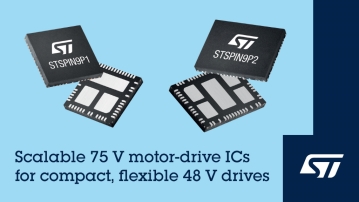
ST Launches 75V Drive IC Targeting 48V Industrial Motor Driving
ST Microelectronics has unveiled the 'STSPIN9P' series of 75V motor drive ICs tailored for 48V-class industrial drive system design. The new product family is characterized by half-bridge and full-bridge configurations that enable design scalability according to motor type and output conditions. Power supply circuits, protection functions, and current sensing circuits are integrated on-chip to simplify system configuration, and the devices are designed to support applications up to 500W maximum. The company plans to provide reference designs and demo boards to support development and evaluation in industrial automation, robotics, pumps, fans, lighting, and textile machinery.
2026.03.26by 배종인 기자

Nordic supports security updates for the entire lifecycle of IoT devices at a single fixed cost
Nordic Semiconductor, a global leader in low-power wireless connectivity solutions, has unveiled a single fixed-cost licensing model that delivers FOTA (Firmware Over-the-Air) and device management capabilities throughout the device lifecycle via nRF Cloud, and introduced a new firmware update solution to prepare for the enforcement of the European Union's Cyber Resilience Act (CRA).
2026.03.26by 배종인 기자

Practical Training in Low-Noise, Low-Power Circuit Design All in One Place… Training Fee Support
The "2026 Advanced Engineer Practical Masterclass" to strengthen competencies in high-sensitivity analog circuit and sensor-based system design will be held on April 16 at the e4ds Conference Center in Gasan-dong, Seoul. This program will be conducted as an offline paid hands-on training session, not online, and is targeted at engineers seeking on-site intensive learning. Texas Instruments will provide educational support for this training, allowing participation at 150,000 won, a 100,000 won discount from the original price of 250,000 won.
2026.03.26by 배종인 기자











