



Launch of Highest Accuracy Ultra-Compact Li+ Battery Gauge
 Published2011.10.12 12:18
Common occurrences in Coulomb counting battery gauges
Accuracy by eliminating sudden changes in SOC
Improving Model Gauge M3 Algorithm
October 12, 2011 -- Maxim Integrated Products has launched the MAX17047 battery gauge for 1-cell Li+ battery packs. The MAX17047 is the only Coulomb counting battery gauge in the industry that uses Maxim's new ModelGauge™ m3 algorithm and does not exhibit the sudden calibration seen in conventional Coulomb counter algorithms.
This ModelGauge m3 IC saves space and cost by using a smaller current sensing resistor and fewer external components compared to other Coulomb counters. This IC is ideal for portable 1-cell and multi-cell Li+ battery gauges in a variety of portable applications, including wireless handsets, smartphones, tablets, e-book readers, portable game players, digital cameras, financial terminals, portable navigation devices, and portable medical devices.
Challenge: Improve battery level accuracy while minimizing cost and space.
Conventional Li+ battery gauges are mounted inside the battery pack, requiring multiple individual components to support them. To estimate the remaining battery level, the battery gauge relies on Coulomb counters. These Coulomb counters suffer from the problem of small ADC offset errors accumulating indefinitely. Correcting this offset accumulation drift requires not only large and expensive sensing resistors but also the battery to be regularly fully charged, fully discharged, or put into standby mode.
Some recent design improvements implement battery gauge functions on the system side rather than inside the battery pack. This method reduces application costs but still requires a large sensing resistor, so it has almost no impact on board space.
Finally, currently available algorithms for correcting this drift produce an undesirable negative effect where the State of Charge (SOC) jumps abruptly. This phenomenon occurs because the algorithm measures the battery voltage in standby mode and then performs the correction based on the relationship between the battery's Open-Cell Voltage (OCV) and SOC.
modelGauge m3 Technology: Accurate and economical Li+ battery gauge
ModelGauge m3 technology overcomes the limitations of currently available battery gauge techniques. This technology combines the superior short-term accuracy and linearity of Coulomb counters with the excellent long-term stability of voltage-based battery gauges. ModelGauge m3 eliminates the offset accumulation error of Coulomb counters and provides superior short-term accuracy compared to battery gauges that rely solely on voltage. Because this algorithm continuously corrects in small increments over time, the sudden corrections commonly seen in Coulomb counter algorithms do not occur.
The ModelGauge m3 algorithm reduces sensitivity to current measurement ADC offset errors, so the MAX17047 can use a smaller current sensing resistor without degrading the accuracy of battery SOC prediction.
The MAX17047 automatically compensates for aging, temperature, and discharge rate. It also provides accurate remaining time and SOC % under a wide range of operating conditions. This device uses 75% less power than competitors, adjusts to battery changes over time and usage, and provides alerts for abnormal battery conditions. The device reports battery life or current status in two ways: capacity reduction and cycle recorder.
This IC provides precise measurements for current, voltage, and temperature. The temperature of the battery pack is measured using an external thermistor supported by ratio metering measurements of the auxiliary input. If temperature information is available through other methods, the system microcontroller writes the corresponding temperature directly to the IC. This method eliminates resistors and capacitors, as well as the thermistors associated with the external thermistor network.
The MAX17047 is shipped after undergoing a calibration process at the factory. This eliminates calibration on the final unit's production line, thereby reducing production complexity and costs.
Finally, the ModelGauge m3 IC can be mounted on the system side instead of the battery pack, allowing system manufacturers to control all costs and minimize the complexity of supply chain constraints. This ultimately leads to a significant reduction in battery pack costs.
Various advantages for portable, battery-powered devices
The MAX17047 helps maximize usage and standby time by using the industry's lowest current consumption (25μA, typical), which is 75% less than competing products. In addition to the small current sensing resistor, this 1-cell battery gauge requires only one other resistor and three capacitors, thus utilizing very little PCB space.
Since the measurement and power inputs of the MAX17047 are connected directly to the battery pack, a separate regulator is not required. This IC can also be used in multi-cell serial configurations and battery pack applications by using an external buffer such as the MAX9910.
Various monitoring and alarm functions ensure reliable operation of the end device. Various programmable alarm indicators provide the system microcontroller with alarms regarding critical battery voltage, SOC, and temperature conditions. For example, when using low battery conditions, it enables appropriate power management measures to be taken when the battery is nearly discharged.
This feature further extends battery life by eliminating the need to poll the battery gauge for battery status, thereby keeping the microcontroller in sleep mode for longer. The IC notifies the system if abnormal battery temperatures occur, helping to maintain system safety and long lifespan. Finally, the MAX17047 notifies the system when the battery is inserted or removed, enabling smooth management of the power-up/down sequence.
The MAX17047 ModelGauge m3 battery gauge is available in a lead-free, 10-pin, 3mm x 3mm TDFN package and communicates with system microprocessors via an industry-standard 2-wire interface. Further information can be found at http://www.maxim-ic.com/ModelGauge .

관련뉴스

.jpg)
20% extension of battery life for ultra-low power wireless applications
2011.08.08by 명세환 기자
.jpg)

Intel Unveils Next-Generation 'Core Ultra Series 3' and vPro Platform for Enterprise PCs
인텔이 차세대 기업용 PC를 위한 ‘인텔 코어 Ultra 시리즈 3’와 최신 vPro 플랫폼을 공식 발표하며, 기업용 노트북부터 고성능 워크스테이션까지 폭넓은 수요 충족에 나섰다.
2026.03.26by 배종인 기자
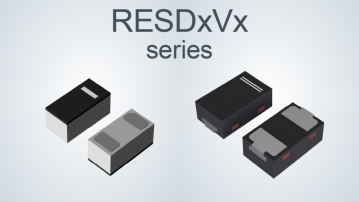
ROHM Launches ESD Protection Diode Compatible with High-Speed Interfaces of 10Gbps or Higher
반도체 전문 기업 로옴(ROHM)이 10Gbps를 넘어서는 차세대 고속 데이터 통신 환경에 대응할 수 있는 ESD(정전기 방전) 보호 다이오드 ‘RESDxVx 시리즈’를 개발하며, 고속 인터페이스에서 요구되는 신호 품질 유지와 IC 보호 성능을 동시에 끌어올렸다.
2026.03.26by 배종인 기자











