



Intel Offers Advanced Foundry Based on Intel 3
 Published2024.06.21 11:41
Introduction of EUV Lithography, Hybrid Bonding Options
Intel offers a cutting-edge FinFET process node series through Intel 3 technology, providing 10% higher density and a generation-advanced performance than the Intel 4 node.
Intel announced on the 21st at its annual VLSI Symposium that it is regaining process leadership by providing state-of-the-art foundry nodes with Intel 3 technology.
The Intel 3 process node provides up to 18% better performance across all processor cores at the same power, a set of flexible metal interconnect options, and up to 10% higher density compared to the previous generation Intel 4 node.
This was achieved through meticulous optimization of every aspect of the process, from transistors to metal stacks. This improvement in integration density was made possible by a new high-density standard cell library developed by Intel.
In 2021, Intel set a goal of achieving five nodes over four years (5N4Y) as part of a bold milestone to regain process technology leadership.
Intel introduced EUV lithography, a complex technology that affects various aspects of the process, from the front to the back vias and metal interconnects of transistors, to the 4th node.
The Intel 4 Node, used in the Intel Core Ultra processor family with over 9 million units shipped, ushered in the era of AI PCs.
As planned, Intel's 3rd node reached the manufacturing readiness stage at the end of last year. This proves that Intel's process technology has returned to normal.
In addition, this node has reached mass production at the research and development (R&D) site in Oregon, and is currently mass-producing chips for foundry customers, including Intel Xeon 6 server processors, at the Leixlip fab in Ireland.
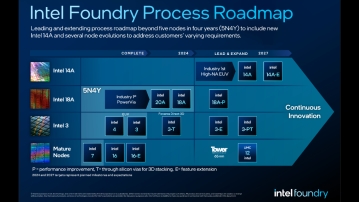
Intel's 3 process node is designed to reduce risk and enable consistent execution, and includes four progressively co-developed variants.
First, the Intel 3-T process node is based on the base process and includes Through Silicon Via (TSV) for 3D stacking applications that need to integrate multiple computing and memory components, such as image processing, high-performance computing, and AI, into a single package.
The Intel 3-E node has expanded its scope of application by adding a wide set of I/O for external interfaces, analog, and mixed-signal functions.
The Intel 3-PT node combines all these technical improvements into a single process, providing designers with higher performance enhancements and ease of use, and enables higher density 3D stacking by offering ultra-fine 9um TSVs and hybrid bonding options.
Intel 3-PT nodes are expected to provide a unique combination of performance, flexibility, and cost factors for a variety of applications. As a state-of-the-art FinFET-based process node, it is set to be utilized for both internal and external foundry customers along with new technologies over the next few years.
In addition, Intel 3 Node is Intel Foundry's first state-of-the-art process node designed as a sustainable node for foundry customers, and will continuously provide technology and performance improvements for various design and product applications.
Intel's 3 node reached manufacturing readiness in the fourth quarter of 2023 and is currently in mass production for the Intel Xeon 6 processor family.
Intel is consistently fulfilling its commitment to the 5N4Y plan and is laying the groundwork for the transition to the RibbonFET and Angstrom eras with the Intel 20A and Intel 18A process nodes.
Details regarding Intel's 3 process node can be found in the VLSI paper presentation video on the blog.
For details, please refer to the blog video or check the Intel team's paper, 'Intel 3 Advanced FinFET Platform Technology for High-Performance Computing and SoC (System-on-Chip) Product Applications,' at https://www.vlsisymposium.org/.

Comments
Related news
Intel: “The Next Step After Moore’s Law Is Multi-Chiplet Packaging”
Intel held its third annual Intel Innovation developer event in San Jose, California, and unveiled a variety of technologies designed to enhance accessibility and usability of artificial intelligence across all workloads spanning clients, edge, network, and cloud.
2023.09.20by 배종인 기자
Intel Starts Mass Production of EUV-Based Products at New Fab in Ireland
Intel's Fab 34 in Ireland, which received a 17 billion euro investment, has reportedly begun mass production of products based on EUV technology.
2023.10.04by 명세환 기자
Intel Launches World's Fastest 6GHz 14th Generation CPU
Intel has launched the Intel Core 14th generation desktop processor family, led by the Intel® Core™ i9-14900K, delivering maximum desktop performance and exceptional overclocking experience through the world's fastest desktop clock speeds.
2023.10.17by 배종인 기자
Intel Opens Semiconductor Manufacturing Facility 'Fab 9' in New Mexico, USA
Intel opened its state-of-the-art semiconductor manufacturing facility "Fab 9," which enables mass production of cutting-edge 3D packaging technology.
2024.01.25by 배종인 기자
Intel Launches Systems Foundry...1nm Shipments in 2025
The advanced semiconductor foundry market is prepared to expand from a two-way competition into a three-way battle. Intel has launched a full-fledged systems foundry business, revealing ambitions to establish ecosystem leadership by leveraging advanced process nodes and cutting-edge packaging technologies.
2024.02.22by 권신혁 기자











