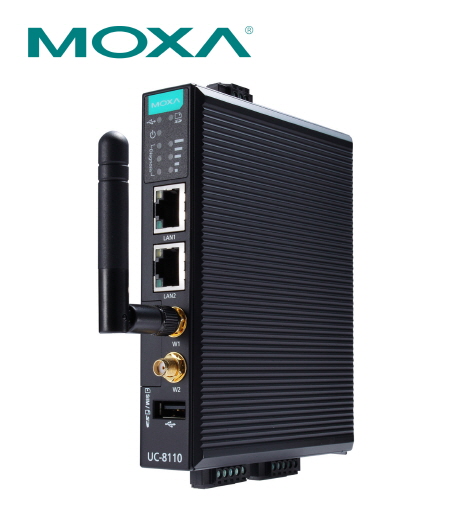
As spatial constraints are always a critical challenge for distributed IA (Industrial Automation) systems, compact computing solutions are required to meet application demands for high computing performance, high storage capacity, and flexible wireless connectivity. To meet these demands, MOXA announced the release of the UC-8100 wireless Linux computer, a miniaturized form factor designed for use in large-scale big data WAN computing solutions. Based on the ARMv7 Cortex-A8 processor, the UC-8100 provides up to two RS-422/485 serial ports and dual 10/100Mbps Ethernet LAN ports. Additionally, these computers feature Mini PCIe sockets to support cellular interfaces and other modules. By offering these general-purpose communication capabilities, users can efficiently utilize the UC-8100 for various types of complex communication and processing solutions. The UC-8100 can be used as a communication platform for large-scale distributed applications or as a secure and reliable gateway for data collection and real-world processing.
Miniaturized size and scalability enable adaptation to future changes
Charles Chen, Head of Embedded Business Development at MOXA Americas, stated, “As technology becomes increasingly diverse and advances at an ever-faster pace, manufacturers are striving to find common communication interfaces. Just ten years ago, we were still using ISDN or POTS, and we hadn't even heard of UMTS or ADSL. 3G hadn't even been born yet. But now we are preparing to welcome 4G, and we are considering the capabilities for 5G and even further, 6G.” “Designed with scalability and flexibility in mind, the UC-8100 Linux computer provides Wi-Fi and Mini PCIe sockets to support cellular modems and enables “3-in-1” communication as a programmable Linux RISC computer, which can reduce implementation and maintenance costs,” he said.
It features a space-saving compact form factor and is easy to install thanks to the inclusion of a DIN rail.
It provides sufficient free space to expand memory using an SD or mini SD card.
It provides a Mini PCIe socket, making cellular and modular upgrades easy.
By utilizing various types of pin-to-pin compatible RISC CPUs, platform performance can be expanded and development costs can be reduced.
Easy maintenance of large-scale distributed computing applications
Management and maintenance are critical challenges for distributed processing applications. By combining a high-performance RISC architecture with ample storage capacity, the UC-8100 computer enables high flexibility for users when developing new automation systems. Programmable LEDs allow integrators or end users to define unique event signaling, making it convenient to design troubleshooting tools for the system.
You can utilize the rich and diverse types of free software solutions provided by the Debian ARM 7 system.
Since it is a programmable LED, debugging and troubleshooting in the field are much easier.
Since it supports Modbus, sensor installation is easy.
Protecting critical data on both hardware and software sides with outstanding security
The UC-8100 computer also provides exceptional protection against network attacks. MOXA has further enhanced the powerful Trusted Platform Module (TPM) and, by adopting its proprietary Secure Boot algorithm, offers superior protection against any form of kernel compromise. This blocks the only possible attack path for an attacker (excluding physical key theft). By protecting the kernel, the computer can be operated safely with the assurance that all communications conducted through the TPM remain confidential and are safe from potential exposure to the underlying system.
TPM Integration and Highly Robust Commercial Firewall Protection: EAL4+ Certified Security
Proprietary secure boot technology uses a dynamic encryptor to securely protect the Linux kernel.
It ensures OS integrity through SD write protection and TPM integration.



 Published2014.10.10 18:57