



Microchip Launches Microcontroller Family Providing Core-Independent Peripherals, Closed-Loop Digital Control, and Safety Monitoring Capabilities
 Published2014.11.28 14:44
- Provides enhanced integrated peripheral features such as hardware PID, phase angle measurement, and 100mA current driving.
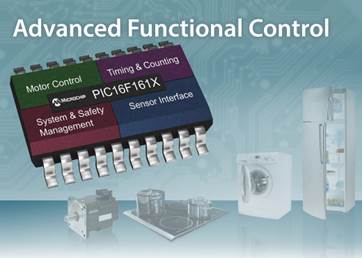
Seoul, November 20, 2014 – Microchip Technology (Korea Representative: Byung-Don Han), a global leader in microcontrollers, analog semiconductors, and flash-IP solutions, announced at the “Electronica” exhibition in Germany that it has expanded its 8-bit PIC® microcontroller (MCU) portfolio with the launch of the low-pin-count PIC16(L)F161X family, which integrates multiple peripheral functions.
The new MCU family expands the selection of microcontrollers integrating Microchip's Core Independent Peripherals (CIPs) in various combinations. These products are designed to reduce interrupt latency, lower power consumption, improve system efficiency and safety, and shorten design time and workload. Since these peripherals do not require additional code or external components, they can reduce system complexity. Hardware-based peripherals reduce CPU critical time or core-intensive functions, thereby lightening the CPU load and allowing the CPU to focus on other important tasks within the system.
The PIC16(L)F161X PIC MCU includes a Proportional Integral Derivative (PID) function and a Math Accelerator (Math ACC), enabling 16-bit math and PID operations with fully core-independent computation. This product family also includes an Angle Timer (AngTmr). The Angle Timer is a hardware module that calculates rotation angles in motor control, TRIAC control, Capacitive Discharge Ignition (CDI) systems, and the like. Angle timers enable repetitive interrupts at specific rotation or sine angles regardless of speed, and do not require core intervention during calculations. Since Core-Independent Peripherals (CIPs) can be configured to perform specific functions, execution speed can be increased and software requirements reduced. By relieving the burden of processing these functions on the CPU, the CPU can be directed to handle other critical tasks, reduce program memory utilization, and decrease the MCU's overall power consumption.
In addition to mathematical operation accelerators and angle timers, the PIC16(L)F161X includes numerous peripherals to conveniently implement various functions and add flexibility. The 24-bit Signal Measurement Timer (SMT) enables high-resolution hardware measurement of digital signals, allowing for more precise and accurate measurements. This feature is suitable for use in speed control, distance detection, and RPM displays. Furthermore, this product family includes a Zero Cross Detect (ZCD) module to monitor AC line voltage and detect zero-crossing operations. Simplifying TRIAC control applications can reduce CPU requirements and BOM costs. In addition, it integrates a new high-current I/O (100mA), a verified CLC (Configurable Logic Cell), and I2C, SPI, and EUSART for communication, shortening design work, facilitating implementation, and providing additional flexibility.
Furthermore, by combining the Windowed Watchdog Timer (WWDT), which enhances reliability by monitoring whether software operations are performed properly within specified limits, and the Cyclic Redundancy Check with Memory Scan (CRC/SCAN) function, which checks and scans for corrupted data in memory, it supports safety standards such as Class B and UL 1998 as well as fail-safe operation. By including the Hardware Limit Timer (HLT), which can detect hardware fault conditions (stall, stop, etc.), engineers can conveniently implement safety and monitoring functions in their applications with minimal or no CPU intervention. In addition, these products utilize low-power XLP technology and are available in small form factor packages of 8-pin, 14-pin, and 20-pin.
Steve Drehobl, Vice President of Microchip's MCU8 business unit, said, "With the launch of the PIC16F161X family, we are now able to provide products that integrate a wider variety of Core Independent Peripherals (CIPs), including motor control and safety monitoring." “These products integrate multiple peripheral functions, allowing for the convenient application of features such as closed-loop control with little to no core intervention,” he said. “This enables developers to conveniently develop customized functions that meet their specific applications while minimizing code development.”
Development support
The PIC16(L)F161X family is supported by world-class tool suites, including Microchip’s PICkit™ 3 (product number PG164130) and MPLAB® ICD 3 (product number DV164035). MPLAB® Code Configurator, a plugin for Microchip’s free MPLAB® X IDE, provides a graphical environment to configure 8-bit systems and peripheral functions, automatically generates C code for use in your applications, allows for convenient modification, and enables prototype creation in minutes.
supply
The PIC12(L)F1612 MCU is currently available in samples and mass production in 8-pin PDIP, SOIC, 3mm x 3mm DFN, and UDFN packages. The PIC16(L)F1613 MCU is also currently available in 14-pin PDIP, SOIC, TSSOP, 4mm x 4mm UQFN, and QFN packages. The PIC16(L)F1614 and PIC16(L)F1615 are currently available in 14-pin PDIP, SOIC, TSSOP, 4mm x 4mm UQFN, and QFN packages, and mass production is scheduled to begin next January. The PIC16(L)F1618 and PIC16(L)F1619 MCUs are currently being supplied as samples in 20-pin PDIP, SOIC, TSSOP, 4mm x 4mm UQFN, and QFN packages, and mass production is scheduled to begin next January. These products will be supplied in quantities of 10,000 units.
For more detailed information, please contact a Microchip sales representative or an authorized distributor worldwide, or visit the Microchip website ( http://www.microchip.com/PIC16_LF161X-Family-Product-Page-111114a ). You can also purchase by visiting Microchip Direct or by contacting an authorized Microchip distributor partner.

관련뉴스

Intel Unveils Next-Generation 'Core Ultra Series 3' and vPro Platform for Enterprise PCs
Intel has officially unveiled the "Intel Core Ultra Series 3" for next-generation enterprise PCs and the latest vPro platform, addressing a wide range of demands from enterprise notebooks to high-performance workstations.
2026.03.26by 배종인 기자

ROHM Launches ESD Protection Diode Compatible with High-Speed Interfaces of 10Gbps or Higher
반도체 전문 기업 로옴(ROHM)이 10Gbps를 넘어서는 차세대 고속 데이터 통신 환경에 대응할 수 있는 ESD(정전기 방전) 보호 다이오드 ‘RESDxVx 시리즈’를 개발하며, 고속 인터페이스에서 요구되는 신호 품질 유지와 IC 보호 성능을 동시에 끌어올렸다.
2026.03.26by 배종인 기자
ST Launches 75V Drive IC Targeting 48V Industrial Motor Driving
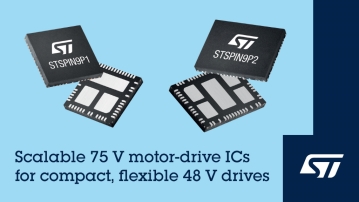
ST Microelectronics has unveiled the 'STSPIN9P' series of 75V motor drive ICs tailored for 48V-class industrial drive system design. The new product family is characterized by half-bridge and full-bridge configurations that enable design scalability according to motor type and output conditions. Power supply circuits, protection functions, and current sensing circuits are integrated on-chip to simplify system configuration, and the devices are designed to support applications up to 500W maximum. The company plans to provide reference designs and demo boards to support development and evaluation in industrial automation, robotics, pumps, fans, lighting, and textile machinery.
2026.03.26by 배종인 기자

Nordic supports security updates for the entire lifecycle of IoT devices at a single fixed cost
Nordic Semiconductor, a global leader in low-power wireless connectivity solutions, has unveiled a single fixed-cost licensing model that delivers FOTA (Firmware Over-the-Air) and device management capabilities throughout the device lifecycle via nRF Cloud, and introduced a new firmware update solution to prepare for the enforcement of the European Union's Cyber Resilience Act (CRA).
2026.03.26by 배종인 기자

Practical Training in Low-Noise, Low-Power Circuit Design All in One Place… Training Fee Support
The "2026 Advanced Engineer Practical Masterclass" to strengthen competencies in high-sensitivity analog circuit and sensor-based system design will be held on April 16 at the e4ds Conference Center in Gasan-dong, Seoul. This program will be conducted as an offline paid hands-on training session, not online, and is targeted at engineers seeking on-site intensive learning. Texas Instruments will provide educational support for this training, allowing participation at 150,000 won, a 100,000 won discount from the original price of 250,000 won.
2026.03.26by 배종인 기자











