



TI Introduces 7GHz ADC Driver Enables DC-Coupled Applications with Superior AC Performance
 Published2014.11.28 14:47
Fully differential amplifier products improve the performance of radar, test and measurement equipment, and wireless base stations.
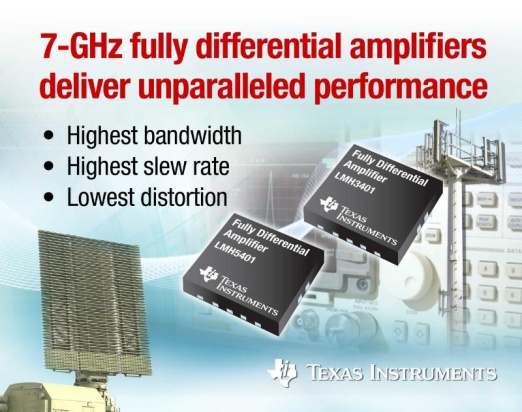
DALLAS, Nov. 20, 2014 – Texas Instruments (TI) ( NASDAQ: TXN) today introduced two new fully differential amplifier (FDA) devices that enhance system functionality and performance in DC-coupled applications with best-in-class AC performance. The LMH3401 and LMH5401 FDAs deliver higher bandwidth, slew rate and lower distortion than traditional ADC drivers, enabling the design of more reliable radar systems. They also enable the design of wireless base stations with fewer dropped calls and faster upload speeds. (For more information about the LMH3401 and LMH5401, visit www.ti.com/lmh3401-pr-kr .)
The LMH3401 not only provides higher performance than similar FDAs with 16 dB of gain, but also saves 30% in size and power consumption. It also boasts -3 dB bandwidth of 7 GHz with 16 dB of gain, high slew rate of 18,000 V/ms, and low harmonic distortion of -77 dBc at 500 MHz.
The LMH5401 can be designed with 6 dB or more gain and provides a -3 dB bandwidth of 6.2 GHz with 12 dB gain. Additionally, it offers industry-leading performance specifications with a slew rate of 17,500 V/ms, harmonic distortion of -90 dBc at 200 MHz, and IMD3 characteristics of -90 dBc at 200 MHz.
Key Features of LMH3401 and LMH5401
· Best-in-class bandwidth and slew rate at low power: Enables system designers to track fast edges in pulse-based systems such as radar and amplify high frequencies in continuous RF waveform environments such as wireless base stations, all while maintaining low power consumption.
· High signal quality: The system can receive small signals even in the presence of large blocker signals.
· No Baluns Required: The signal can be converted from single-ended to differential, eliminating the need for baluns. This reduces the overall BOM (Bill of Materials), enables wider bandwidth, and allows for smaller system footprints and simpler designs. The advantages of the LMH3401 and LMH5401 over baluns are detailed in the blog.
Maximize system performance with complementary devices
The LMH3401 and LMH5401 minimize data converter distortion when converting pure DC to over 1 GHz in transmit/receive applications. Therefore, by utilizing these products, system developers can optimize the performance of TI's high-speed data converters, including the 12-bit 4GSPS ADC12J4000, 16-bit 370MSPS ADC16DX370, and 16-bit 2.5GSPS DAC38J84.
Additionally, TI's low-dropout regulators (LDOs) maximize the performance of the LMH3401 and LMH5401 by providing noiseless positive and negative supply rails. The LP5907 enables the LMH3401 to meet today's RF and analog circuit requirements by providing low noise, high power supply rejection ratio (PSRR), low quiescent current, and high-speed line and load transient response. The TPS7A3001 LDO generates a clean negative power rail required for dual power supplies by attenuating upstream ripple.
Tools and support for rapid design
Evaluation modules for the LMH3401 and LMH5401 are available for $149, and TINA-TI SPICE models and reference designs enable rapid simulation of system performance.
For support for engineers, visit the High Speed Amplifiers forum in the TI E2E™ Community to search for troubleshooting tips, ask questions, get help and solve problems with fellow engineers and TI experts.
Packages, Supply and Prices
The LMH3401 and LMH5401 are available in a 14-pin 2.5 mm x 2.5 mm QFN package, with suggested retail pricing of $8.95 and $7.95, respectively, in 1,000-unit quantities.
Learn more about TI's high-speed amplifier portfolio:
· LMH3401 and LMH5401 data sheets
· Article on how to reduce the effects of common-mode noise on differential signal paths
· Article on how to reduce high-speed power supply problems using LDOs
· Tips on how to deal with filter loss in communication systems

관련뉴스

Intel Unveils Next-Generation 'Core Ultra Series 3' and vPro Platform for Enterprise PCs
Intel has officially unveiled the "Intel Core Ultra Series 3" for next-generation enterprise PCs and the latest vPro platform, addressing a wide range of demands from enterprise notebooks to high-performance workstations.
2026.03.26by 배종인 기자
ROHM Launches ESD Protection Diode Compatible with High-Speed Interfaces of 10Gbps or Higher
반도체 전문 기업 로옴(ROHM)이 10Gbps를 넘어서는 차세대 고속 데이터 통신 환경에 대응할 수 있는 ESD(정전기 방전) 보호 다이오드 ‘RESDxVx 시리즈’를 개발하며, 고속 인터페이스에서 요구되는 신호 품질 유지와 IC 보호 성능을 동시에 끌어올렸다.
2026.03.26by 배종인 기자
ST Launches 75V Drive IC Targeting 48V Industrial Motor Driving
ST마이크로일렉트로닉스가 48V급 산업용 구동 시스템 설계에 맞춘 75V 모터 드라이브 IC ‘STSPIN9P’ 시리즈를 공개했다. 새 제품군은 하프 브리지와 풀 브리지 구조로 구성돼 모터 종류와 출력 조건에 따라 설계를 확장할 수 있도록 한 것이 특징이다. 전원 회로와 보호 기능, 전류 감지 회로를 칩에 통합해 시스템 구성을 단순화했으며, 최대 500W급 애플리케이션까지 대응하도록 설계됐다. 회사는 레퍼런스 디자인과 데모 보드도 함께 제공해 산업 자동화, 로보틱스, 펌프, 팬, 조명, 섬유 기계 등에서 개발과 평가를 지원할 계획이다.
2026.03.26by 배종인 기자

Nordic supports security updates for the entire lifecycle of IoT devices at a single fixed cost
Nordic Semiconductor, a global leader in low-power wireless connectivity solutions, has unveiled a single fixed-cost licensing model that delivers FOTA (Firmware Over-the-Air) and device management capabilities throughout the device lifecycle via nRF Cloud, and introduced a new firmware update solution to prepare for the enforcement of the European Union's Cyber Resilience Act (CRA).
2026.03.26by 배종인 기자

Practical Training in Low-Noise, Low-Power Circuit Design All in One Place… Training Fee Support
고감도 아날로그 회로와 센서 기반 시스템 설계 역량을 강화할 수 있는 ‘2026 고급 엔지니어 실무 마스터 클래스’가 오는 4월16일 서울 가산동 e4ds 컨퍼런스 센터에서 열린다. 이번 과정은 온라인이 아닌 오프라인 유료 실습 교육으로 진행되며, 현장 중심의 심화 학습을 원하는 엔지니어를 대상으로 한다. 이번 교육은 텍사스 인스트루먼트(Texas Instruments)가 교육비를 지원해 정가 25만원에서 10만원 할인 된 15만원에 참가할 수 있다.
2026.03.26by 배종인 기자











