


Functionality Optimization of the JESD204B Serial Interface in Analog Devices Jerseyter 1.25GSPS Clock, GSPS Data Converter Applications
 Published2014.12.08 18:19
– Implementation of the unique functionality of the JESD204B SERDES high-speed interface with a new clock IC
December 3, 2014 – Analog Devices ( www.analog.com , NASDAQ: ADI), a global leader in high-performance semiconductors for signal processing applications, has released the AD9528 JESD204B clock and SYSREF generator, suitable for supporting the clock requirements needed for LTE and multi-frequency GSM base station designs, defense electronics systems, RF test instrumentation, and other emerging broadband RF GSPS data acquisition signal chains. As data rates increase to the range of several Gb per second and multi-channel synchronization and data latency management become essential components of systems, the JESD204B standard is increasingly being used for high-speed interfaces from converters to digital processors across various modern applications. The JESD204B interface was specifically developed to address the growing need for high-data-rate system designs, and the AD9528 clock device includes features to support and enhance the inherent performance of such interface standards.
The AD9528 supports clock distribution with low power, multiple outputs, and low-frequency performance, as well as on-chip, 2-stage PLL and VCO. The on-chip VCO adjusts the frequency between 3.6 GHz and 4.0 GHz through an input receiver and oscillator that provide both single-ended and differential operations.
The AD9528 provides JESD204B compliant subclass 1 SYSREF and deterministic latency clocking signals and offers various options for generating SYSREF signals. The most basic function is a simple buffering feature where the user-provided SYSREF signal is spread to the SYSREF output pin. If an external SYSREF source is provided, the AD9528 can also synchronize the SYSREF output with the internally generated clock output, which is essential to achieve precise deterministic delay. The AD9528 can also generate the SYSREF source internally. The AD9528 supports both continuous-signal SYSREF generation and n-shot pulse generation. N-shot generation is mandatory for systems where a continuous signal may cause unwanted spurts in the output spectrum of the clock-provided data converter.
When connected to a recovered system reference clock and VCXO, the AD9528 generates 12 low-noise outputs ranging from 1 MHz to 400 MHz and 2 high-speed outputs at speeds up to 1.25 GHz. To vary the frequency and phase of a single clock output relative to other clock outputs, a divider phase-select function can be used, providing jitter-free coarse timing adjustment as the period of the signal from the VCO output increases by half. Each SYSREF signal provides additional phase offset performance, making it easier to adjust for the optimal arrival time at each target device.
The design of the AD9528 can be implemented using ADI's AD9680 dual-channel, 14-bit, 1.0 GSPS JESD204B A/D converter within a broadband RF data acquisition application.
Price and Mass Production Supply Status
product | Sample Supply Status | Mass production supply status | Unit price ( Per 1000 ) | 17, 217, 217); padding: 3.75pt; border: 1pt solid black; width: 20.14%;">
AD9528BCPZ | Supplying | m; border-style: none solid solid none; border-color: currentColor black black currentColor; padding: 3.75pt; width: 19.42%; height: 48.6pt;"> $8.25 | 72- Lead LFCSP |
Supplying | r" class="MsoNormal" style="text-align: center;"> Supplying | $190 | N/A |
More detailed information can be found via the link below .
.5pt;">
- Download AD9528 Datasheet , Order Samples and Evaluation Boards : http://www.analog.com/AD9528
- ADI 's Online Technical Support Community, Engineer ZoneExchange information with engineers and ADI product experts at EngineerZone ™
- wireless
and communicationView details of application and technical manuscripts regarding the solution
- ADI 's broadband RF signal
processing-US"> Check webpage details
- ADI 's JESD204B interface design
EN-US"> Resources Check page details

관련뉴스

Intel Unveils Next-Generation 'Core Ultra Series 3' and vPro Platform for Enterprise PCs
Intel has officially unveiled the "Intel Core Ultra Series 3" for next-generation enterprise PCs and the latest vPro platform, addressing a wide range of demands from enterprise notebooks to high-performance workstations.
2026.03.26by 배종인 기자

ROHM Launches ESD Protection Diode Compatible with High-Speed Interfaces of 10Gbps or Higher
반도체 전문 기업 로옴(ROHM)이 10Gbps를 넘어서는 차세대 고속 데이터 통신 환경에 대응할 수 있는 ESD(정전기 방전) 보호 다이오드 ‘RESDxVx 시리즈’를 개발하며, 고속 인터페이스에서 요구되는 신호 품질 유지와 IC 보호 성능을 동시에 끌어올렸다.
2026.03.26by 배종인 기자
ST Launches 75V Drive IC Targeting 48V Industrial Motor Driving
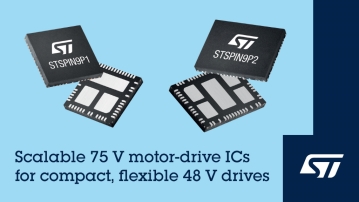
ST마이크로일렉트로닉스가 48V급 산업용 구동 시스템 설계에 맞춘 75V 모터 드라이브 IC ‘STSPIN9P’ 시리즈를 공개했다. 새 제품군은 하프 브리지와 풀 브리지 구조로 구성돼 모터 종류와 출력 조건에 따라 설계를 확장할 수 있도록 한 것이 특징이다. 전원 회로와 보호 기능, 전류 감지 회로를 칩에 통합해 시스템 구성을 단순화했으며, 최대 500W급 애플리케이션까지 대응하도록 설계됐다. 회사는 레퍼런스 디자인과 데모 보드도 함께 제공해 산업 자동화, 로보틱스, 펌프, 팬, 조명, 섬유 기계 등에서 개발과 평가를 지원할 계획이다.
2026.03.26by 배종인 기자

Nordic supports security updates for the entire lifecycle of IoT devices at a single fixed cost
Nordic Semiconductor, a global leader in low-power wireless connectivity solutions, has unveiled a single fixed-cost licensing model that delivers FOTA (Firmware Over-the-Air) and device management capabilities throughout the device lifecycle via nRF Cloud, and introduced a new firmware update solution to prepare for the enforcement of the European Union's Cyber Resilience Act (CRA).
2026.03.26by 배종인 기자

Practical Training in Low-Noise, Low-Power Circuit Design All in One Place… Training Fee Support
고감도 아날로그 회로와 센서 기반 시스템 설계 역량을 강화할 수 있는 ‘2026 고급 엔지니어 실무 마스터 클래스’가 오는 4월16일 서울 가산동 e4ds 컨퍼런스 센터에서 열린다. 이번 과정은 온라인이 아닌 오프라인 유료 실습 교육으로 진행되며, 현장 중심의 심화 학습을 원하는 엔지니어를 대상으로 한다. 이번 교육은 텍사스 인스트루먼트(Texas Instruments)가 교육비를 지원해 정가 25만원에서 10만원 할인 된 15만원에 참가할 수 있다.
2026.03.26by 배종인 기자











