



"The true performance of WBG semiconductors depends on the gate driver." - NovoSense's driver strategy for the GaN and SiC era.
 Published2025.07.28 08:19
 Wide bandgap (WBG) semiconductors, such as silicon carbide (SiC) and gallium nitride (GaN), are emerging as mainstream in the power electronics field. Capable of high voltage and high-speed switching, these devices are rapidly expanding into applications such as electric vehicles (EVs), renewable energy inverters, and high-performance server power supplies. However, operating these high-performance devices safely and efficiently requires precise control that differs from traditional methods. This is where the importance of "gate drivers" is highlighted.
WBG semiconductors can withstand high voltages and have fast switching speeds, maximizing system efficiency. However, they are also sensitive to noise and require precise operating conditions. "The low-voltage and low-current signals from the controller alone cannot accurately turn high-voltage devices like GaN or SiC on and off," explained Geun-dong Noh, Director at Novosense. "The gate driver is a key analog circuit that amplifies and converts this signal into voltage and current appropriate for the power device."
The core roles of a gate driver can be summarized into three main points. First, it shifts the voltage of low-voltage PWM signals output from digital controllers such as MCUs and DSPs to match the threshold voltage of the device. Second, it provides a driving function that provides sufficient current during switching, enabling the device to turn on and off quickly. Third, it incorporates various protection functions to ensure system reliability.
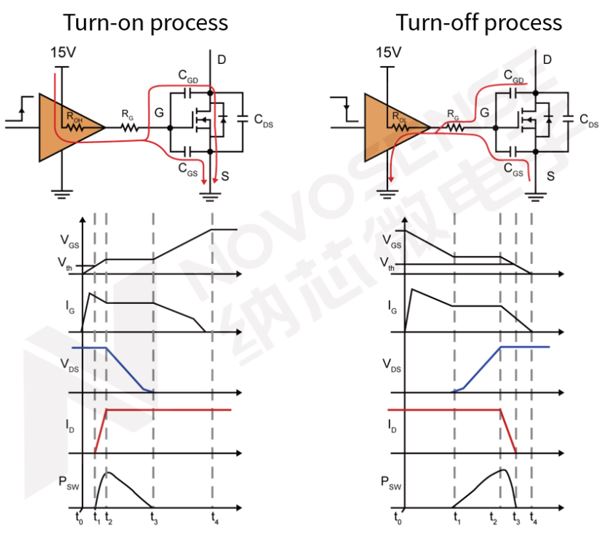
Director Noh said, “Recently, ‘smart gate drivers’ with various protection functions such as isolation, undervoltage lockout (UVLO), short-circuit protection, and mirror clamping are in the spotlight,” and emphasized, “The selection is very important because the specifications of the driver vary depending on the stress hold voltage or on/off speed of the power element.” He added, “For SiC devices, the gate voltage is 0V to 15V as standard, but in some cases, a negative voltage of -5V must be applied to account for noise sensitivity, which increases the design difficulty,” as an example of a real-world system design.
In particular, GaN devices offer faster switching characteristics and higher frequency response than SiC, but they are also susceptible to noise and require more stringent circuit stability. Consequently, the distance between the driver and the device, the wiring structure, and even operating parameters must be carefully designed. Director Noh explained, "Recently, products that integrate GaN devices and drivers into a single chip are also emerging. These integrated products can reduce design complexity, clarify responsibilities between vendors, and even reduce EMI."
The adoption of a gate driver depends on the system's power capacity and protection requirements. In small systems, a simple driving circuit can be constructed using discrete transistors, resistors, and diodes. However, for systems exceeding several hundred watts or requiring protection features, the use of specialized gate driver ICs is virtually mandatory.
NovoSense will present its diverse range of gate drivers, including half-bridge, single-channel, isolated, and built-in protection, during a technical webinar. In particular, he said, “We plan to focus on explaining technical points that should be taken into consideration when applying the device in practice, such as driver selection in a half-bridge structure that requires high-side and low-side switching, setting sink/source current specifications, and package considerations.”
Finally, Director Noh emphasized, “Gate drivers are not simply switch control circuits, but rather a technology that determines the reliability and efficiency of the entire power system,” and “With increasing power density and increasing protection design requirements, driver selection is not simply an option, but an essential design element.”
This webinar is expected to provide practical design insights to practitioners at a time when the transition from silicon-based power devices to high-speed, high-efficiency WBG semiconductors such as SiC and GaN is accelerating.

Comments
Related news

Intel Unveils Next-Generation 'Core Ultra Series 3' and vPro Platform for Enterprise PCs
Intel has officially unveiled the "Intel Core Ultra Series 3" for next-generation enterprise PCs and the latest vPro platform, addressing a wide range of demands from enterprise notebooks to high-performance workstations.
2026.03.26by 배종인 기자

ROHM Launches ESD Protection Diode Compatible with High-Speed Interfaces of 10Gbps or Higher
Semiconductor specialist ROHM has developed the 'RESDxVx series' of ESD (electrostatic discharge) protection diodes capable of responding to next-generation high-speed data communication environments exceeding 10Gbps, simultaneously enhancing both signal quality maintenance required in high-speed interfaces and IC protection performance.
2026.03.26by 배종인 기자
ST Launches 75V Drive IC Targeting 48V Industrial Motor Driving
ST Microelectronics has unveiled the 'STSPIN9P' series of 75V motor drive ICs tailored for 48V-class industrial drive system design. The new product family is characterized by half-bridge and full-bridge configurations that enable design scalability according to motor type and output conditions. Power supply circuits, protection functions, and current sensing circuits are integrated on-chip to simplify system configuration, and the devices are designed to support applications up to 500W maximum. The company plans to provide reference designs and demo boards to support development and evaluation in industrial automation, robotics, pumps, fans, lighting, and textile machinery.
2026.03.26by 배종인 기자

Nordic supports security updates for the entire lifecycle of IoT devices at a single fixed cost
Nordic Semiconductor, a global leader in low-power wireless connectivity solutions, has unveiled a single fixed-cost licensing model that delivers FOTA (Firmware Over-the-Air) and device management capabilities throughout the device lifecycle via nRF Cloud, and introduced a new firmware update solution to prepare for the enforcement of the European Union's Cyber Resilience Act (CRA).
2026.03.26by 배종인 기자

Practical Training in Low-Noise, Low-Power Circuit Design All in One Place… Training Fee Support
The "2026 Advanced Engineer Practical Masterclass" to strengthen competencies in high-sensitivity analog circuit and sensor-based system design will be held on April 16 at the e4ds Conference Center in Gasan-dong, Seoul. This program will be conducted as an offline paid hands-on training session, not online, and is targeted at engineers seeking on-site intensive learning. Texas Instruments will provide educational support for this training, allowing participation at 150,000 won, a 100,000 won discount from the original price of 250,000 won.
2026.03.26by 배종인 기자











