



Silicon Labs Unveils Wireless Networking Solution Using Energy Harvesting System
 Published2011.06.01 17:01
Silicon Labs Unveils Wireless Networking Solution Using Energy Harvesting System
- As a turnkey energy harvesting reference design
Powers industry-leading power-efficient wireless sensor node applications –
May 31, 2011 – Silicon Laboratories Inc. (NASDAQ: SLAB, Country Manager Jong-Chan Lee), a global leader in high-performance analog-intensive mixed-signal ICs, has launched the industry's most energy-efficient wireless sensor node solution powered by solar energy harvesting sources. Through the new turnkey energy harvesting reference design, developers can implement self-sustaining, ultra-low-power wireless sensor networks for home and building automation, security systems, industrial control applications, medical monitoring devices, asset tracking systems and infrastructure, and agricultural monitoring systems.

Over the past decade, the energy harvesting device market has grown exponentially. IDTechEx predicts that 10 billion energy harvesting devices will be released by 2019, a figure approximately 20 times the 500 million released in 2009. While systems powered by harvested energy sources have existed, developers have struggled to implement wireless sensor nodes with very low power. Silicon Labs has solved these design challenges by developing a wireless energy harvesting system based on its Si10xx wireless microcontroller (MCU) family. The Si10xx wireless microcontroller is the industry's most power-efficient single-chip MCU and wireless transceiver solution, capable of performing control and wireless interface functions at very low power levels.

Environmentally friendly and virtually inexhaustible energy harvesting offers an economical and convenient alternative to batteries used in various applications, such as wireless networking systems. Batteries have the disadvantages of being expensive and inconvenient to replace. In particular, battery replacement in large-scale wireless sensor node applications is not only very inconvenient but also suffers from low reliability under extreme temperature conditions. Wireless sensor nodes rely heavily on batteries because they are used in locations where main power cannot be supplied or is difficult to operate. Energy harvesting can simplify these applications by reducing the number of waste batteries for recycling and landfills, while simultaneously resolving the issue of inconvenient battery replacement in inaccessible locations.
Silicon Labs' complete energy harvesting reference design includes complete circuit designs for the wireless network, USB software, and RF layout, as well as BOMs, drawings, and Gerber files. This design consists of three parts:
• Solar energy-powered wireless sensor node measuring temperature, light level, and charge level using Si10xx wireless MCU: The Si10xx wireless MCU is used for the sensor system and for controlling thin-film batteries that store wirelessly transmitted data and harvested energy.
• Wireless USB adapter connecting a wireless sensor node and a PC for sensor data display: The adapter features Silicon Labs' Si4431 EZRadioPRO® transceiver, equipped with an MCU to run USB-HID class software and the EZMac® wireless software stack.
•

관련뉴스

Intel Unveils Next-Generation 'Core Ultra Series 3' and vPro Platform for Enterprise PCs
Intel has officially unveiled the "Intel Core Ultra Series 3" for next-generation enterprise PCs and the latest vPro platform, addressing a wide range of demands from enterprise notebooks to high-performance workstations.
2026.03.26by 배종인 기자

ROHM Launches ESD Protection Diode Compatible with High-Speed Interfaces of 10Gbps or Higher
반도체 전문 기업 로옴(ROHM)이 10Gbps를 넘어서는 차세대 고속 데이터 통신 환경에 대응할 수 있는 ESD(정전기 방전) 보호 다이오드 ‘RESDxVx 시리즈’를 개발하며, 고속 인터페이스에서 요구되는 신호 품질 유지와 IC 보호 성능을 동시에 끌어올렸다.
2026.03.26by 배종인 기자
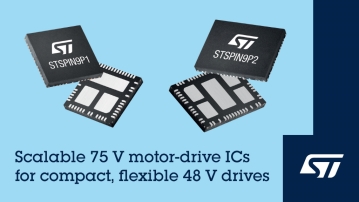
ST Launches 75V Drive IC Targeting 48V Industrial Motor Driving
ST마이크로일렉트로닉스가 48V급 산업용 구동 시스템 설계에 맞춘 75V 모터 드라이브 IC ‘STSPIN9P’ 시리즈를 공개했다. 새 제품군은 하프 브리지와 풀 브리지 구조로 구성돼 모터 종류와 출력 조건에 따라 설계를 확장할 수 있도록 한 것이 특징이다. 전원 회로와 보호 기능, 전류 감지 회로를 칩에 통합해 시스템 구성을 단순화했으며, 최대 500W급 애플리케이션까지 대응하도록 설계됐다. 회사는 레퍼런스 디자인과 데모 보드도 함께 제공해 산업 자동화, 로보틱스, 펌프, 팬, 조명, 섬유 기계 등에서 개발과 평가를 지원할 계획이다.
2026.03.26by 배종인 기자

Nordic supports security updates for the entire lifecycle of IoT devices at a single fixed cost
Nordic Semiconductor, a global leader in low-power wireless connectivity solutions, has unveiled a single fixed-cost licensing model that delivers FOTA (Firmware Over-the-Air) and device management capabilities throughout the device lifecycle via nRF Cloud, and introduced a new firmware update solution to prepare for the enforcement of the European Union's Cyber Resilience Act (CRA).
2026.03.26by 배종인 기자

Practical Training in Low-Noise, Low-Power Circuit Design All in One Place… Training Fee Support
고감도 아날로그 회로와 센서 기반 시스템 설계 역량을 강화할 수 있는 ‘2026 고급 엔지니어 실무 마스터 클래스’가 오는 4월16일 서울 가산동 e4ds 컨퍼런스 센터에서 열린다. 이번 과정은 온라인이 아닌 오프라인 유료 실습 교육으로 진행되며, 현장 중심의 심화 학습을 원하는 엔지니어를 대상으로 한다. 이번 교육은 텍사스 인스트루먼트(Texas Instruments)가 교육비를 지원해 정가 25만원에서 10만원 할인 된 15만원에 참가할 수 있다.
2026.03.26by 배종인 기자











