


Lam Research Launches Advanced Packaging Equipment for the AI Era
 Published2025.09.11 16:10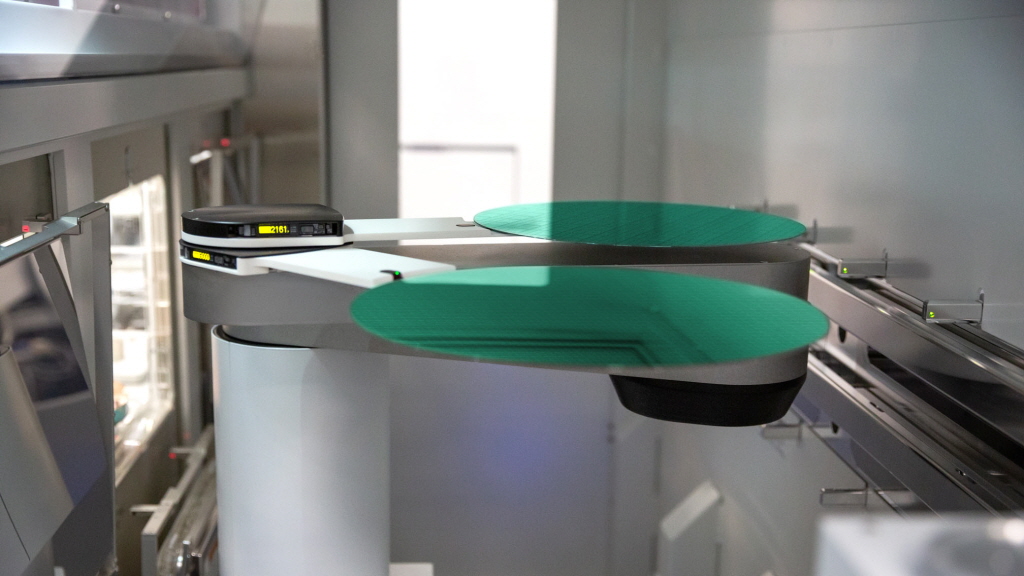
▲Lam Research's VECTOR® TEOS 3D wafer handling
Lam Research, a global semiconductor equipment company, supports next-generation semiconductor packaging technology for the era of artificial intelligence (AI) and high-performance computing (HPC).
Lam Research announced on the 11th that it recently launched its innovative deposition equipment, 'VECTOR® TEOS 3D'.
This device addresses technical challenges arising from 3D die stacking and chiplet-based high-density heterogeneous integration processes, and is attracting attention as a key foundation for implementing AI-accelerated architectures.
VECTOR® TEOS 3D combines Lam's proprietary wafer bow handling technology, dielectric deposition technology, and Lam Equipment Intelligence® capabilities to deliver uniform inter-die gapfill down to 100 microns thick.
In particular, it enables the deposition of the industry's thickest, void-free film, enabling stable processing even on wafers subject to extreme stress and warpage.
“VECTOR® TEOS 3D delivers differentiated innovation that meets the demands of the AI era that goes beyond Moore’s Law,” said Sesha Varadarajan, senior vice president, Global Products Group, Lam Research.“This will be an opportunity to add powerful solutions to our advanced packaging portfolio,” he said.
Due to the recent rapid development of AI technology, semiconductor manufacturers are adopting advanced 3D packaging technology that places memory and processing units in close proximity.
On the other hand, as the die height and complexity increase, various defects such as wafer warpage, film cracks, and voids occur, resulting in a decrease in yield.
To address these challenges, VECTOR® TEOS 3D deposits dielectric films with nanoscale precision, and its clamping technology and pedestal design ensure stable wafer fixation and thermal and mechanical stress distribution.
Additionally, Lam Research's proprietary Quad Station Module (QSM) architecture delivers approximately 70% higher throughput through parallel processing and up to 20% lower cost of ownership. Equipment intelligence technology enhances process repeatability and reliability, while a high-efficiency RF generator and ECO mode control improve energy efficiency.

Comments
Related news
.jpg)
Lam Research, EUV Dry Resist ‘Groans’
Lam Research has partnered with Inphi and Zeleste, a Mitsubishi Chemical Group company, to develop dry photoresist for EUV lithography. Upon successful mass production, it is expected to replace conventional wet resists, which have raised stability concerns, by eliminating cleaning processes and reducing material consumption.
2022.07.20by 배종인 기자

Lam Research pioneers 1,000-layer 3D NAND with cryogenic etching technology
Lam Research is actively stepping forward to enable memory chip manufacturers to realize their goal of mass-producing 1,000-layer 3D NAND by 2030 through Lam Cryo™ 3.0, its third-generation cryogenic dielectric etch technology.
2024.08.01by 배종인 기자
Lam Research Invests 7 Billion Won in ‘Semiverse Solution’ to Foster Korean Semiconductor Talent
Lam Research is moving into the semiconductor megacluster in Yongin, Gyeonggi Province as the first global semiconductor equipment company, and will directly invest 7 billion won to nurture domestic semiconductor talent. The company has partnered with the Korea Semiconductor Industry Association and Sungkyunkwan University to promote semiconductor education infrastructure called the 'SemiBus™ Solution'.
2024.10.09by 배종인 기자
.jpg)
Lam Research Manufacturing Korea CEO Lee Che-soo Receives Prime Minister's Award on 'Semiconductor Day'
Lam Research Manufacturing Korea President Lee Che-soo received a commendation from the Prime Minister at the 17th Semiconductor Day commemorative ceremony, having been recognized for his contributions to strengthening the competitiveness and ecosystem of the domestic semiconductor industry.
2024.10.24by 배종인 기자
Lam Research, Semiconductor Talent Training 'Tech Academy' 2nd Class Recruitment
Lam Research Korea announced on the 12th that it is recruiting the second cohort of students for the "Lam Research Tech Academy," an initiative to nurture next-generation talent in the semiconductor industry.
2024.11.12by 명세환 기자











