



TI to Unveil Expanded Automotive Semiconductor Portfolio at CES 2026
 Published2026.01.06 15:28
10BASE-T1S PHY Ethernet extension to vehicle edge nodes
Texas Instruments (TI) will accelerate the technological transformation of the global automotive industry by unveiling a comprehensive portfolio of high-performance automotive semiconductors for the development of next-generation autonomous vehicles at CES 2026.
At CES 2026, held in Las Vegas from the 6th to the 9th, TI presented key technologies for implementing Level 3 autonomous driving by introducing new product lines, including a high-performance computing SoC that maximizes edge AI performance, a single-chip 8x8 4D imaging radar transceiver, and a 10BASE-T1S PHY that extends Ethernet to vehicle edge nodes.
TI stated, “The automotive industry is rapidly moving toward reduced driver involvement, and semiconductors are a key technology for realizing safe and intelligent autonomous driving experiences.” TI’s end-to-end systems support automotive technology innovation across sensing, communication and decision-making.
TI's TDA5 high-performance computing SoC family delivers scalable edge AI acceleration performance from 10 TOPS up to 1,200 TOPS.
Power efficiency is over 24 TOPS/W, satisfying both high-performance computing and low-power requirements.
In particular, by applying UCIe-based chiplet-responsive design within a single portfolio,It also has various functional configurations and supports SAE Level 3 autonomous driving.
The TDA5 SoC features TI's next-generation C7 NPU, delivering up to 12x improved AI computing performance compared to the previous generation.
It enhances in-vehicle AI intelligence by supporting large-scale language models (LLMs) and transformer-based network processing while maintaining similar power consumption levels.
Additionally, the latest Arm Cortex-A720AE core can be applied to widely integrate safety, security, and computing applications.
The TDA5 SoC provides a cross-domain convergence architecture that integrates ADAS, infotainment, and gateway systems into a single chip, reducing system complexity and cost.
Simplifies automotive system design with a safety architecture that meets ASIL-D standards without external components.
TI is partnering with Synopsys to offer the Virtualizer Development Kit to accelerate software-centric vehicle (SDV) development.
A digital twin-based development environment can shorten SDV release times by up to 12 months.
Radar technology, a key sensor for autonomous vehicles, has also been significantly enhanced.
TI's AWR2188 4D imaging radar transceiver is the industry's first 8x8 single-chip solution that integrates eight transmitters and eight receivers into a single package.
While existing high-resolution radars required cascading multiple chips, the AWR2188 significantly simplifies design by enabling a high-resolution radar system to be implemented with just a single chip. It is cost-effective because it reduces the number of devices required even when expanding to more channels.
The AWR2188 provides up to 30% performance improvement over previous models by applying improved ADC data processing and radar chirp signal slope engine.
This supports advanced radar use cases such as lost cargo detection, short-range vehicle differentiation, and object identification in highly dynamic environments, and enhances autonomous driving safety by enabling long-distance detection of over 350m.
It also supports both satellite and edge architectures, enabling efficient expansion of ADAS functions across all vehicle types, from compact cars to premium vehicles.
The shift toward software-defined vehicles (SDVs) and advanced autonomous driving also requires changes to in-vehicle network architecture. To address this, TI has unveiled the DP83TD555J-Q1 10BASE-T1S Ethernet PHY.
This product features a built-in MAC, providing nanosecond-level time synchronization and high reliability, and also supports Power over Data Line (PoDL). This allows engineers to extend Ethernet to vehicle edge nodes while reducing wiring complexity and costs.
TI helps automakers improve safety and automation across a wide range of vehicle models with system solutions that integrate sensing, networking, and processing technologies.
TI will showcase its full analog and embedded processing portfolio at CES 2026 in booth N115, North Hall, Las Vegas Convention Center.
The exhibition areas include vehicle technology, advanced mobility, smart home, digital health, energy infrastructure, robotics, and data centers, allowing visitors to experience TI's latest innovative technologies firsthand.

Comments
Related news
.jpg)
[2025 e4ds Tech Day] TI Vice President Seungmok Kim: "GaN Automotive Power Systems Open New Possibilities"
As automotive power systems rapidly evolve, GaN (Gallium Nitride) solutions are gaining attention as next-generation automotive power semiconductors, moving away from the previous trend of utilizing silicon (Si) semiconductors in the low-voltage range and silicon carbide (SiC)-based semiconductors in the high-voltage range. GaN provides optimal efficiency in the 200–500V power supply range and enables wide power scaling from 50W to 25kW, allowing simultaneous realization of both power density and system miniaturization. Recently, GaN applications are expanding even in low-voltage systems of 200V or below, making it possible to select the optimal device according to design requirements. In this context, Texas Instruments will participate in the '2025 e4ds Tech Day' event on September 9th to present on the topic of 'Implementing High Power Density and Efficient Digital Power Systems with TI GaN FETs.' We have arranged an interview with Kim Seung-mok, Section Chief at TI, who will be giving the presentation, to learn more about TI's GaN devices.
2025.08.28by 명세환 기자

TI Brings Premium Motor Control to More Consumers
Texas Instruments (TI) has launched the C2000™ F28E12x series, an ultra-low-cost real-time MCU that delivers premium motor control capabilities for consumer appliances and power tools, ushering in a new era of affordable premium motor control.
2025.09.18by 배종인 기자
.jpg)
[2025 e4ds Tech Day] "GaN, the Future of Power Semiconductors, is Ready for Commercialization in 48V Power Systems."
Texas Instruments (TI) Manager Kim Seung-mok presented on the topic of "Implementing High Power Density and Efficient Digital Power Systems with TI GaN FET" at the '2025 e4ds Tech Day' event held on September 9th, emphasizing that power semiconductors are the core of next-generation industries such as electric vehicles, renewable energy, and high-efficiency power supplies. Manager Kim Seung-mok first reviewed the evolution of power semiconductors, stating, "Until 20 years ago, IGBTs were mainstream, but with the emergence of SiC, it began to be applied to high-voltage systems above 1,200V. However, there were limitations in terms of switching frequency. In contrast, GaN can switch up to 12MHz at voltage levels of 600-650V, making it possible to dramatically increase power density."
2025.09.29by 배종인 기자
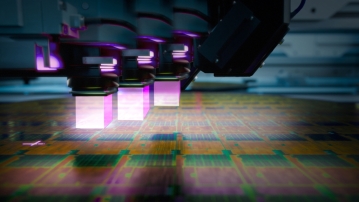
TI Strengthens High-Precision Digital Lithography Technology for Advanced Packaging
Texas Instruments (TI) has launched the DLP991UUV, a new digital micromirror device (DMD) for next-generation digital lithography technology, strengthening high-precision digital lithography capabilities for advanced packaging.
2025.10.02by 명세환 기자
.jpg)
TI Unveils Next-Generation Scalable Power Management Solution to Meet AI Data Center Power Demands
Texas Instruments (TI) announced a new power management solution for AI data centers at the Open Compute Summit (OCP) held in San Jose, USA. The announcement focused on implementing a scalable power architecture ranging from 12V to 48V and up to 800VDC in response to growing AI computational demands.
2025.10.14by 배종인 기자











