o Meaningful new performance added to the expanded SenseMe software library
o Optimized for QuickLogic ArcticLink 3 S2 programmable sensor hub platform with 150uW power consumption
o Algorithm features with industry-leading accuracy, power efficiency, and low latency
March 17, 2015 – QuickLogic Corporation, a leader in ultra-low power CSSP (Customer Specific Standard Product), announced today that it has added several new algorithms to its SenseMe™ sensor algorithm library. When SenseMe algorithms are used with QuickLogic’s Sensor Hub semiconductor platform and reference designs, designers can expand the performance and functionality of smartphones and wearable devices, as well as significantly reduce design time while lowering design risk and improving battery life and data accuracy.
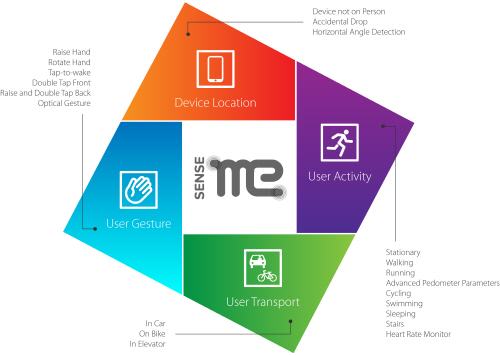
QuickLogic's SenseMe algorithm library includes a variety of new algorithms, such as algorithms that define low-latency contexts when a user is in a vehicle or on a bicycle, fitness/health check performance for Heart Rate Monitoring (HRM), advanced pedometer functions, and sleep analysis functions. Advanced pedometers provide step counts for slow, normal, fast, and running, while sleep analysis algorithms provide information on light sleep, deep sleep, and waking states. OEMs that have benchmarked QuickLogic's pedometers against products from other leading competitors have evaluated that QuickLogic products consistently provide over 97% accuracy.
QuickLogic's SenseMe algorithm enables smartphone and wearable design teams to easily interpret data collected from a wide range of sensors, including inertial sensors, magnetic sensors, biosensors, proximity sensors, and optical sensors, to define the user's activity state and context.
color:background1;mso-border-themeshade: 191;padding:0cm 5.4pt 0cm 5.4pt"> pedometer
o-border-themeshade:191;padding:0cm 5.4pt 0cm 5.4pt"> Advanced pedometer supporting invalid step exclusion , distance , speed , and calorie analysis
lor:background1; mso-border-top-themeshade:191;mso-border-alt:solid #BFBFBF .25pt;mso-border-themecolor: background1;mso-border-themeshade:191;padding:0cm 5.4pt 0cm 5.4pt"> context
themecolor: background1;mso-border-right-themeshade:191;mso-border-top-alt:solid #BFBFBF .25pt; mso-border-top-themecolor:background1;mso-border-top-themeshade:191; mso-border-left-alt:solid #BFBFBF .25pt;mso-border-left-themecolor:background1; mso-border-left-themeshade:191;mso-border-alt:solid #BFBFBF .25pt;mso-border-themecolor: background1;mso-border-themeshade:191;padding:0cm 5.4pt 0cm 5.4pt"> Stop , walk ,n style="font-size:8.0pt;font-family:"Malgun Gothic";mso-ascii-font-family:"Times New Roman"; mso-fareast-font-family:"Malgun Gothic";mso-fareast-theme-font:minor-fareast; mso-hansi-font-family:"Times New Roman";mso-bidi-font-family:"Times New Roman"; mso-fareast-language:KO">Running , falling ,Not On Person, Cycling , Sleep Analysis , While in a Vehicle
und1; mso-border-top-themeshade:191;mso-border-alt:solid #BFBFBF .25pt;mso-border-themecolor: background1;mso-border-themeshade:191;padding:0cm 5.4pt 0cm 5.4pt"> gesture
background1;mso-border-right-themeshade:191;mso-border-top-alt:solid #BFBFBF .25pt; mso-border-top-themecolor:background1;mso-border-top-themeshade:191; mso-border-left-alt:solid #BFBFBF .25pt;mso-border-left-themecolor:background1; mso-border-left-themeshade:191;mso-border-alt:solid #BFBFBF .25pt;mso-border-themecolor: background1;mso-border-themeshade:191;padding:0cm 5.4pt 0cm 5.4pt"> Raising the hand , twisting the hand , tapping twice , horizontal angleuot;Times New Roman";color:#1F497D;mso-fareast-language:KO">
figfamily:"Times New Roman"; color:#1F497D"> | Heart Rate Monitor ( Custom ) |
r-top-alt:solid #BFBFBF .25pt;mso-border-top-themecolor:background1; mso-border-top-themeshade:191;mso-border-alt:solid #BFBFBF .25pt;mso-border-themecolor: background1;mso-border-themeshade:191;padding:0cm 5.4pt 0cm 5.4pt"> etc
border-right:solid #BFBFBF 1.0pt;mso-border-right-themecolor: background1;mso-border-right-themeshade:191;mso-border-top-alt:solid #BFBFBF .25pt; mso-border-top-themecolor:background1;mso-border-top-themeshade:191; mso-border-left-alt:solid #BFBFBF .25pt;mso-border-left-themecolor:background1; mso-border-left-themeshade:191;mso-border-alt:solid #BFBFBF .25pt;mso-border-themecolor: background1;mso-border-themeshade:191;padding:0cm 5.4pt 0cm 5.4pt"> Multi-axis fusiont-language:KO">, ultraviolet light , ambient lightgauge:KO">, close
| Supported sensors | FBF .25pt;mso-border-left-themecolor:background1; mso-border-left-themeshade:191;mso-border-alt:solid #BFBFBF .25pt;mso-border-themecolor: background1;mso-border-themeshade:191;padding:0cm 5.4pt 0cm 5.4pt"> Accelerometer , magnetometer , gyroscope , pressure , proximity , temperature , PPG heart rate monitor , humidity , ambient light sensor , ultraviolet light sensorquot;Times New Roman";color:#1F497D;mso-fareast-language:KO">
operating systemfamily:"Times New Roman"; color:#1F497D"> | RTOS,Android 4.2 ( Ice Cream Sandwich">), 4.3 ( Jelly Bean ), 4.4 ( KitKat:KO">), 5.0 ( Lollipop ), No OSman";color:#1F497D;mso-fareast-language: KO"> |
ArcticLink 3 S2 and the SenseMe algorithm are fully compatible with Android OS and RTOS-based systems, including KitKat 4.4 and Lollipop 5.0. QuickLogic provides standard Android drivers for fast and seamless integration.
To meet unique customer needs, the ArcticLink 3 S2 platform can be easily customized through QuickLogic’s Integrated Development Environment (IDE) and reference designs. By utilizing this IDE, which encompasses QuickLogic’s vast software, customer-developed algorithms, third-party algorithms, or various combinations of these three elements, users can rapidly develop products that are differentiated from competitors.
Frank Shemansky, Senior Director of Product Management at QuickLogic, stated, “Combining QuickLogic’s powerful algorithm suite with highly efficient hardware provides a toolset for defining and analyzing user activities,” and added, “It also enables the prediction of the correlation between user intent and information through nearly unlimited opportunities ranging from biometric correlations to environmental predictions.” "This was impossible in the past," he explained.
For more information, see http://www.quicklogic.com/technologies/sensor-algorithms/senseme/.
Latest QuickLogic News:
http://blog.quicklogic.com/
http://www.youtube.com/QuickLogicCorp
http://twitter.com/QuickLogic_Corp
http://www.facebook.com/QuickLogic



 Published2015.03.20 15:08