



DigiKey, “AI-based Prototyping Changes the Speed of Engineering Development”
 Published2026.04.09 16:41
AI Expands Design Exploration and Simulation Beyond Coding and Debugging, Accelerating Future Development
Engineering used to proceed on a seasonal basis, with requirements being designed in one quarter, circuit diagrams in the next, and boards and firmware in the last.
Nowadays, everything is moving faster.
You can develop new ideas into a proof of concept on a whiteboard within a few days, or in some cases, within a few hours.
With the removal of silos and barriers, today's innovation environment is fundamentally different.
Development speed has been accelerated through the convergence of rapid prototyping methods, AI-assisted workflows that shorten the distance between idea and implementation, and more cost-effective work methods.
As a result, a new operating model was implemented with iteration speed as a differentiating factor.
In this model, the process is designed so that the best teams can learn faster than the rate of problem evolution.
■ The New Era of Rapid Prototyping
For decades, accessibility has served as a gatekeeper.
Due to specialized tools, expensive licenses, and limited supply chains, prototyping of electronic devices is research that is not sufficiently fundedIt was only possible in the room.
Now the situation has changed.
Open source software and pre-developed code from companies like Arduino and Raspberry Pi enable any designer with sufficient resources to perform prototyping.
Thanks to low-cost boards and a community-based ecosystem, engineers and makers rarely start from scratch; instead, they begin at 'Step 5' based on proven libraries, reference designs, and demo projects.
Speed has become a competitive advantage.
In a market where requirements change with every software release and hardware cycle, a slow pace of development becomes a strategic risk.
Whether you are solving sensor fusion stack problems or exploring new wireless architectures, the ability to rapidly assemble prototypes and make necessary modifications determines how quickly you can verify what works and what does not.
Modular hardware, cloud-based IDEs, and a plug-and-play stack for connectivity and data processing make this possible.
The result leads not only to a reduction in prototyping time but also to a reduction in decision-making time.
■ How AI Supports Prototyping Innovation
AI is now fundamental to daily engineering tasks.
The most noticeable changes appear in the coding and debugging layers. At this layer, AI can find logical defects, refactor functions, suggest test scaffolds, and even pinpoint a single misconfigured register that was not found in three code reviews.
Tasks that once took an entire afternoon, such as tracing compilation errors in unfamiliar libraries, converting pseudocode into working drivers, or generating boilerplates for new microcontrollers, have now been reduced to minutes.
However, the true value here is not just speed, but range.
AI expands the scope of design that small teams can explore.
Instead of narrowing down the scope early due to a lack of time to test that approach, the team can ask the AI to sketch multiple architectures, compare pros and cons, and generate candidate implementations to test in simulations before ordering the first board.
It is precisely at this point that rapid engineering emerges as a true technology.
The quality of the output depends on how accurately constraints are described, interfaces are defined, and assumptions are encoded.
In fact, engineers are increasingly designing both the system and the queries that generate it.
■ Lifting Accessibility Restrictions in the Engineering World
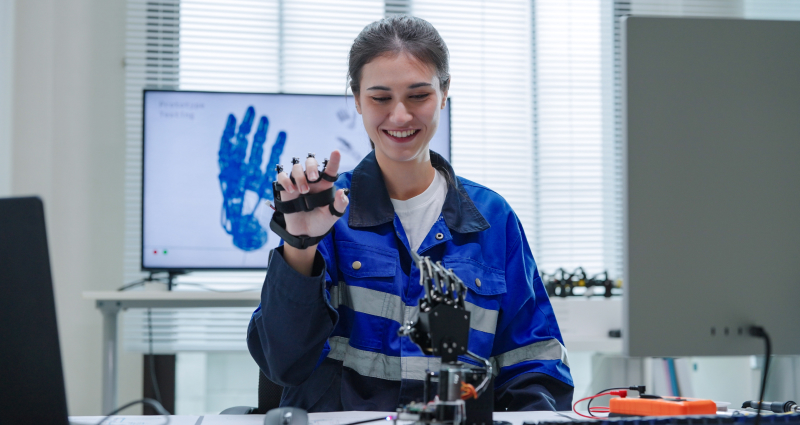
Infinite possibilities have opened up as access to engineering tools and information has become available.
If entry barriers are lowered, participation increases and homeBut the speed of learning also increases.
Open tutorials and maker-friendly documentation transform abstruse content limited to specific domains into repeatable recipes.
Community forums like DigiKey's TechForum shorten the problem-solving cycle by connecting those who have already solved the problem with those who are encountering it for the first time.
This is actually very important.
This is because in many cases, you must share not only the completed code and circuit diagrams but also 'what didn't work and why' to solve the next team's problems.
The dynamism of these communities is likewise bringing about transformation in the field of education.
The simulator teaches the principles, and the hardware teaches perseverance, intuition, and the joy of the first success.
If you put a programmable robot or a simple microcontroller kit into a student's hands, you can see their curiosity turn into confidence.
Through reasonably priced kits and guided curriculums, educators can move beyond passive instruction to active creation.
Learners verify causes and effects in real time and connect abstract concepts with tangible results.
The ripple effect is very significant.
This is because more students identify themselves as builders at an earlier age, and often carry this mindset into advanced programs and industry roles.
■ Future: Wireless, Autonomous, and Measurement-based
Looking 10 years ahead, three trends come to mind in the field of rapid prototyping.
First, wireless will become essential.
Most prototypes for consumer, industrial, and scientific use are based on connectivity and edge intelligence from the start.
Second is autonomy as a design goal.
Systems must increasingly perform cognition, decision-making, and operation while minimizing human intervention, which increases the demands for sensing, local computation, and robust fault handling.
Third, measurement will become widespread.
As prototypes become complex systems, observability such as structured logging, telemetry, and status monitoring helps to understand behavior under real-world conditions.
AI will support development across all three trends.
It is expected that toolchains will become commonplace that perform not only firmware generation but also optimal sensor placement suggestions, synthetic data set generation for edge models, flagging abnormal power signatures during development, and board modification suggestions based on field operation.
Before hardware exists, integration problems can be detected early through richer AI-augmented simulations.
After the hardware is delivered, AI mines operational data to predict failures and recommends updates.
The engineering loop does not end with launch, but leads to a continuous, data-driven dialogue with the product operating in a real-world environment.
■ Performing the build now Practical advice for the team
Treat failure as an element of the process, not a defect. The speed of learning is the true indicator, and each failed attempt is information that brings you closer to a successful outcome.
Before you know how something works, you can learn 100 ways it doesn't work.
Explicitly capture these lessons through brief post-hoc analysis, commented comments, shared forum posts, etc., so that they can be helpful for the next iteration (and the next team member).
Please use the community. Ask questions early, and answer as quickly as possible.
The fastest way to resolve driver issues or ambiguous toolchain behavior is often to talk to someone who has experienced the same problem.
Likewise, publishing reference materials and partial solutions can help accelerate next-generation development.
Leverage AI as a partner to automate tedious tasks and enhance exploration.
Build a prompt library connected to codebases and architectural patterns. Set up guardrails using style guides, test harnesses, linting, and CI to ensure that quality is not compromised due to speed.
As AI-generated code increases, the importance of verification discipline does not decrease but rather becomes stronger.
Finally, cultivate a beta mind.
New toolchains, updated firmware, and new modules don't always work correctly from day one, but that is where the insight lies.
Teams that adopt early, test responsibly, and share their learning help innovate the tools they rely on, staying ahead in competence and influence.
■ The Future Created by the Fastest Learners
AI-powered rapid prototyping is more than just a way to build faster; it is the very way of working.
This prioritizes curiosity over certainty, feedback over assumptions, and collaboration over isolation.
As hardware, software, and data converge, teams that design with acceleration in mind will succeed.
In other words, it is a method of shortening cycles, measuring everything, and converting all results—whether success or failure—into a driving force for progress.
The future of engineering belongs to the fastest-learning organizations. By integrating AI into the latest prototyping methods and workflows, this future is not far off.
 ※ Author Introduction
Kevin Walseth is a Technology Marketing Manager at DigiKey, leading continuous innovation as a global leader in the advanced distribution of electronic components and automation products worldwide. DigiKey supplies over 17.5 million components from approximately 3,000 leading brand manufacturers.
Comments
Related news

Digi-Key celebrates its 50th anniversary by distributing electronic components to over 180 countries.
Digi-Key Electronics, which provides the world's largest-scale electronic component distribution and rapid shipping services, has contributed to the global electronics industry by distributing electronic components to over 180 countries for more than 50 years.
2023.04.06by 배종인 기자

DigiKey Announces Artificial Intelligence Exploration Video Series
DigiKey, the world's leading commercial distributor with the largest range of technical components and automation products available for immediate shipment, has launched "AI in a Smart World," Season 4 of the City Digital video series, under the sponsorship of Molex and STMicroelectronics.
2024.06.28by 배종인 기자

Kobo Signs Global Distribution Agreement with Digi-Key
Qorvo, a global leader in connectivity and power solutions, has entered into a worldwide distribution agreement with DigiKey, which enables immediate shipment of a diverse range of technology components and automation products.
2025.02.26by 배종인 기자
Digi-Key Adds 10,000 New Products and 104 Suppliers in Q1
DigiKey, a global distributor of electronic components and automation products, is accelerating industry growth by adding 98,320 new products (NPI) and 104 new suppliers during the first quarter of 2025, providing engineers with the components and solutions they demand.
2025.04.29by 명세환 기자
Leading AI, semiconductor, and SDV technologies at a glance... '2025 e4ds Tech Day' to be held at the ST Center on September 9th.
e4ds news will hold the '2025 e4ds Tech Day' on Tuesday, September 9th at the ST Center in Gangnam-gu, Seoul (B1F, Building 1, Korea Science and Technology Center, 22 Teheran-ro 7-gil, Gangnam-gu, Seoul (Yeoksam-dong 635-4)). This conference, under the theme of 'Power Efficiency Centered on Semiconductors, and the Future and Changes in AI and Automotive Technology,' will examine next-generation technology trends ranging from semiconductor technology innovation, on-device AI, autonomous driving, and software-defined vehicles (SDV). The event is sponsored by Texas Instruments (TI), STMicroelectronics, MDS Tech, QNX, Tektronix, Mouser Electronics, Digi-Key, Analog Devices (ADI), NI, Vector Korea, Eti-Pos, Infineon, and Asung Korea.
2025.07.25by 명세환 기자











