
Maestro Forensics Hosts Security Seminar on Vulnerability Assessment to Incident Response
 Published2026.04.30 11:18
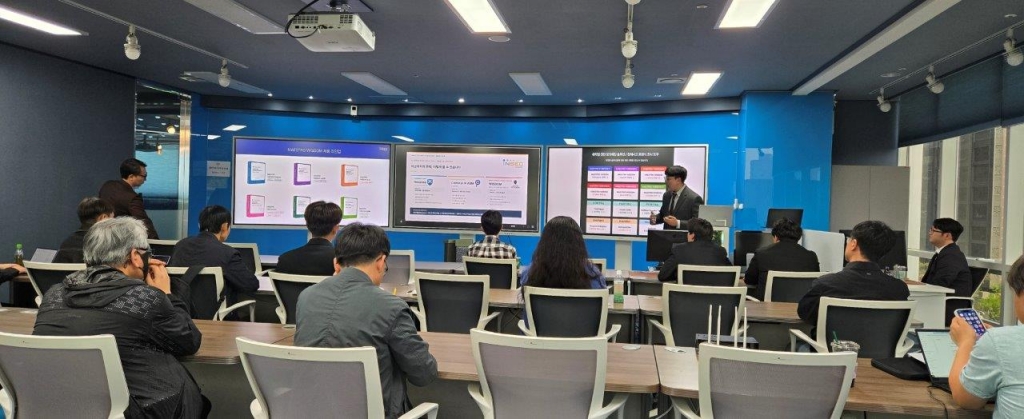
Demonstration of attack scenarios and forensic analysis, sharing of asset management and initial response issues
Maestro Forensic announced on April 30 that it held the 'Integrated Seminar on Vulnerability Assessment, Penetration Testing, and Incident Response' the previous day at the Insec Security Training Center in Doksan-dong, Seoul. Security practitioners from the public, financial, manufacturing, and IT sectors attended the event.
The seminar introduced recent changes in cyber attack types. Cases were shared regarding ransomware, Advanced Persistent Threats (APTs), and fileless attacks, which are difficult to respond to with existing detection systems.
In addition, difficulties in vulnerability management and response were mentioned as the number of assets under management increases due to the proliferation of cloud, IoT, and endpoints. Unmanaged assets, long-term unpatched systems, and the potential for attacks through the supply chain were also presented as major issues.
At the event, an integrated scenario spanning from attack to response was presented in the form of a live demo. In the vulnerability assessment phase, a method for analyzing asset-specific risk based on vulnerability data was introduced, and in the penetration testing session, the exploitation of remote code execution vulnerabilities, internal spread, and privilege escalation processes were demonstrated step-by-step.
In the digital forensics session, the process of reconstructing attack flows through memory-based data collection and analysis was shared. Following this, the incident response session introduced methods for securing data during the initial response phase and preventing internal spread.
Kim Jong-kwang, CEO of Maestro Forensic, stated, “Unmanaged assets and delayed response are being identified as major causes of security breaches,” adding, “A security management system is needed that extends from vulnerability identification to response.”

Comments
Related news
Maestro Forensics Strengthens Practice-Oriented Security Capabilities
Maestro Forensics will hold a special lecture on "Vulnerability Assessment, Malware Detection, and Incident Forensics Solutions" at the InSecurity Education Center in Doksan-dong, Geumcheon-gu, Seoul from 2 p.m. to 5 p.m. on October 17th.
2025.09.19by 명세환 기자
Maestro Wisdom, an AI-based digital forensics innovation platform, has been launched, identifying evidence three times faster than before.
Domestic security specialist company Maestro Forensics (CEO Kim Jong-gwang) has launched 'MAESTRO WiSDOM,' which is equipped with a 'Forensics Accelerator' that provides dramatically improved analysis speed and evidence data filtering and extraction capabilities compared to existing products. The new solution provides full-scale support for root cause analysis of increasingly sophisticated digital breach incidents driven by recent AI technologies and evidence identification that is three times faster than conventional methods.
2025.12.11by 배종인 기자
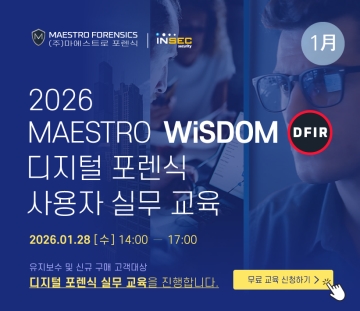
Maestro Forensics Hosts '2026 Maestro Wisdom Digital Forensics User Training'
Security specialist company Maestro Forensics will hold the "2026 Maestro Wisdom Digital Forensics User Practical Training" on January 28 at the Insecurity Seoul Doksan Training Center located in Doksan-dong, Geumcheon-gu, Seoul.
2026.01.16by 배종인 기자

Maestro Forensics Unveils 'Maestro Wisdom' with Enhanced DFIR
As the limitations of existing security systems become apparent due to increasingly sophisticated ransomware and the spread of fileless attacks, the importance of digital forensics-based incident response is growing. Maestro Forensic announced that it has strengthened DFIR capabilities in its AI-based automated forensics platform "Maestro Wisdom" to support precise analysis and rapid response. The platform covers various operating systems and environments and was designed to complement existing EDR solutions. In actual customer cases, the analysis period was significantly reduced compared to previous methods.
2026.02.10by 배종인 기자

Maestro Forensics Unveils 'WiSDOM Linux' with Enhanced Linux Server Analysis
Maestro Forensic has unveiled 'MAESTRO WiSDOM Linux,' a digital forensics solution that enhances analysis capabilities for major Linux distributions including Red Hat and Ubuntu. This version newly supports precision analysis of EXT-series and XFS file systems, which are widely used in enterprise servers and cloud environments. The company cited as background the growing demand for DFIR analysis that extends beyond log-centric approaches to encompassing overall system analysis, as Linux-based infrastructure has become a primary target for ransomware, web server compromises, and supply chain attacks. The company emphasized the extraction and analysis of over 250 types of digital artifacts and integration with its product portfolio including Windows, Mac, and threat intelligence, while industry assessment suggests that the expanded XFS support can reduce the gap in analyzing large-scale server environments.
2026.02.24by 배종인 기자