



UNIST Develops Water-Reactive Luminescent Material That Changes Brightness
 Published2026.05.20 11:22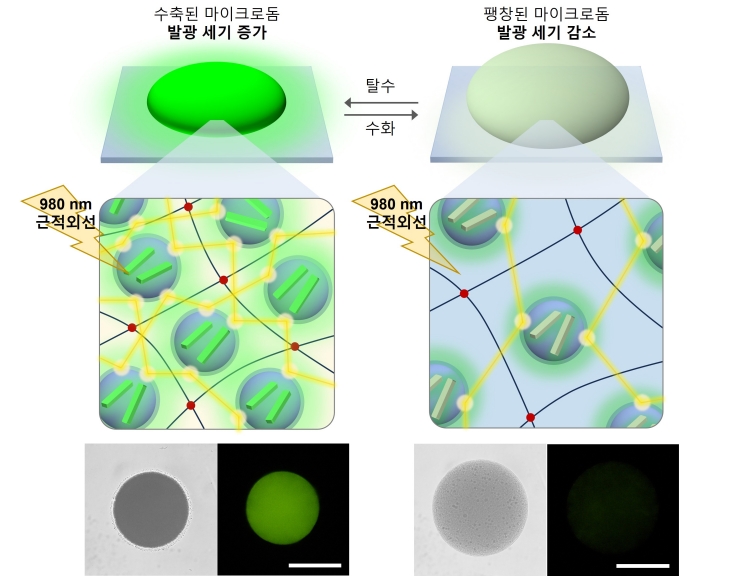
Up-conversion nanoparticle-based soft optical materials present potential for security and sensor applications
Professor Lee Ji-seok's team from the Department of Energy and Chemical Engineering and Professor Park Jung-hoon's team from the Department of Biomedical Engineering at UNIST announced on the 20th that they have developed a soft optical material based on upconversion nanoparticles that shines more than seven times brighter in a dry state than when it is moist.
This material has a structure in which upconversion nanoparticles are placed inside a hydrogel dome. Upconversion nanoparticles have the property of converting near-infrared light into visible light that humans can see when exposed to it. The research team placed the nanoparticles inside an oil droplet and then confined them inside a hydrogel dome to control the path of light.
In this structure, near-infrared light does not escape directly from the hydrogel but is scattered between oil droplets. As the time the light stays inside increases, the opportunity for nanoparticles to absorb near-infrared light increases, and the luminescence intensity increases. Conversely, if moisture is introduced, the scattering effect decreases, and the luminescence weakens.
The research team utilized this property to demonstrate moisture-responsive security technology and QR code recognition technology. When characters and images made of upconversion nanoparticles are placed under a bright hydrogel dome, they remain invisible in a dry state but become visible when they absorb water. The QR code is recognized based on the difference in brightness only in a dry state, and the code disappears when moisture is introduced.
The repeatability of the material was also confirmed. Even after repeating the process of absorbing water and drying it more than 100 times, the change in brightness was less than 4%. The response speed was also fast, with the decrease in luminescence starting within 0.1 seconds after contact with water.
"First author Chaeyoung Ryu explained, 'This is a technology that enhances luminescence by designing a path for light to travel within the hydrogel without complexly altering the upconversion nanoparticles themselves.'"
Professor Lee Ji-seok said, “The luminescence color of the nanoparticles and the hydrogel dome pattern can be controlled, and the manufacturing process is simple, so it can be expanded not only into security technology but also into wearable sensors and displays.”
The results of this study were published in the international academic journal Advanced Functional Materials on April 20 and were conducted with support from the National Research Foundation of Korea under the Ministry of Science and ICT.

Comments
Related news
IBS, UNIST, and POSTECH Improve Room-Temperature Luminescence Performance of 2D Semiconductor Quantum Light Sources
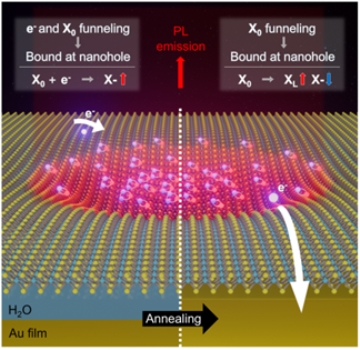
A joint research team from the Institute for Basic Science (IBS), UNIST, and POSTECH has improved the room-temperature luminescence performance of 2D semiconductor-based quantum light sources. The research team confined excitons, which easily diffuse at room temperature, within nanohole structures and reduced excess charges through heat treatment to improve light emission conditions. As a result, exciton confinement efficiency reached approximately 98%, and luminescence efficiency increased by approximately 130 times compared to previous results. The research results were published in the international journal Science Advances on March 13. This achievement demonstrates the potential to lead to research on photonic quantum devices with reduced cryogenic dependence and room-temperature single-photon light sources.
2026.04.14by 배종인 기자
KIMS and UNIST Develop Electrochemical System for Simultaneous Production of Hydrogen and Formate Using Waste Glycerol
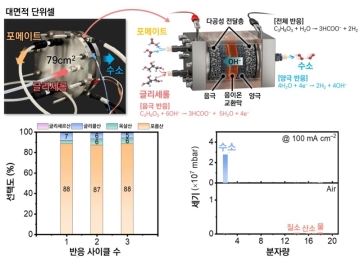
A joint research team from the Korea Institute of Materials Science and UNIST has developed an electrochemical system that produces hydrogen and formate simultaneously by utilizing glycerol, a biodiesel byproduct. The research team implemented an anion exchange membrane electrolysis system that applies glycerol oxidation reaction instead of the conventional oxygen evolution reaction in water electrolysis. Using a copper-cobalt-based non-precious metal catalyst, the team achieved 110 mA/cm² at 1.31 V, with formate selectivity of approximately 96%, and confirmed stable operation even in a large-area cell of 79 cm². The related research was published in the international academic journal Joule on March 18, 2026.
2026.04.14by 배종인 기자
UNIST Develops Smart Contact Lenses That Control Robotic Arms with Eye Movements
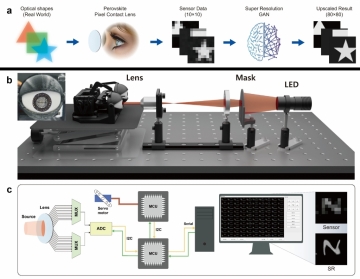
A research team led by Professor Jeong Im-du from the Department of Mechanical Engineering at UNIST has developed a smart contact lens that enables control of a robotic arm through eye movement alone. The lens surface features 100 optical sensors directly implemented on it that read gaze changes, and AI restores these into high-resolution information and converts it into control signals. The research results were published in Advanced Functional Materials in March 2026, and in eye model experiments, the system recognized nine-directional gaze gestures with 99.3% accuracy.
2026.04.15by 배종인 기자
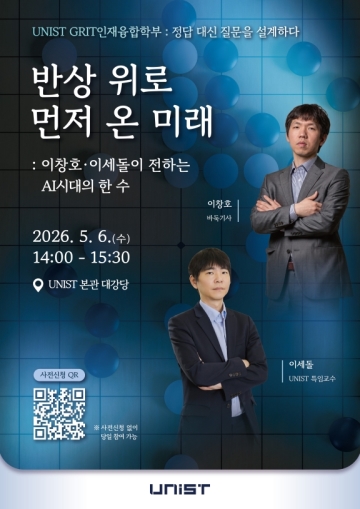
Lee Chang-ho and Lee Se-dol Discuss Human Capabilities in the AI Era at UNIST
UNIST will host an open talk concert on May 6 featuring Lee Chang-ho, a Go master, and Lee Se-dol, UNIST Distinguished Professor. The event will be held under the theme of human judgment, creativity, and perseverance in the AI era, and will serve as an occasion to introduce the educational direction of the newly established GRIT School of Talent Convergence.
2026.04.29by 명세환 기자
UNIST Develops 60-Second Micro 3D Printing Technology
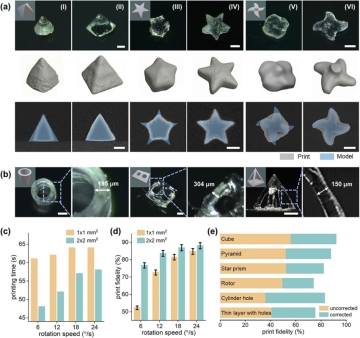
A research team led by Professor Jung Im-du at ULSAN National Institute of Science and Technology (UNIST) has developed a droplet-based volumetric additive manufacturing technology that cures and dispenses structures within droplets in a single step. The research results were published in Advanced Functional Materials on March 21st, and the research team presented experimental results demonstrating continuous fabrication of different microstructures at approximately 60-second intervals.
2026.04.29by 명세환 기자











