



KETI Provides Remote Art Museum Experience to Pediatric Cancer Patients via Telepresence Robot
 Published2026.08.05 08:43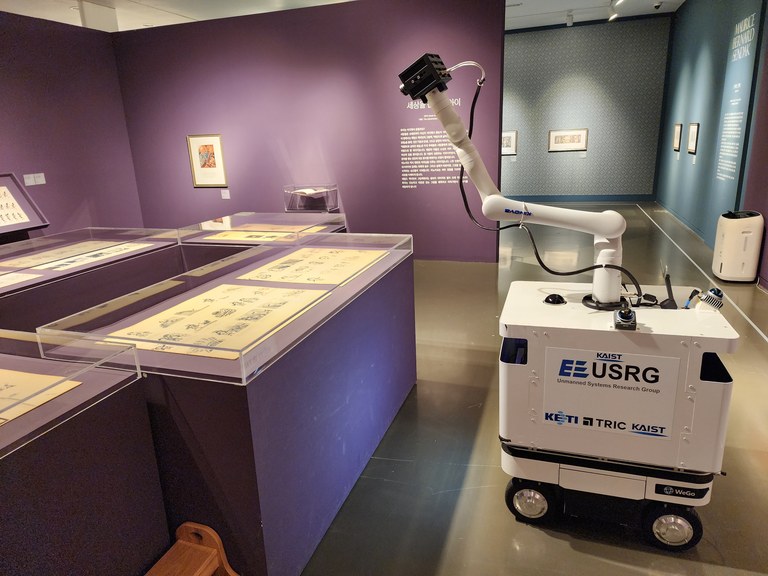
Demonstration at Chungnam National University Hospital Children's Hospital School; Expansion to Mobility-Impaired and Rural/Mountainous Areas
Pediatric and adolescent cancer patients whose external activities are restricted due to treatment experienced remote viewing of actual art museum exhibitions from the hospital.
The Korea Electronics Technology Institute (KETI) announced on the 5th that it completed a demonstration of 'Robot-Telepresence Platform Technology' on August 3rd at the Children's Hospital School on the 5th floor of Chungnam National University Hospital's pediatric ward in collaboration with the hospital's Medical Social Welfare Team.
In this demonstration, hospitalized pediatric and adolescent cancer patients remotely operated a telepresence robot installed at Soma Art Museum to view the special exhibition "Picture Books Come to Life!"
The platform was constructed by combining KETI's real-time video transmission, viewpoint switching, and AI docent technology; autonomous driving technology from Professor Shim Hyun-chul's research laboratory at the Korea Advanced Institute of Science and Technology (KAIST); and content production capabilities from the Cultural Heritage Technology Research Institute (TRIC).
Through experience equipment such as Galaxy XR prepared at the hospital school, the Soma Art Museum site was transmitted in real-time high-definition video, and patients viewed the exhibition in a bidirectional manner by directly remotely operating the robot and camera.
Active viewing was possible, such as pausing in front of specific artworks or adjusting the camera viewpoint to appreciate works in detail.
The "Picture Books Come to Life!" special exhibition, which was the subject of this demonstration, is an exhibition showcasing approximately 140 original artworks by nine world-renowned picture book authors.
KETI's Hologram Research Center announced plans to expand the application targets based on this demonstration from children's hospitals and hospital schools to mobility-impaired individuals, students in rural and mountainous areas, and other groups who face difficulties accessing cultural facilities.
Hong Sung-hee, director of KETI's Hologram Research Center, stated, "This demonstration aims not merely to showcase technology, but to provide pediatric patients with the experience of encountering the world beyond the classroom through picture books," and added, "We will advance field-oriented technology and research so that children can enjoy diverse cultures even in restricted environments."
This research was conducted with support from the Korea Culture Technology Planning and Evaluation Institute as part of the Cultural Technology Research and Development (R&D) project of the Ministry of Culture, Sports and Tourism.
KETI is responsible for technology development and overall project management, with TRIC and Professor Shim Hyun-chul's research laboratory at KAIST participating as joint and commissioned research institutions.

Comments
Related news
KETI Begins Full-Scale Demonstration of Physical AI-Based Smart Factory
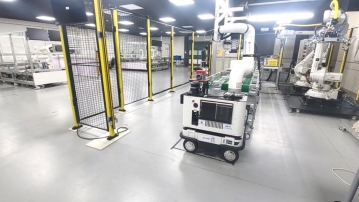
The Korea Electronics Technology Institute (KETI) has unveiled a '5G AMM (Autonomous Mobile Manipulator) testbed' constructed in Anyang, Gyeonggi Province, and has begun full-scale demonstration of physical AI technology for domestic manufacturing innovation. KETI's Intelligent Robotics Research Center is continuously advancing field-applicable AI and robot technologies through collaboration with major domestic universities including Sungkyunkwan University, Yonsei University, and Korea University, as well as AI and robot specialist companies such as CEMES, Yuyin Robotics, and Saphtix.
2026.02.23by 배종인 기자
.jpg)
KETI Unveils ezAAS at SIMTOS 2026… Showcases AAS Applications
The Korea Electronics Technology Institute (KETI) operated a special AI Factory pavilion at SIMTOS 2026 and unveiled the integrated software 'ezAAS' based on AAS. The exhibition featured domestic and international equipment companies and manufacturing solution providers showcasing application cases of manufacturing data based on AAS. KETI plans to accelerate field adoption of manufacturing data standards following this exhibition.
2026.04.14by 명세환 기자
.jpg)
KETI Secures AI Technology for ESS Lifecycle Prediction with University of Warwick… Presents Potential for Application in Edge Environments
The Korea Electronics Technology Institute (KETI) has secured artificial intelligence (AI) technology to predict the battery lifespan of energy storage systems (ESS) through joint research with the University of Warwick in the United Kingdom. By combining distributed federated learning and ultra-lightweight AI models, the institute has simultaneously improved data security and computational efficiency, with the distinctive feature of being applicable even in low-spec environments. The research results have been published in an international academic journal, and the research director has been appointed as an Honorary Associate Professor at the University of Warwick. KETI plans to expand demonstrations centered on domestically produced batteries and broaden international cooperation in the future.
2026.04.28by 명세환 기자
KETI Begins Development of International Standard for Autonomous Vehicle Charging Communication… Approved by 7 Countries
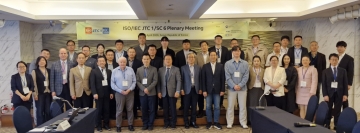
Korea Electronics Technology Institute (KETI) is taking the lead in developing an international standard for autonomous mobile robot charging control communication, bringing global specification discussions into full swing. The standard proposal aims to integrate communication methods between various equipment such as autonomous mobile robots and charging infrastructure, and was approved with support from seven countries including the United States, China, and Japan at a conference under the International Organization for Standardization. The research team plans to propose an integrated communication architecture encompassing from the physical layer to the application layer, thereby enhancing equipment interoperability and energy management efficiency in industrial settings. As this represents a case of expanding a domestic standard into an international standard, it is expected to have an impact on the formation of technical standards in related industries going forward.
2026.05.06by 명세환 기자
KETI Wins 1st Place in AI Image Detection at CVPR 2026 IEEE Low Power Computer Vision Challenge
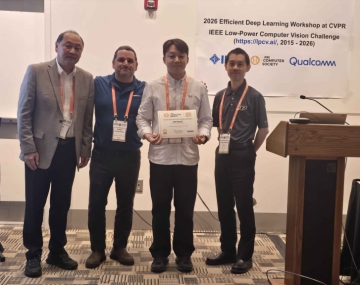
Researchers at the Korea Electronics Technology Institute (KETI) achieved first place in the AI-generated image detection category at the IEEE Low Power Computer Vision Challenge (LPCVC) held during the CVPR 2026 workshop in Denver, USA. The research team achieved not only image discrimination accuracy but also explainability and inference performance by optimizing a large vision-language model (VLM) to suit low-power edge device environments. This achievement is evaluated as confirming practical applicability in real industrial settings, as demand for detecting false images increases with the proliferation of generative AI.
2026.06.11by 배종인 기자











