


ams, Enhancing Humanoid Robot Sensing and Communication with Digital Photonics
 Published2026.08.27 16:06
이 센서는 카메라 대비 낮은 단가로 로봇 손의 여러 위치에 복수 배치가 가능하며, 팔다리와 주변 물체 사이의 거리를 실시간으로 측정해 물체 조작 안전성을 높인다고 전했다.

저항식·정전용량식·압전식 방식과 비교해 신뢰성이 높고 통합이 간단하며, 전자기 간섭(EMI)과 정전기 방전(ESD) 영향을 받지 않는다고 ams OSRAM은 설명했다.
구조광 이미터는 바닥 표면에 점 패턴을 투사해 미세한 굴곡을 감지하고, 이족 보행 로봇이 고르지 않은 지형에서 균형을 유지하도록 지원한다.
EVIYOS™ 플랫폼은 수천 개의 마이크로LED를 개별 제어해 문자·아이콘·이미지를 주변 표면에 투사하며, ALIYOS™ LED-on-foil 기술은 발광 소자를 로봇 표면에 직접 통합해 로봇 외피 자체가 발광체 역할을 하도록 구현할 수 있다고 밝혔다.
또한 OSP(Open System Protocol) 기반 LED 드라이버가 광학 신호 조정을 지원한다.

Comments
Related news

Infineon Acquires Ams OSRAM Sensor Business for €570 Million
Infineon Technologies strengthens its position in the global sensor market by acquiring the non-optical analog and mixed-signal sensor portfolio of ams OSRAM for a value of 570 million euros.
2026.02.04by 명세환 기자
ams OSRAM to Celebrate 120 Years of OSRAM Brand at 'Light + Building 2026'
ams OSRAM has announced an exhibition featuring the OSRAM brand's 120th anniversary as a major focus at 'Light + Building 2026'. The exhibition will be held from March 8-13, 2026 in Frankfurt am Main, Germany, with the booth located at Hall 8.0, D40. The company cited the OSRAM trademark registration in 1906 as the benchmark for the 120th anniversary, and announced it will showcase solutions for smart buildings and infrastructure that combine lighting and sensors.
2026.03.05by 명세환 기자
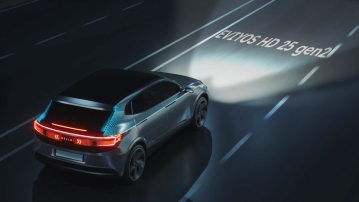
ams OSRAM lighting solutions applied to new Audi Q3 headlights
ams OSRAM's high-resolution pixel-based lighting solution EVIYOS HD25 has been applied to the digital matrix LED headlights of the new Audi Q3. With this implementation, lighting functions linked to driver assistance features such as lane guidance, directional guidance, blind spot warning, lane departure indication, and icing warning have been realized in compact-class vehicles. EVIYOS HD25 is based on more than 25,000 individually controlled pixels and adjusts the light distribution pattern according to vehicle motion, sensor input, and changes in the surrounding environment.
2026.06.01by 배종인 기자
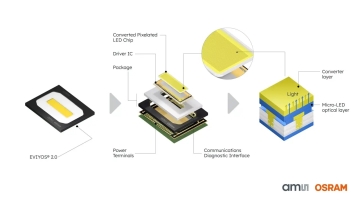
ams OSRAM Targets AI Data Center Optical Interconnects with Automotive MicroLED Technology
ams OSRAM is expanding its EVIYOS microLED technology, which has been applied to automotive headlamps, into the optical interconnect field for AI data centers. As generative AI proliferation drives a sharp increase in data transmission volumes and power consumption within data centers, the company has proposed a 'Slow-and-Wide' architecture leveraging hundreds to thousands of parallel microLED optical channels. The strategy aims to address the power, thermal, and EMI limitations of conventional copper-based interconnects and expand its footprint in the low-power, high-bandwidth data transmission solutions market for AI infrastructure.
2026.06.10by 명세환 기자

ams OSRAM Launches SFH 7019 Multi-chip LED Integrating Three Light Sources
ams OSRAM launched the multichip LED 'SFH 7019' on June 22, integrating three light sources—UV-A (383nm), green light (530nm), and infrared (980nm)—into a single 1.65×2.15×0.6mm package. In addition to heart rate measurement and PPG, it incorporates a light source for non-invasive assessment of advanced glycation end products (AGE) in tissue through skin autofluorescence. The dedicated photodiode SFH 2705U simultaneously detects autofluorescence and PPG signals, with individual chip control minimizing interference. The company targets this product for wearables, home care, and preventive healthcare applications for analyzing long-term physiological burden.
2026.06.22by 배종인 기자











