


KETI wins first place in IEEE JPEG Trust Challenge…invisible watermarking technology reaches world-class level
 Published2026.09.21 11:31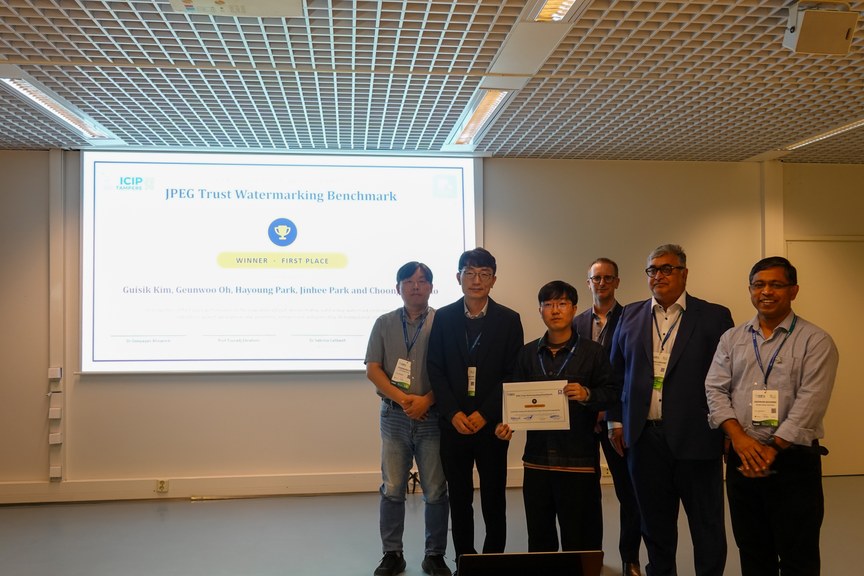
The competition was attended by companies and institutions from 12 countries including the United States, United Kingdom, Germany, and France. In the final round, the research team competed against Trufo, a U.S. startup specializing in content authenticity, and won first place.
Invisible watermarking is a security technology that embeds information in digital content such as images and video in a manner that is not visually discernible to the human eye.
The competition comprehensively evaluated whether watermarks could be stably detected under various conditions including compression, cropping, geometric transformation, signal processing, and transformation using generative AI, based on international standards (ISO/IEC 21,617).
Cho Chung-sang, principal researcher who led technology development, stated, "We will continuously advance our technological capabilities to respond to increasingly complex content transformation techniques."
Lee Young-han, director of the Composite Intelligence Research Center, said, "We will contribute to building a reliable media ecosystem by spreading the related technology to the industry and enhancing its sophistication."
This research was conducted through national research and development projects supported by the Institute for Information & Communications Technology Planning & Evaluation (IITP).

Comments
Related news
KETI Leads Development of International Standard for Automotive Thermal Imaging Camera Test Methods
Korea Electronics Technology Institute (KETI) is leading the development of the international standard ISO 26,284 on image quality testing methods for automotive thermal cameras. Targeting establishment by 2029, this standard specifies key performance indicators and test procedures for FIR thermal cameras used to detect vehicle surrounding environments, and will serve as a global benchmark for perception sensor reliability evaluation driven by autonomous vehicle proliferation. U.S. regulations mandating nighttime pedestrian detection and automatic braking will also be reflected.
2026.06.26by 배종인 기자
KETI Develops Nickel Porous Diffuser for Next-Generation Water Electrolysis
The Korea Electronics Technology Institute (KETI) has developed a next-generation nickel-based porous diffusion layer for water electrolysis with enhanced green hydrogen production efficiency. By optimizing pore size through powder sintering methods, the water electrolysis performance has been improved by up to 59% compared to conventional nickel foam, and large-area manufacturing technology exceeding 1,500cm² has been secured, reaching commercialization readiness.
2026.07.15by 배종인 기자
KETI Provides Remote Art Museum Experience to Pediatric Cancer Patients via Telepresence Robot
KETI completed a demonstration in which pediatric and adolescent cancer patients at hospitals remotely viewed exhibitions at Soma Art Museum using a robot-telepresence platform developed by KETI. This platform, which combines real-time video transmission, AI docent, and autonomous driving technology, enables patients to directly operate the robot and camera to appreciate exhibited artworks in detail. KETI plans to expand the application scope to include mobility-impaired individuals and students in rural and mountainous areas who face difficulties accessing cultural facilities.
2026.08.05by 배종인 기자
KETI, Establishing AI Transformation Hub for Southwestern Mobility Manufacturing
The Korea Electronics Technology Institute (KETI) Gwangju Regional Headquarters is jointly pursuing the construction of a humanoid demonstration center and autonomous driving perception component functional safety test center to spearhead AI transformation in the southwestern automotive and mobility industry. The institute is establishing a full-cycle support system ranging from deployment of specialized humanoids in assembly processes to international standard testing and certification of perception components such as LiDAR, cameras, and radars, thereby supporting on-site applications for regional OEMs and parts suppliers.
2026.08.14by 배종인 기자
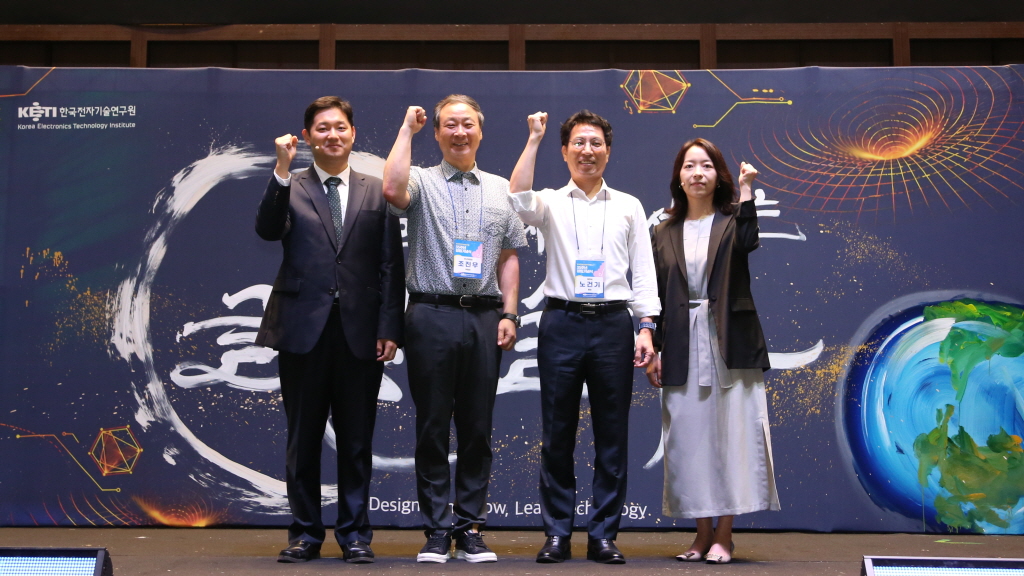
KETI Marks 35th Anniversary with New Vision as 'Global Technology Hub'
The Korea Electronics Technology Institute (KETI) has declared a new vision, "Design Tomorrow, Lead Technology," marking its 35th anniversary. In response to intensifying competition in AI technology hegemony and rapid changes in the industrial environment, the institute aims to make a leap forward as a global research institution by strengthening R&D strategy and domestic and international cooperation. The new vision, established based on a survey of all employees, will pursue innovative technology development and collaborative research based on the electronics and IT technology capabilities accumulated over 35 years.
2026.08.24by 배종인 기자











