



UNIST Develops Next-Generation EUV Photoresist Design Technology...Customizable Sensitivity and Precision Control
 Published2026.09.21 11:50
Establishing Foundation for Next-Generation Semiconductor Lithography Photoresist Development
UNIST researchers have developed design technology that enables the sensitivity and pattern precision of tin-based photoresists used in next-generation extreme ultraviolet (EUV) lithography processes to be controlled according to desired characteristics.
A research team led by Professor Jang Ji-hyun from the Department of Energy and Chemical Engineering at UNIST announced on the 21st that they have developed a technology to control the sensitivity and pattern precision of photoresists by adjusting the ligand characteristics of tin oxo clusters (SnOC).
Photoresist is a photosensitive material that reacts to light or electron beams during semiconductor lithography processes to form circuit patterns. In particular, tin-based photoresists are attracting attention as materials for next-generation semiconductor processes due to their high EUV absorption rate and excellent etch resistance.
The research team varied the bonding structure of tin atoms by applying adamantane-1-carboxylic acid, which has electron-donating characteristics, and diphenylphosphinic acid, which has electron-withdrawing characteristics, as ligands respectively.
As a result, '6-SnOC' employing adamantane-1-carboxylic acid formed a structure with six bonded tin atoms and exhibited high sensitivity. Implementation of fine patterns with a width of approximately 20 nanometers (nm) was possible with minimal electron beam exposure.
Conversely, '3-SnOC' employing diphenylphosphinic acid formed a structure with three bonded tin atoms and, while showing relatively low sensitivity, demonstrated more uniform pattern edges. Line edge roughness (LER) of 1.02nm was recorded for 50nm width patterns.
Through density functional theory (DFT) calculations and electron beam lithography analysis, the research team identified that the electronic characteristics of ligands determine the photosensitive reaction pathway.
The research results confirmed the possibility of applying the 6-SnOC series for processes requiring high sensitivity and the 3-SnOC series for processes where pattern precision is critical.
Professor Jang Ji-hyun stated, "This research clarifies that ligand characteristics are a key factor in determining sensitivity and pattern precision," and explained, "It could serve as a new standard for designing next-generation EUV photoresists."
This research was conducted with support from the National Research Foundation of Korea (NRF), UNIST research funds, and the InnoCORE project of the Ministry of Science and ICT (IITP). The research results have been published in the international academic journal Small.

Comments
Related news
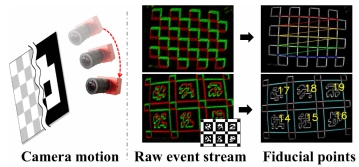
UNIST Develops Event Camera Correction Technology
UNIST research team has developed a technology to improve checkerboard calibration accuracy in event cameras. Event cameras excel in fast motion and low-light environments, but have had limitations in detecting checkerboard reference points. The research team proposed a method that first analyzes grid lines in event data and then calculates reference points in the regions where lines intersect. This research has been selected as a CVPR highlight paper.
2026.06.01by 명세환 기자
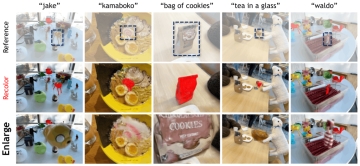
UNIST Develops AI Technology to Find Objects in 3D Space Using Natural Language
UNIST researchers have developed 'LightSplat', an AI technology that locates specific objects in three-dimensional space using natural language commands. This technology is characterized by increased processing speed and reduced memory consumption compared to existing open-vocabulary-based 3D spatial awareness techniques. The research results have been accepted at CVPR 2026, an international conference in the computer vision field.
2026.06.08by 명세환 기자
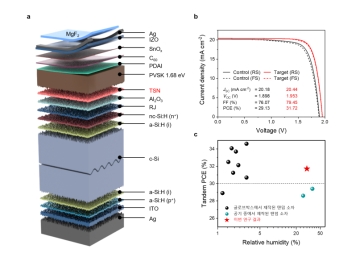
UNIST and KAUST Achieve 31% Efficiency in Atmospheric Process Tandem Battery
Researchers from UNIST Professors Sang-il Suk and Kyung-jin Choi's team and a joint research team with KAUST have developed an interfacial coating technology that enables high-efficiency perovskite-silicon tandem solar cells to be fabricated even in general atmospheric environments. The research team applied a three-component coating layer comprised of the conventional SAM interfacial material plus GDMA and AG, achieving an efficiency of 31.72% in cells manufactured in air. The certified efficiency was confirmed as 31.36%. This achievement is evaluated as a technology that reduces dependence on moisture and oxygen blocking equipment and increases the possibility of large-area production of next-generation tandem solar cells.
2026.06.11by 배종인 기자

UNIST Develops Memristor Semiconductors for 6G and Satellite Communications
Researchers at Ulsan National Institute of Science and Technology (UNIST) have developed a semiconductor device capable of reducing power consumption in 6G and satellite communication environments. The structure enables simultaneous high-frequency communication and signal computation, presenting possibilities for improving communication chip design efficiency.
2026.06.22by 배종인 기자

UNIST Identifies Principles of Multimodal AI Performance Improvement… Paper Accepted for ICML 2026
UNIST (Ulsan National Institute of Science and Technology) announced on the 26th that Professor Yoon Sung-hwan's research team has elucidated the principles of performance improvement in multimodal AI from the perspective of 'loss landscape.' The research has been accepted to the International Conference on Machine Learning (ICML 2026).
2026.06.29by 배종인 기자











