


[Technical Contribution] ADI, "Extension of Portable Device Battery Life Depends on Power Management Optimization"
 Published2026.10.02 14:01
Highly Integrated PMIC Reduces Component Count, Redundant Circuits, and Quiescent Current
Dynamic Voltage Scaling and Low-Noise Power Supply Design Must be Implemented Together
This article describes several important factors that affect overall efficiency in low-power portable electronic equipment. Some factors, such as overall power supply efficiency, are well-known, but other factors, such as the widespread adoption of fast dynamic voltage scaling (DVS), are relatively less considered.
■ Power Supplies Must Provide High Voltage Conversion Efficiency
Many electrical circuits must be as energy efficient as possible. This is especially true in applications where low power consumption is critical, such as environments with limited heat dissipation, limited available power sources, and above all, when the device operates on battery power. In addition to designing the entire circuit for energy efficiency, the power supply itself is also very important. The power supply must provide the highest possible voltage conversion efficiency. The factors that can be adjusted to improve power supply efficiency vary from application to application. We will now examine this in detail.
Figure 1 shows a wearable sensor system, a typical application that can be worn on the body. This system is a battery-powered small platform for performing various measurement functions in the medical technology field, such as blood oxygen content, pulse rate, respiration rate, impedance electrocardiography, bioelectric impedance analysis, and skin temperature.
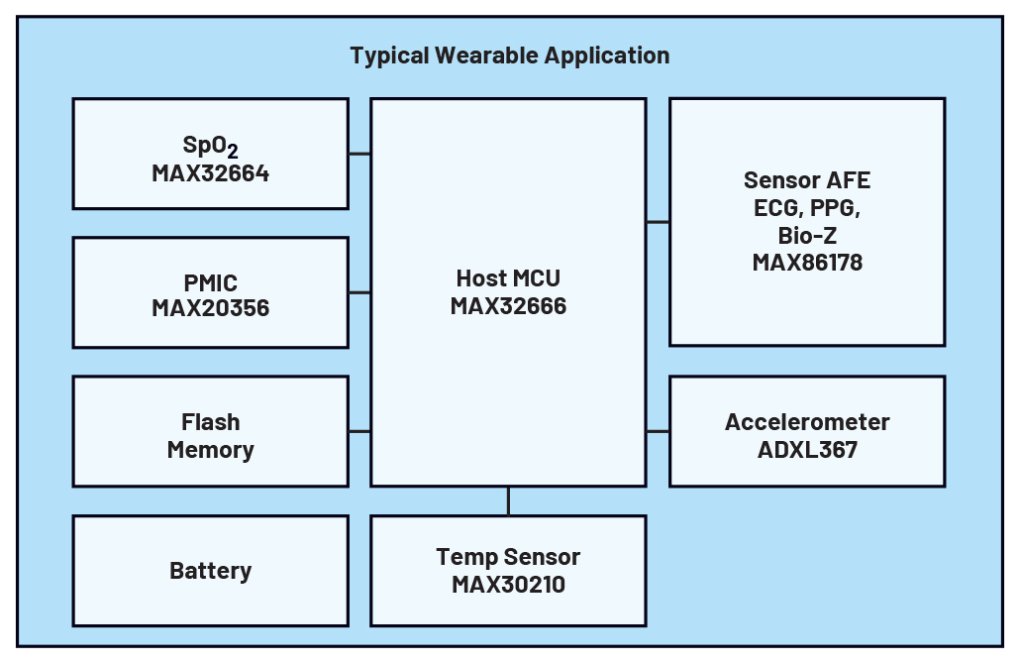
To select the smallest possible battery for this application, the device must have very high energy efficiency. There are several ways to optimize the power supply.
■ High Integration Level
A high level of integration not only makes efficient use of limited space but also helps improve power supply efficiency. Figure 2 shows the block diagram of MAX20356, a power management IC (PMIC). The MAX20356 includes one battery charging controller, three switch-mode buck power supplies, four linear regulators, one switch-mode buck-boost converter, one fuel gauge for measuring the current state of battery charge, and extensive monitoring functions and power flow switching circuits.
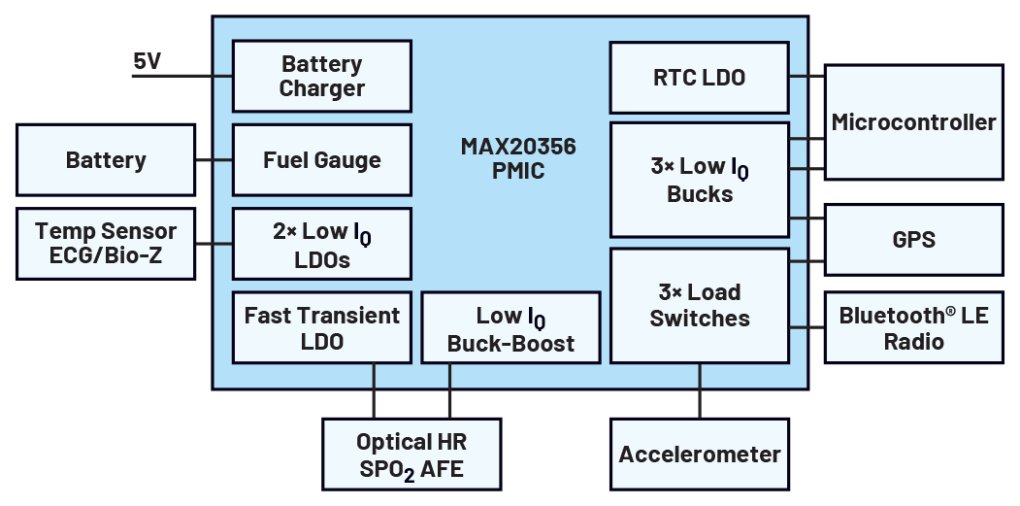
These various functions can also be implemented using separate discrete integrated circuits. However, this approach significantly increases quiescent current, the current consumed by the circuit even when idle. This is because in a highly integrated design, only one instance of many essential support functions, such as the reference voltage that regulates the PMIC's output voltage, is needed and can be shared by all circuit blocks. In contrast, in designs using discrete components, these functions must be implemented redundantly in each circuit, resulting in increased power consumption.
■ Efficient Voltage Conversion
Of course, voltage conversion must be performed as efficiently as possible. This is optimized by the following adjustment factors commonly used in voltage converters. These include optimized selection of switching frequency, optimization of passive components such as inductors and capacitors, use of various operating modes such as pulse skipping or burst mode in low load ranges, and optimization of dead time of MOSFETs switched within the power stage of the voltage converter.
■ Low Quiescent Current / Self-Consumption Current
In addition to conversion efficiency, the current consumption of the PMIC itself, that is, the required quiescent current, must also be very low. Modern semiconductor processes and optimized circuit design help reduce self-consumption current. Also important is the current flowing through various resistive dividers in the circuit. Higher resistance values result in lower bias currents. However, in this case, the circuit impedance increases, making it easier for interference signals to couple. Therefore, designs that increase impedance should only be implemented after sufficient evaluation.
■ Rapid Adjustment of Processor Supply Voltage
One way to reduce energy consumption in systems like Figure 1 is to use dynamic voltage scaling (DVS). A microcontroller (MCU) requires a higher supply voltage when high computational performance is needed, but a lower supply voltage is sufficient for low computational performance or standby states. By continuously adjusting the voltage generated by the DC-DC converter to meet these requirements, power loss can be significantly reduced depending on the operating state of the system. DVS is not a new technology. However, recently, adjusting voltage very rapidly to meet required levels has become increasingly important. By adjusting voltage rapidly according to specific applications, system efficiency can be significantly improved.
■ Low Power Supply Noise
Finally, the relationship between energy efficiency and noise generated from the power supply is also important. When a sensor is powered through a voltage converter, certain noise components such as voltage ripple are also transferred from the power supply to the sensor. Some sensors can tolerate larger voltage ripple and interference at various frequencies when they can use higher current. However, when the current flowing to the sensor is lower, the interference on the power line must be very low to obtain sensor data of the same quality. Therefore, in some applications, there is a direct correlation between the purity of the supply voltage and system power consumption.
■ Energy-Efficient System Development Requires High Power Supply Efficiency
All these methods help extend the operating time of portable devices or make the batteries used as small as possible. Power supply efficiency is very important when developing energy-efficient systems. However, there are various factors in power supply efficiency that can be adjusted. It is necessary to design with consideration for the fact that some of these factors are closely related to various components that make up the system.
※ Author Introduction
Frederik Dostal is a power management expert with over 20 years of experience. After studying microelectronics at the University of Erlangen in Germany, he joined National Semiconductor in 2001 and worked as a field applications engineer, gaining experience implementing power management solutions in customer projects. During his time at NS, he worked for 4 years in Phoenix, Arizona, as an applications engineer responsible for switch-mode power supplies (SMPS). Since joining Analog Devices in 2009, he has played various roles including product lines and European technical support, and currently works as a power management expert based on extensive design and application experience. He currently works at Analog Devices' Munich office.
Comments
Related news
.jpg)
[Technical Contribution] ADI's Frederic Dostal: Why Smaller is Better
We heard from Frederick Dostal of Analog Devices (ADI) about the advantages of integrated inductor power modules.
2023.05.22by 명세환 기자
.jpg)
ADI Frederik Dostal, “Power Management Development Toolchain, Architecture Optimization Most Important”
We spoke with Frederick Dostal from Analog Devices (ADI) about the toolchain for developing power management systems.
2024.12.06by 배종인 기자
ADI Frederik Dostal, “Digital-enabled linear regulators, all functions integrated into one IC”
With new digital LDOs like the LT3074, all functions can be integrated into a single IC, as Frederick Dostal of Analog Devices (ADI) discusses a new approach to linear regulators that support digital interfaces.
2025.05.13by 명세환 기자
[Technical Contribution] ADI's Frederik Dostal: "Buck-boost voltage conversion topology combined with ADI's Silent Switcher technology achieves exceptional EMI/EMC performance."
We spoke with Frederik Dostal of Analog Devices, Inc. about buck-boost voltage conversion technology with excellent EMI/EMC performance.
2025.09.11by 배종인 기자
[Technical Contribution] ADI: "Multiphase Flyback Converter Delivers Over 60W of Power"
Frederik Dostal, a power management expert at Analog Devices, Inc., discusses the design of flyback converters for high-power applications.
2025.10.13by 명세환 기자











