This page was machine-translated and may differ from the original. View original
Samsung Electronics Develops Technology to Achieve Twice the Energy Density of Commercial Lithium-Ion Batteries

◇ Published online in the scientific journal 'Nature Communications' on the 25th
◇ First proposal of technology to grow high-crystallinity graphene on a silicon anode
◇ Expectations of accelerated expansion in the mobile device and electric vehicle markets
Samsung Electronics Advanced Institute of Technology has developed a high-crystallinity graphene-coated silicon anode material technology capable of achieving nearly twice the energy density of commercial lithium-ion batteries.
Research results related to this were published online on the 25th in the scientific journal Nature Communications under the title "Realization of high-capacity lithium-ion battery using SiC-free (Silicon carbide-free) graphene direct-growth silicon anode material."
Since lithium-ion batteries were first commercialized in 1991, development has focused on improving capacity through battery structure optimization due to limitations in anode or cathode materials.
As a result, capacity development only reached the level of twofold, which limited the development of high-capacity, high-density batteries in response to the full-scale growth of the mobile device and electric vehicle markets.

Recently, the development of high-capacity battery materials capable of fundamentally innovating capacity is accelerating. In particular, while research on silicon is actively underway as a candidate material capable of increasing capacity by more than 10 times compared to graphite, the existing cathode material, there was a technical challenge in that the lifespan of the battery rapidly deteriorated as charging and discharging were repeated.
Samsung Electronics Advanced Institute of Technology has developed a high-capacity, high-durability cathode material capable of solving this problem.
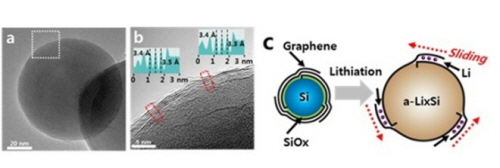
The research team synthesized a material with a structure having a graphene layer that prevents structural collapse due to volume expansion during charging and discharging by growing graphene with high physical strength and conductivity on a silicon surface for the first time in the world.
In particular, for the first time in the world, a mechanism was identified in which a graphene protective layer slides to improve durability when the volume expands.
This material has four times the capacity of graphite, and when applied to commercial lithium-ion batteries, it can achieve nearly twice the energy density.
A total of five patent applications for related technologies have been filed in the United States, Europe, China, Korea, and other countries.
“This study is the result of significantly improving the performance of lithium-ion battery materials by applying a novel synthesis method of highly crystalline graphene to a high-capacity silicon anode,” said Inhyeok Son, a principal researcher at Samsung Electronics’ Advanced Institute of Technology and the first author of the paper. “We will continue to innovate secondary battery technology to keep pace with the expansion of the mobile device and electric vehicle markets.”
Samsung Electronics Advanced Institute of Technology has also developed a technology capable of controlling phonon characteristics within graphene at the nanometer scale.
This was published online in Nature Communications on the 25th under the title 'Control of graphene phonons at the nanometer scale'.
argonThey succeeded in realizing a pure graphene state at the nanometer scale by colliding ions with graphene to widen the gap between the graphene and the substrate.
This study, which for the first time presented a method to generate pure graphene regions with minimal interaction with the substrate at a nanometer size—one-tenth the size of semiconductor linewidths—has laid the foundation for the design and analysis of future high-density semiconductor devices utilizing graphene through the measurement of local phonon characteristics.
본 기사에 대한 정정·반론·추후보도 청구는 보도 청구 안내를, 그간 게재된 보도문은 정정·반론보도 모아보기를 참고해 주세요.