o QuickLogic's proprietary multicore sensor processing SoC providing industry-leading low-power characteristics and computational capabilities in a hierarchical structure
o Achieves 80% better computational performance than typical ARM M4F-based microcontroller sensor hub solutions with lower power consumption
o Power always-on voice applications with less than 350µA of power using a dedicated voice processing architecture
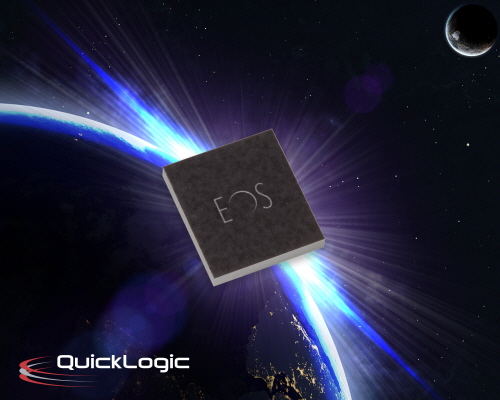
August 6, 2015 – Quicklogic Corporation, an innovator in ultra-low power programmable sensor processing solutions, announced the development of the new EOS™ S3 sensor processing system. The EOS platform features the industry's latest performance and is designed to run computationally intensive sensor applications with less power than competing technologies.
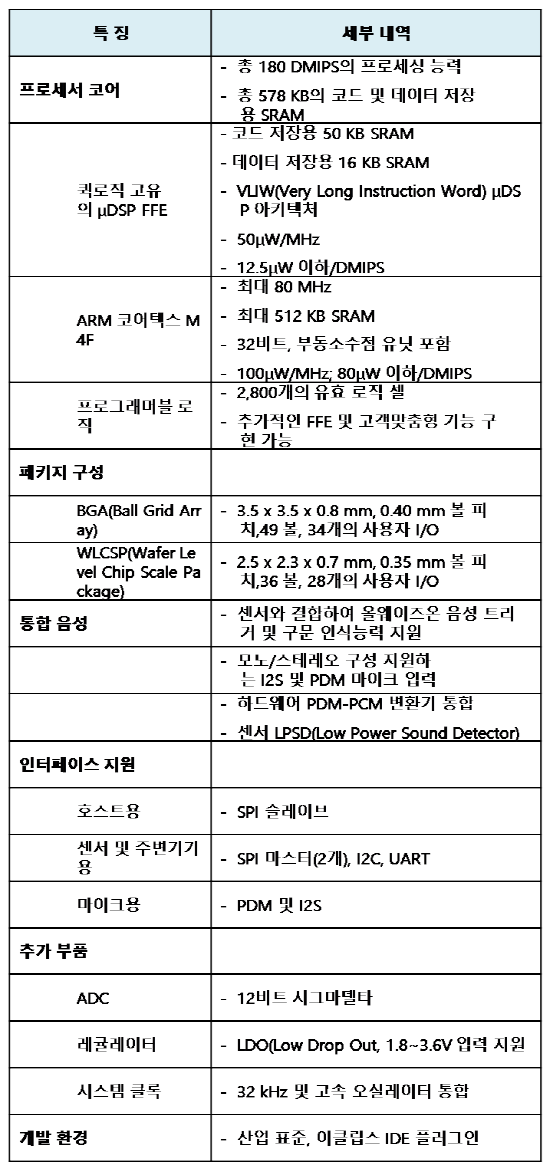
The EOS platform is a multi-core SoC with three dedicated processing engines. These include QuickLogic's patent-pending µDSP-like Flexible Fusion Engine (FFE), an ARM Cortex M4F microcontroller, and a front-end sensor manager. The FFE and sensor manager handle large-scale algorithm processing to minimize the duty cycle for the floating-point microcontroller. Because this method can significantly reduce overall power consumption, designers of mobile, wearable, and IoT devices can utilize this technology to introduce next-generation sensor-centric applications such as pedestrian dead reckoning (PDR), indoor navigation, motion-compensated heart rate measurement, and other modern bio applications within a given power budget.
The EOS platform includes a more powerful subsystem specifically designed for always-on voice listening applications. Through a dedicated Pulse Width Modulation (PDM) to Pulse Code Modulation (PCM) conversion block and Sensory™'s Low Power Sound Detector (LPSD) technology, the EOS system enables always-on voice triggering and recognition with power consumption of less than 350µA, which is significantly lower than that of existing microcontroller-based solutions.
The EOS platform provides 2,800 effective logic cells that can be reprogrammed within the system for use in additional FFE or customer-customized hardware differentiation features. Currently, the EOS platform is the only product on the market that offers hardware, software, computational performance, and microampere-level low-power operation characteristics.
The EOS SoC is designed to maximize the utilization of QuickLogic's vast SenseMe™ algorithm library. The EOS S3 platform and the SenseMe library are compatible with various Real-Time Operating Systems (RTOS) in addition to Android Lollipop. Because this platform can be used regardless of sensors or algorithms, algorithms developed by third parties or customers can be supported through QuickLogic's industry-standard Eclipse Integrated Development Environment (IDE) plugin. The IDE is designed to enable the rapid porting of existing code to both the EOS S3 platform's FFE and ARM M4F microcontrollers by providing a multi-functional debugging environment along with optimized and verified code generation tools.
According to research released by IHS iSupplies, the Total Available Market (TAM) for sensor processing solutions in smartphones, tablets, and wearable applications is expected to reach approximately 2 billion units in 2019.
“The annual market for embedded processors acting as sensor hubs in terminals, tablets, and wearable health and fitness devices is expected to surpass 2 billion units in 2019,” said Tom Hackenberg, Senior Analyst at IHS Technology. “As the market shifts from simple products like pedometers to high-end, multi-purpose devices featuring always-on functionality, the use of sensors in each product is increasing, leading to parallel growth. Providing these demanding features without impacting battery life is becoming a key success factor for these latest devices.” “Power-efficient sensor hubs like QuickLogic’s EOS platform enable device designers to more easily and quickly incorporate various modern features without increasing power consumption,” he said.
The main applications are as follows, but it can be utilized in many other places as well.
· Always-on, continuous listening voice recognition and triggering
· Pedometer, Pedestrian Dead Redemption (PDR), and Indoor Navigation
· Sports and activity monitoring
· Bio and Environmental Sensor Applications
· Sensor fusion including gesture and context awareness
· Augmented Reality
· Gaming
Brian Faith, Vice President of Global Sales and Marketing at QuickLogic, emphasized, “QuickLogic’s revolutionary EOS platform enables OEMs to introduce a new dimension of advanced applications that were previously impossible to implement under the battery life conditions of today’s mobile devices,” adding, “The EOS platform establishes a new standard for multi-core sensor processing. No solution currently on the market offers this combination of flexibility, computational bandwidth, and ultra-low power characteristics.”
Supply Status
Samples of the EOS sensor processing platform are scheduled to begin in September 2015. For more information, please refer to www.quicklogic.com/EOS.



 Published2015.08.06 20:38