


I looked into where the Ministry of Science, ICT and Future Planning's budget for next year is being spent, and...
 Published2015.09.11 18:07
The Ministry of Science, ICT and Future Planning's budget proposal is set at 14.3 trillion won, focusing on the creation of new future industries.
The Ministry of Science, ICT and Future Planning (Minister Choi Yang-hee) announced that the government's research and development (R&D) budget for 2016 has been set at 18 trillion 936.3 billion won, an increase of 46.3 billion won (0.2%) from this year (18 trillion 890 billion won).
The policy for next year's research and development (R&D) budget is to prioritize and focus support on creating future growth engines for dynamic economic innovation.
Expansion of R&D in 5G mobile communications, smart automobiles, and new energy industries
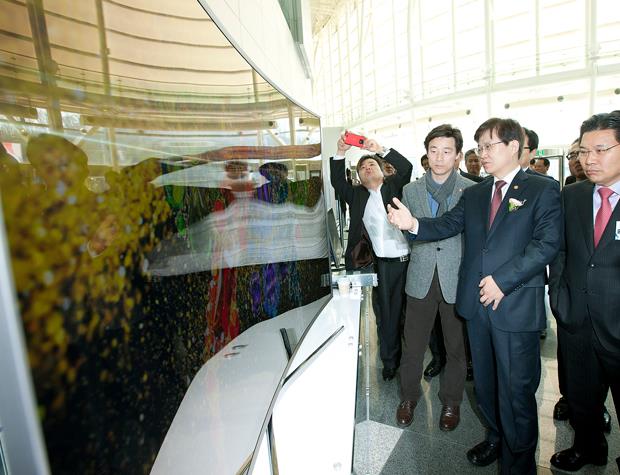 We will expand R&D investment to create new energy industries, including future growth engines such as 5G mobile communications and smart automobiles, which have a high potential for early commercialization. We will also increase the scale of investment and the number of beneficiary companies so that small and medium-sized enterprises can become the leading players in a dynamic innovation economy. In particular, we plan to strengthen strategic investments in the cultural service industry, which is emerging as a new growth engine, and in promising bio sectors.
Specifically, 69.9 billion won was allocated in 2016 to build the pan-governmental Giga Korea, an increase of 70.5% compared to this year. In addition, the proportion of investment in small and medium-sized enterprises will be expanded to 18% next year, and 47.7 billion won will be spent on cultural technology research and development (Ministry of Culture, Sports and Tourism), an increase of 12.4%.
We plan to expand investment in basic research to create future knowledge and secure core technologies, and to support the stable establishment of infrastructure such as the Science Belt and the timely implementation of large-scale space projects. We will also strengthen investment in core defense technologies, disaster relief including infectious diseases, and safety-related fields. Perhaps due to the aftermath of MERS, which caused a shock this year , 41 billion won has been allocated to the development of crisis response technologies for infectious disease management (Ministry of Health and Welfare), an increase of 33.1%.
Last March, the Ministry of Science, ICT and Future Planning [at] Pangyo Techno Valley, Bundang-gu, Seongnam-si, Gyeonggi-do
A scene of the 'K-ICT Strategy Presentation for the Realization of the Creative Economy' being held at the R&D Center.
An official from the Ministry of Science, ICT and Future Planning stated, "During the deliberation by the National Science and Technology Council, the budget for major inter-ministerial research and development was reduced by 2.3% compared to the previous year. Compared to other sectors such as SOC, the R&D sector maintained the previous year's level in order to promote dynamic economic innovation, despite difficult economic conditions."
Ministry of Science, ICT and Future Planning budget reduced compared to last year
The Ministry of Science, ICT and Future Planning's budget proposal for 2016 was set at 14 trillion 331.2 billion won, a decrease of 7.1 billion won from this year (14 trillion 338.3 billion won).
The Ministry of Science, ICT and Future Planning's R&D budget is 6.4999 trillion won, a decrease of 13.9 billion won from this year (6.5138 trillion won), which is 34% of the total government R&D (18.9363 trillion won).
The Ministry of Science, ICT and Future Planning stated that the reason for the budget reduction was "a slight decrease due to the large scale of projects ending this year (a total of 12 projects worth 180.7 billion won) and the alignment with the fiscal year."
The Ministry of Science, ICT and Future Planning plans to continue expanding investment in key areas, such as revitalizing global regional innovation ecosystems to realize a dynamic creative economy, strengthening future readiness based on science and technology including basic and fundamental research and space development, and improving the fundamental structure and revitalizing the ICT industry through K-ICT.
I hear they are focusing on creating global innovation clusters to foster star ventures...
Accordingly, next year, key new projects will be significantly expanded, including the creation of a global innovation ecosystem (14 billion KRW), Korean-style I-Corps (3.7 billion KRW), lunar exploration (10 billion KRW), unmanned vehicles (6 billion KRW), establishment of an IoT demonstration complex (3.5 billion KRW), foundation building for revitalizing the fintech industry (3 billion KRW), and training of leading personnel for new regional industries (10 billion KRW).
"width: 500px; height: 589px;" />
▲ Major New Projects of the Ministry of Science, ICT and Future Planning for 2016 (Unit: 100 million KRW)
First, regarding the creation of a global innovation ecosystem, in order to spread the creative economy nationwide and accelerate the creation of tangible results, we plan to strengthen the support for idea and technology commercialization and startup hub functions of the 17 regional Creative Economy Innovation Centers, and develop the Pangyo Creative Economy Valley, scheduled to begin construction at the end of this year, into a global innovation cluster where promising ICT startups, high-tech ventures, and investors from Asia and around the world will gather.
We will expand support for the commercialization of ideas and technologies. To support the commercialization of creative ideas from the public and excellent public research results, we will lead the creation of startups based on outstanding ideas through initiatives such as the 6-Month Challenge Platform, and actively support the establishment of a virtuous cycle ecosystem for venture capital through partnerships with private accelerators. We also plan to establish a new Korean-style I-Corps program to encourage technology commercialization and startup exploration among highly skilled personnel holding master's and doctoral degrees.
To prepare for a science and technology-based future, we will continuously expand investment for the creation of new creative knowledge and the early industrialization of promising future fields. Support for individual research for next year has been set at 607.5 billion won, an increase of 20 billion won (3.4%) from this year, and support for group research has been set at 158.2 billion won, an increase of 9.3 billion won (6.3%) from this year. In the field of fundamental research, we plan to launch new developments in unmanned vehicle technologies, such as drones, to expand investment in the development of core source technologies for securing new global markets and to actively respond to future trends.
Next year, the development of space nuclear power is expected to be revitalized, with the full-scale implementation of the lunar exploration project (10 billion won reflected in the government's proposal) and the joint development of advanced domestic small and medium-sized reactors (SMART).
Investing 3 billion won to lay the foundation for revitalizing the fintech industry
In order to concretely realize the "K-ICT Strategy" established last March, a significant investment in the budget is notable, including the launch of the discovery and demonstration of new growth engines (39.1 billion won) through the convergence of advanced ICT technologies such as IoT, big data, and cloud with other fields such as medical, financial, transportation, and urban sectors, as well as the acceleration of the pan-governmental Giga Korea project for the world's first demonstration of 5G technology and the timely implementation of the fast and convenient PyeongChang K-ICT Winter Olympics.
In order to establish a foundation for the sustainable development of software and digital content, which are the core basis of IT advancement, we will strengthen support for elementary and secondary software education in cooperation with the Ministry of Education, including expanding the operation of SW Education Leading Schools and SW Meister High Schools. Additionally, we will support innovation in university software education that reflects the demands of the industrial field by integrating existing small-scale and fragmented support programs into SW-focused universities.
In addition, the budget was increased to strengthen the functions of KIC and overseas IT support centers to support the global expansion and overseas startups of small and medium-sized enterprises and venture companies, and to respond promptly to the demand for continuous new market development and overseas expansion projects.
Min Won-ki, Head of Planning and Coordination at the Ministry of Science, ICT and Future Planning, explained, “As we enter the fourth year since the launch of the Ministry, we plan to focus our investments on accelerating the creation of tangible results for the creative economy, preparing for the future through science and technology and ICT, and building a foundation for creating new industries.”
관련뉴스
Nvidia invests $5 billion in Intel
글로벌 AI 컴퓨팅 기술을 선도하는 엔비디아(NVIDIA)와 인텔(Intel)이 NV링크 기반 아키텍처 통합으로 최첨단 솔루션 제공에 본격 나선다. 엔비디아와 인텔은 전략적 협력을 공식 발표하고, 하이퍼스케일부터 엔터프라이즈, 소비자 시장까지 다양한 애플리케이션과 워크로드를 가속화하기 위한 맞춤형 데이터센터 및 개인용 컴퓨팅 제품을 공동 개발하며, 차세대 컴퓨팅 시대의 기반을 마련한다고 밝혔다.
2025.09.22by 배종인 기자
.jpg)
Applied Materials Launches Environmental Protection Campaign to Mark World Cleanup Day
어플라이드 머티어리얼즈 코리아(대표 박광선)가 ‘세계 청소의 날(World Cleanup Day)’을 맞아 동탄 신리천 일대에서 임직원 및 가족과 함께 환경 정화 활동을 펼치며, 기술 혁신을 넘어 지역사회와 함께하는 기업으로 거듭나고 있다.
2025.09.22by 명세환 기자
.jpg)
The combination of electrical and electronic technologies like AI, semiconductors, and electric vehicles with renewable energy will determine industrial competitiveness.
Professor Lim Chun-taek from Gwangju Institute of Science and Technology (GIST) stated in his keynote speech at the '2025 e4ds Tech Day' on the 9th, "Global energy investment is already shifting from fossil fuels to renewable energy, and the trend of electrification combined with electrical and electronic technologies is changing the industrial landscape."
2025.09.12by 배종인 기자
.jpg)
"Data Center Power Demand Surges: Distributed Energy is the Solution"
인공지능(AI), 클라우드, 전기차 산업의 급속한 성장과 함께 데이터센터의 전력 수요가 폭증하고 있다. 특히 미국을 중심으로 한 글로벌 전력 수급 구조는 이 변화에 적응하기 위해 대대적인 인프라 재편에 나서고 있으며, 한국 역시 이 흐름에서 예외는 아니다. 기존 중앙집중형 전력 시스템의 한계를 넘어서기 위한 대안으로, 분산형 에너지 시스템과 스마트그리드 기술이 주목받고 있다.
2025.09.02by 배종인 기자
Huawei Begins Full-Scale Training of Young Korean Global ICT Leaders
글로벌 ICT 기업 화웨이코리아가 동국대학교, 이화여자대학교, 한양대학교와 업무협약(MOU)을 체결하고, 차세대 ICT 리더 양성을 위한 글로벌 교육 프로그램을 공동 추진한다.
2025.08.29by 배종인 기자











