


The car's hidden 'eyes' protect you
 Published2015.09.15 09:43
On the path toward autonomous vehicles, the ultimate goal of future automobiles, camera sensor-based Surround View has emerged as a hot topic.
On the path to autonomous vehicles, a German automotive parts company has already showcased a system where a driver selects a parking space using a touchscreen, gets out of the vehicle, and automatically parks using a smartphone app. This service was made possible by the ever-evolving surround view systems.
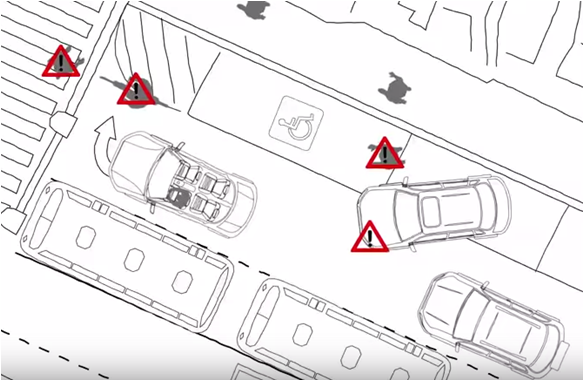 With increasing interest in ADAS (Advanced Driver Assistance Systems) that promote driver convenience and safety, surround view systems that support features such as parking assistance and blind spot detection are also gaining popularity.
Accordingly, technology development aimed at improving the accuracy and efficiency of surround view systems is in full swing. Maxim Integrated's attempt to reduce the overall system cost and design time at the semiconductor level of the surround view system is very impressive.
Replacing 5 parts significantly reduces costs and design time
Maxim announced last July the release of the MAX9286 GMSL (gigabit multimedia serial link) 4-channel deserializer. The 4-channel deserializer is attracting attention for its significance in that it reduces the number of components, thereby saving system design costs and time.
Then, how does a 4-channel deserializer reduce the number of system components and design time? Since the surround view system must process signals from a total of four or more cameras simultaneously, it is structured such that a serializer and a deserializer are connected for each camera, and the FPGA receives and processes each of these signals before transmitting them to the application processor.
However, Maxim's 4-channel deserializer not only integrates four deserializers into one but also eliminates the need for a separate FPGA.
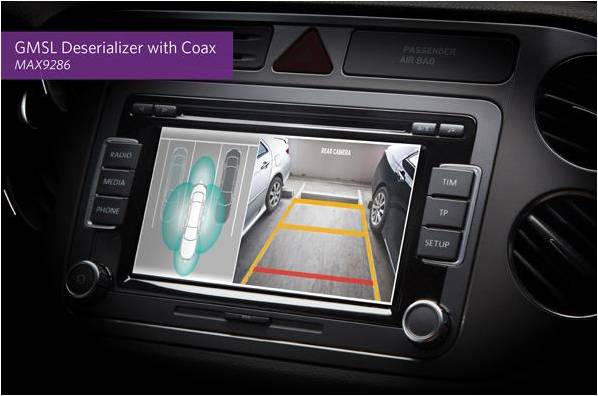
Designed to receive and automatically synchronize video generated by up to four cameras with a single device, the MAX9286 receives and synchronizes video streams from up to four cameras via Shielded Twisted-Pair (STP) or coaxial cable up to 15m long.
The company stated that this solution can be applied not only to surround view systems but also to machine vision and 3D camera systems. Choi Young-kyun, Director of Maxim Integrated Korea, said, "Existing surround view systems were composed of very complex structures using multiple chips. Maxim leveraged the advantages of integration to consolidate them into a single chip, making the system design very simple and lightweight."
As ADAS technology is increasingly applied to automobiles, the related market is also expected to grow rapidly. According to the "Research Results on the Global Market for Core Devices/Components for ADAS" report by market research firm Yano Economic Research Institute, the market for ADAS components was estimated at approximately 2.3625 trillion won last year, an increase of 40.5%. This market is projected to grow to approximately 8.1218 trillion won by 2020, showing an average annual growth rate of 25.2%.

관련뉴스
A single misaligned light means 'defect'… Vehicle interior lighting now guarded by semiconductors and software
자동차 실내조명이 '보조 조명'의 자리를 벗어나고 있다. 색상과 애니메이션으로 브랜드 아이덴티티를 드러내고 운전자 취향을 담아내는 사용자 경험(UX)의 핵심 요소로 올라서면서, LED 실내 앰비언트 시장도 빠르게 커지는 중이다. 이에 관하여 '미래 자동차를 밝히는 지능형 LED 실내 조명 솔루션' 이라는 내용으로 기술 웨비나 세션을 발표하는 최영재 다보코퍼레이션 연구위원을 앞서 만나, 시장의 온도와 설계 요구의 변화를 들었다.
2026.08.28by 명세환 기자
TI, HEV·EV 트랙션 인버터용 다축 코어리스 전류 센서 TMCS2100-Q1 공개
Texas Instruments가 HEV·EV 트랙션 인버터용 다축 코어리스 홀 효과 전류 센서 TMCS2100-Q1을 공개했다. 수평·수직 자기장을 동시에 측정하는 다축 센싱 기술로 기존 단일 축 센서 대비 최대 20배 높은 정확도를 달성하며, 버스바 무개조 설계로 기계 설계 유연성을 확보했다. 800V 아키텍처 확산에 따른 고정확도 요구 충족과 소형화를 동시에 구현한다.
2026.08.27by 배종인 기자
Vector Korea Launches New Version of 'CANoe' with AI Agent and MCP
Vector Korea has released a new version of CANoe 20 SP2 equipped with an AI agent and MCP. With a single natural language prompt, it automates the entire process from CAPL test code generation to execution and error correction, completing tasks that previously took several hours to days in just minutes. The Vector-RAG technology suppresses LLM hallucination phenomena, and it is compatible with existing LLMs such as GitHub Copilot and Claude, provided free of charge on CANoe 20 SP2 and higher versions.
2026.08.27by 배종인 기자
자동차연구원, ‘2026 자율주행모빌리티산업전’ 참가
한국자동차연구원이 2026 자율주행모빌리티산업전에 참가해 AI 기반 자율주행, 고성능 컴퓨팅, 시스템 안전·보안 기술 연구 성과를 공개한다. 산학연 협력을 통해 자율주행 기술을 고도화하고 우주모빌리티 분야로 연구 영역을 확장 중이다.
2026.08.25by 배종인 기자
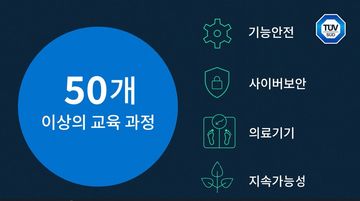
TUV SUD, 자동차 AI 안전·CBAM·방폭 등 5개 전문교육 확대
TUV SUD가 자동차 AI 안전, 탄소국경조정제도(CBAM), 생성형 AI, 품질경영, 국제 방폭 등 5개 분야 전문교육을 9~11월 순차 개설한다. ISO/PAS 8800 기반 자동차 AI 안전성 확보 과정, CBAM 실무 과정, IECEx CoPC 국제 방폭 인증 자격 교육 등이 최신 국제표준과 산업 현장 사례를 반영한 실무 중심으로 구성된다.
2026.08.24by 명세환 기자











