



Engineers' Design Concerns: Which Power Devices Will Solve Them?
 Published2015.09.22 09:49
-Integrating peripheral components with an inductor-integrated power module kills two birds with one stone.
Shin**: With my experience developing DC power supplies during optical fiber development, I believe this will be a valuable piece of test equipment, as there are many situations where compact, efficient components are needed. I hope it will be applied to control and drive devices.
Kim**: It seems like a good solution because it has a built-in inductor and can implement step-down with minimal components.
Lee**: Since it has a built-in inductor, we expect space savings, cost reduction, and reduced pumping noise.
Kim**: It seems like the DC/DC efficiency issues and noise issues caused by inductors will be resolved~~
Seo**: It's interesting that the inductor is built-in. It seems like only the maximum output current is indicated, but I'd like to know the minimum current.
Kim**: I'm looking forward to seeing the potential of this high-voltage DC-DC converter module with integrated inductors. I believe it offers clear advantages over existing DC-DC converters.
Park**: It looks good that the product is modular. The inductor design was difficult, but it seems easy to use because it is built-in.
What is the biggest concern engineers have when designing power supplies?
Comments from Maxim Integrated's recent DC-DC step-down power module event offer a glimpse into the concerns of current engineers. This is because it fully captures the power design challenges experienced by the engineers who participated in the event.
Through the event, engineers expressed their sympathy for the challenges of power design, including the difficulty of designing peripheral components that must be configured with DC-DC, issues with device size, stable output and heat generation, reliability, and selection of power devices that can be applied to various applications.
In particular, engineers who have expressed many concerns about the design of inductors, one of the most basic components of the power supply, have shown deep interest in Maxim's DC-DC step-down power module (MAXM17545).
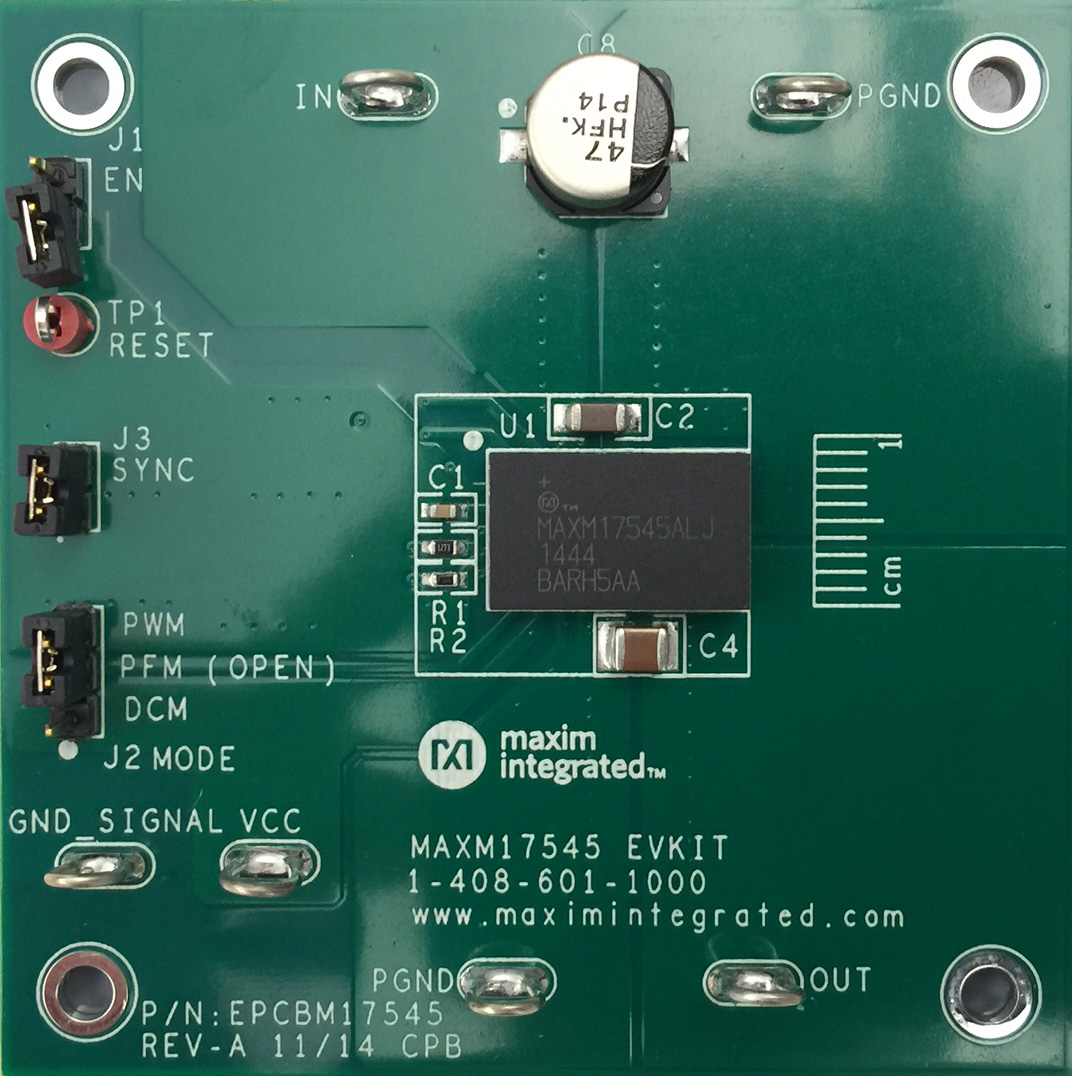 Maxim's DC-DC step-down power module products are notable for integrating peripheral components, including inductors, to reduce component size while also improving efficiency.
Maxim Integrated's Ryu Je-pil, a senior manager, emphasized that using the MAXM17545 power module is "a way to minimize external components and achieve high-efficiency power."
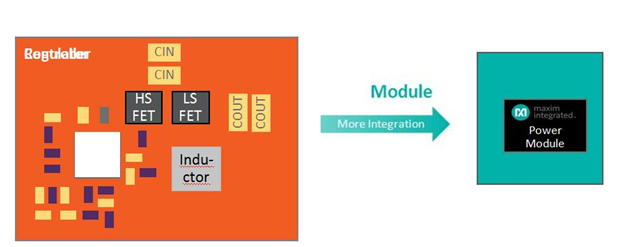
A look at the existing power supply configuration reveals the integrated nature of the MAXM17545 power module. A traditional power stage includes input and output capacitors, external FETs, a power controller, various optional resistors and capacitors, and a large inductor. However, Maxim's power modules provide easy and flexible design features by reducing the number of components and module size.
While modules integrating external FETs still require separate peripheral components and inductors, Maxim's power modules require only simple resistors and input/output capacitors. They require only three to four peripheral components and offer a wide input voltage range of 4.5V to 42V.
Each component integrated in the Maxim power module includes a switching power controller, two MOSFETs, a compensation block, an inductor, and various optional values, all in a single package. The MAXM17504 EV kit supports input voltages from 4.5V to 60V, 0.9V to 12V, and 1.7A output.
This power module integrates multiple components, yet is compact (9mm x 15mm x 2.8mm) and features excellent thermal characteristics thanks to its SiP package. The minimization of heat generation issues is welcomed as it addresses another pressing concern for engineers.
“Maxim’s power modules come in 10 different configurations, from low voltage to high voltage, supporting a wide range of input and output requirements,” said Ryu Je-pil, vice president of Maxim. “These features can be leveraged for a variety of applications, including distributed power supply regulation, FPGA and DSP point-of-load (PoL) regulators, HVAC and building control, and industrial power supplies.”
관련뉴스

Intel Unveils Next-Generation 'Core Ultra Series 3' and vPro Platform for Enterprise PCs
Intel has officially unveiled the "Intel Core Ultra Series 3" for next-generation enterprise PCs and the latest vPro platform, addressing a wide range of demands from enterprise notebooks to high-performance workstations.
2026.03.26by 배종인 기자

ROHM Launches ESD Protection Diode Compatible with High-Speed Interfaces of 10Gbps or Higher
반도체 전문 기업 로옴(ROHM)이 10Gbps를 넘어서는 차세대 고속 데이터 통신 환경에 대응할 수 있는 ESD(정전기 방전) 보호 다이오드 ‘RESDxVx 시리즈’를 개발하며, 고속 인터페이스에서 요구되는 신호 품질 유지와 IC 보호 성능을 동시에 끌어올렸다.
2026.03.26by 배종인 기자
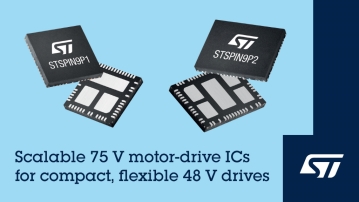
ST Launches 75V Drive IC Targeting 48V Industrial Motor Driving
ST Microelectronics has unveiled the 'STSPIN9P' series of 75V motor drive ICs tailored for 48V-class industrial drive system design. The new product family is characterized by half-bridge and full-bridge configurations that enable design scalability according to motor type and output conditions. Power supply circuits, protection functions, and current sensing circuits are integrated on-chip to simplify system configuration, and the devices are designed to support applications up to 500W maximum. The company plans to provide reference designs and demo boards to support development and evaluation in industrial automation, robotics, pumps, fans, lighting, and textile machinery.
2026.03.26by 배종인 기자

Nordic supports security updates for the entire lifecycle of IoT devices at a single fixed cost
Nordic Semiconductor, a global leader in low-power wireless connectivity solutions, has unveiled a single fixed-cost licensing model that delivers FOTA (Firmware Over-the-Air) and device management capabilities throughout the device lifecycle via nRF Cloud, and introduced a new firmware update solution to prepare for the enforcement of the European Union's Cyber Resilience Act (CRA).
2026.03.26by 배종인 기자

Practical Training in Low-Noise, Low-Power Circuit Design All in One Place… Training Fee Support
The "2026 Advanced Engineer Practical Masterclass" to strengthen competencies in high-sensitivity analog circuit and sensor-based system design will be held on April 16 at the e4ds Conference Center in Gasan-dong, Seoul. This program will be conducted as an offline paid hands-on training session, not online, and is targeted at engineers seeking on-site intensive learning. Texas Instruments will provide educational support for this training, allowing participation at 150,000 won, a 100,000 won discount from the original price of 250,000 won.
2026.03.26by 배종인 기자











