

.png)

Development of High-Power Terahertz Wave Generators: Will Precise Cancer Cell Inspection Become Possible?
 Published2015.10.20 11:35
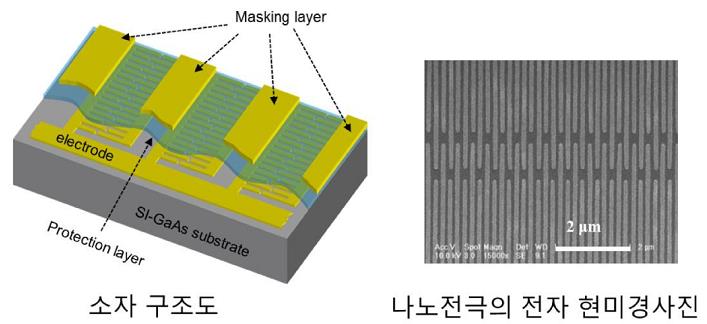
Control of Plasmon and Field Enhancement Effects via Nanoelectrodes
Terahertz (THz) waves are electromagnetic waves that vibrate one trillion times per second. Because they have frequencies hundreds of times higher than the frequency bands used in mobile phones, they can transmit a correspondingly large amount of information. They are electromagnetic waves that possess intermediate properties between light and microwaves, such as containing the natural vibration frequencies of numerous molecules in nature and penetrating materials that light cannot penetrate.
In addition, it has the characteristic of penetrating materials that light cannot penetrate due to their long wavelengths. In particular, the terahertz wave band is an unexplored frequency band and is of great interest worldwide. Amidst this, domestic researchers have developed a technology capable of generating terahertz waves with high efficiency, attracting significant attention.
ETRI (Electronics and Telecommunications Research Institute, President Kim Heung-nam)’s THz Photonics Creative Research Center announced that it has increased efficiency and output by more than 50 times by creating electrodes using metal nanostructures as anodes and cathodes.
Achieved over 50-fold improvement in THz wave output compared to commercial devices
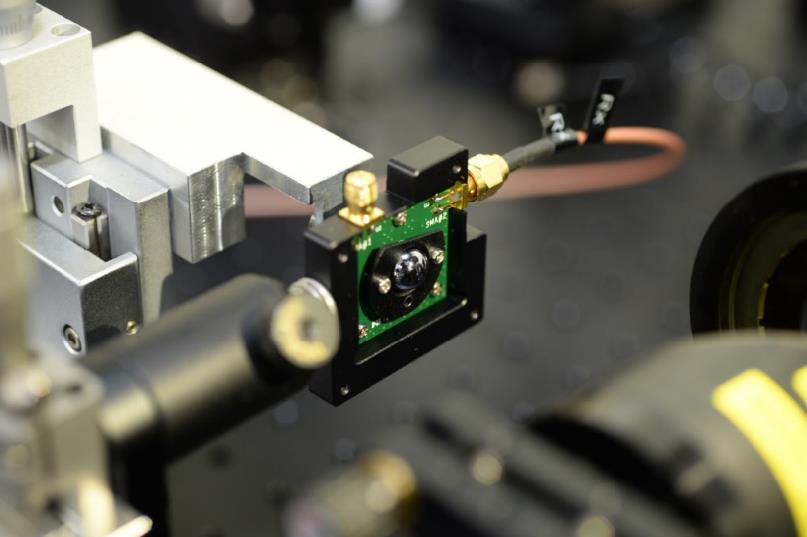
ETRI stated that conversion efficiency was dramatically improved through plasmon effects and local electric field enhancement effects, and that the related research results were published in Scientific Reports, a sister journal of Nature, early last month.
The research team explained that this technology is particularly useful for visualizing internal plastic structures or biological tissues such as cancer cells, as its efficiency and output are more than 50 times higher than existing products using terahertz waves. This has significantly expanded the range of applications.
In the case of existing commercial devices, the output signal was low, making it impossible to see the target accurately. However, thanks to the development of a nanotechnology-based, high-power terahertz generator by ETRI researchers, it appears that terahertz waves will be useful for detecting metals, cancer cells, harmful chemicals, and weapons and bombs in the future.
In addition, the research team predicts that using terahertz waves will be useful for detecting air bubbles in high-precision tiles used in spacecraft launches, measuring paint thickness, checking for defects in plastic manufacturing, and measuring the precise coating thickness of pills in the pharmaceutical field due to their unique properties.
Although various studies have previously reported on efficiency improvements through nanoelectrodes, the electric field effect and plasmon effect have been vaguely cited as the causes of such improvements.
However, the results of this ETRI study are highly significant in that they derived a design capable of maximizing output through a systematic approach to the interaction between two physical phenomena and the conditions under which the effects of each phenomenon can be maximized.
In addition, by adopting a simple array-type nanostructure, the research team achieved a remarkable feat of overcoming the limitations of low-temperature grown devices and securing reproducible and significant output enhancement characteristics. Through this, the research team succeeded in developing a nanotechnology-based high-output THz generator. The developed device is expected to be utilized in terahertz application systems for various inspections and detections in the future.
 Opens the Way for Precise Inspection of Plastic Internal Structures with High Output
Park Kyung-hyun, Head of the THz Photonics Creative Research Center at ETRI, stated, "By improving performance regarding material phenomena occurring in nanostructures and extending large-area nanoelectrode photoconductive antenna technology to two-dimensional structures, we have opened up possibilities for new applications by artificially controlling the characteristics of each unit device."
Terahertz technology is recognized as a core field in security, communications, and medical sectors, which form the foundation of future society , because it has a wider bandwidth than radio waves .
This research was developed with support from the Ministry of Science, ICT and Future Planning and the Ministry of Trade, Industry and Energy. The THz Photonics Creative Research Center announced that through research covering the entire range from materials to systems, it has published 21 SCI papers and filed over 50 domestic and international patents, and that technology transfer for the elemental technologies is currently underway.
The ETRI THz Photonics Creative Research Center is a research group leading domestic and international terahertz technology, having submitted numerous international academic journals and been invited to give keynote speeches at famous terahertz-related conferences, including Photonics West.
The first author of the paper is Dr. Ki-Won Moon of the ETRI THz Photonics Creative Research Center, and Center Director Kyung-Hyun Park is the corresponding author. Seven researchers from the center were also included as authors.
관련뉴스
EV 그룹, 광응용 분야를 위한 나노 임프린트 리소그래피 역량 센터 설립
2015.02.05by 명세환 기자
Internet of Things technology spearheaded by 'low-power long-distance communication' draws attention
SK Telecom announced that it has joined the LoRa Alliance (http://lora-alliance.org), a consortium jointly developing low-power long-range communication technology, and will begin full-scale pilot projects for the Internet of Small Things. The Internet of Small Things is a technology that connects small objects—which measure and process small amounts of simple information such as temperature, humidity, weight, and location—through wireless networks. This is an expanded concept of the Internet of Things (IoT). The concept was developed from the insight that small devices in the IoT market, which transmit data at predetermined intervals, are not well-suited to the latest LTE-grade wireless communication technologies.
2015.07.22by 신윤오 기자
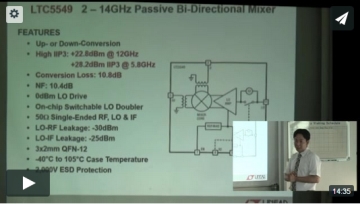
A 'double-balanced mixer' supporting a wide frequency range has been released.
The LTC5549 enhances the performance of a wide range of microwave applications including microwave backhaul, LTE-Advanced (LTE-A) base stations in unlicensed frequency bands, satellite broadband wireless, radar systems, X-band and Ku-band transceivers, test equipment, and satellite modems.
2015.08.26by 신윤오 기자

Intel Unveils Next-Generation 'Core Ultra Series 3' and vPro Platform for Enterprise PCs
Intel has officially unveiled the "Intel Core Ultra Series 3" for next-generation enterprise PCs and the latest vPro platform, addressing a wide range of demands from enterprise notebooks to high-performance workstations.
2026.03.26by 배종인 기자

ROHM Launches ESD Protection Diode Compatible with High-Speed Interfaces of 10Gbps or Higher
Semiconductor specialist ROHM has developed the 'RESDxVx series' of ESD (electrostatic discharge) protection diodes capable of responding to next-generation high-speed data communication environments exceeding 10Gbps, simultaneously enhancing both signal quality maintenance required in high-speed interfaces and IC protection performance.
2026.03.26by 배종인 기자











