


This page was machine-translated and may differ from the original. View original
Downsizing of chemical analysis equipment and precision electrometer-grade operational amplifier
 Published2015.10.30 17:51
Analog Devices (www.analog.com), a semiconductor company in the signal processing applications field, has launched the electrometer-grade operational amplifier ADA4530-1.
With the ADA4530-1, it is possible to implement chemical analysis equipment that achieves high precision and data repeatability over a wider temperature range as a compact solution, thereby reducing overall bill of materials (BOM) and design footprint.
To this end, the ADA4530-1 operational amplifier provides input bias current that is at least 20 times lower than competing products. Due to this extremely low bias current, the ADA4530-1 is well suited for connecting to sensors sensitive to output load like photodiodes, as well as other high output impedance sensors frequently used in precision monitoring/analysis equipment such as spectrophotometers, chromatographs, and mass spectrometers, and in potentiostatic and amperostatic coulometry measurement equipment.
This new operational amplifier can also be used as a front-end amplifier for picoammeter or coulombmeter measurement systems, or as a transimpedance amplifier for photodiodes, ion chambers, and working electrode measurements, or as a high-impedance buffer for chemical and capacitive sensors.
Bias current is 20 times lower at 125℃ and 50 times lower at 85℃ compared to competing products
 The input bias current of the ADA4530-1 operational amplifier decreases to 250fA at 125℃ and 20fA at 85℃, which is 20 times lower at 125℃ and 50 times lower at 85℃ compared to competing products.
Furthermore, the ADA4530-1 is the only operational amplifier that can maintain input bias current at 20fA equally across temperatures between room temperature and 85℃, and among comparable products, the ADA4530-1 is the only operational amplifier that has undergone full production testing for bias current at both room temperature and 125℃.
Even the most similarly specified competing products rarely specify input bias current at 125℃, and none have undergone production testing for bias current at room temperature. If production testing is not performed at room temperature, system designers must reserve a certain frequency guard band to account for large variations in bias current, which prevents full utilization of sensor sensitivity.
Additionally, the ADA4530-1 integrates an on-chip guard buffer that provides useful output for driving interconnected guard shields that track input common-mode voltage and reduce the effects of stray capacitance occurring in PCB guard rings or sensitive connections between sensors and amplifiers.
Therefore, by using the ADA4530-1 amplifier, designers do not need to design separate circuits to provide the required output drive, thereby saving design time, cost, and PCB space, and simplifying sensor interface design.
With the ADA4530-1, it is possible to implement chemical analysis equipment that achieves high precision and data repeatability over a wider temperature range as a compact solution, thereby reducing overall bill of materials (BOM) and design footprint.
To this end, the ADA4530-1 operational amplifier provides input bias current that is at least 20 times lower than competing products. Due to this extremely low bias current, the ADA4530-1 is well suited for connecting to sensors sensitive to output load like photodiodes, as well as other high output impedance sensors frequently used in precision monitoring/analysis equipment such as spectrophotometers, chromatographs, and mass spectrometers, and in potentiostatic and amperostatic coulometry measurement equipment.
This new operational amplifier can also be used as a front-end amplifier for picoammeter or coulombmeter measurement systems, or as a transimpedance amplifier for photodiodes, ion chambers, and working electrode measurements, or as a high-impedance buffer for chemical and capacitive sensors.
Bias current is 20 times lower at 125℃ and 50 times lower at 85℃ compared to competing products
The input bias current of the ADA4530-1 operational amplifier decreases to 250fA at 125℃ and 20fA at 85℃, which is 20 times lower at 125℃ and 50 times lower at 85℃ compared to competing products.Furthermore, the ADA4530-1 is the only operational amplifier that can maintain input bias current at 20fA equally across temperatures between room temperature and 85℃, and among comparable products, the ADA4530-1 is the only operational amplifier that has undergone full production testing for bias current at both room temperature and 125℃.
Even the most similarly specified competing products rarely specify input bias current at 125℃, and none have undergone production testing for bias current at room temperature. If production testing is not performed at room temperature, system designers must reserve a certain frequency guard band to account for large variations in bias current, which prevents full utilization of sensor sensitivity.
Additionally, the ADA4530-1 integrates an on-chip guard buffer that provides useful output for driving interconnected guard shields that track input common-mode voltage and reduce the effects of stray capacitance occurring in PCB guard rings or sensitive connections between sensors and amplifiers.
Therefore, by using the ADA4530-1 amplifier, designers do not need to design separate circuits to provide the required output drive, thereby saving design time, cost, and PCB space, and simplifying sensor interface design.
To request a correction, reply or follow-up report on this article, see how to file a request. Previously published statements are collected in corrections & replies.

Related news



Intel Unveils Next-Generation 'Core Ultra Series 3' and vPro Platform for Enterprise PCs
Intel has officially unveiled the "Intel Core Ultra Series 3" for next-generation enterprise PCs and the latest vPro platform, addressing a wide range of demands from enterprise notebooks to high-performance workstations.
2026.03.26by 배종인 기자
ROHM Launches ESD Protection Diode Compatible with High-Speed Interfaces of 10Gbps or Higher
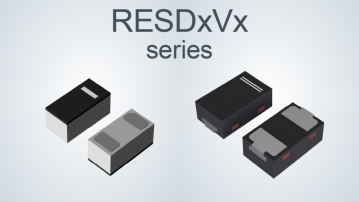
Semiconductor specialist ROHM has developed the 'RESDxVx series' of ESD (electrostatic discharge) protection diodes capable of responding to next-generation high-speed data communication environments exceeding 10Gbps, simultaneously enhancing both signal quality maintenance required in high-speed interfaces and IC protection performance.
2026.03.26by 배종인 기자












Sponsored Company