


Domestic DBMS Market Projected to Grow at an Average Annual Rate of 5.2% Until 2019
 Published2015.11.20 14:17
According to a recent report by IDC Korea (CEO: Yoo-Sook Hong, www.kr.idc.asia) (Korea Relational Database Management Systems Forecast, 2015-2019, Doc #KR321015179), the domestic RDBMS (Relational Database Management System) market was estimated at 530 billion won last year, and is expected to reach 555 billion won this year.
In addition, it is projected to grow at an annual average rate of 5.2% over the next five years, reaching 683 billion won in 2019. The domestic RDBMS market is expected to see a steady increase in demand driven by data warehouse replacements, next-generation projects planned by the financial sector, and RDBMS expansions resulting from the growth of corporate data.
It is expected to reach 683 billion won in 2019.
Factors driving the growth of the domestic RDBMS market include increased sales of integrated systems (DB appliances), rising demand for in-memory databases, and the expansion of public cloud-based database services.
Integrated systems, which combine servers, storage, and software such as RDBMS, are being introduced for purposes such as accommodating OLTP or OLAP database tasks and integrating databases into a single system by configuring hardware and software in an optimized combination. RDBMS vendors are expected to strive for hardware performance improvements to reduce Disk I/O, along with software performance enhancements.
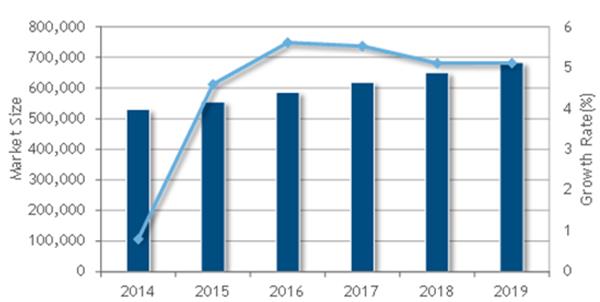
▲ Domestic RDBMS Market Forecast, 2015–2019 (Unit: Million KRW) Source: IDC, 2015
The increasing use of public cloud services is providing a new growth opportunity in the domestic 'Database as a Service' market, and public cloud usage is on the rise due to advantages such as provisioning, auto-scaling, and pay-as-you-go billing.
Initially, there may be fluctuations in revenue as existing RDBMS license sales transition to cloud subscription licenses. To minimize this, it is necessary to guide companies to differentiate between RDBMS tasks used in existing on-premises environments and those used in public cloud environments, and to configure public cloud-based database services primarily for development, testing, and new services.
Due to the advantages of in-memory computing, which enables high-speed data processing, it is being utilized in various software fields, including data analysis areas such as Business Intelligence. Among these, the RDBMS domain is one of the software fields that has utilized in-memory computing technology from the very beginning.
Recently, the demand for in-memory databases utilizing column compression technology has been increasing, particularly in business areas that require high-speed data processing and rapid analysis results. Accordingly, as in-memory databases support columnar data and data compression features, the applicable business areas are expected to expand.
Do Sang-hyuk, a senior analyst at IDC Korea responsible for analyzing the domestic RDBMS market, noted, "While demand in the database market increased last year due to factors such as data warehouse modernization projects and enterprise-level database volume contracts, the overall growth rate of the domestic RDBMS market fell short of initial forecasts due to revenue declines at some vendors." He predicted that future demand for cloud-based databases and in-memory databases will become new drivers for the growth of the domestic RDBMS market.
관련뉴스
.jpg)
SalePoint Signs Multi-Year Partnership Agreement with AWS… Promoting Identity Security that Integrates Even AI Agents
Sailpoint has entered into a multi-year strategic partnership agreement with AWS and is moving forward with establishing an integrated governance system that manages both human and non-human identities together. The plan is to consistently manage access permissions in an environment where AI agents are increasing as work execution entities, while applying the principle of least privilege and automated policy enforcement. The two companies plan to jointly expand capabilities to manage the identities of various entities, including AI agents, within a single layer in the AWS environment. This collaboration is interpreted as a move to design security and governance together in corporate environments where AI adoption is expanding.
2026.03.26by 배종인 기자
.png)
Databricks Unveils Open AI Security Monitoring 'Lakewatch'
Databricks entered the security market on March 24 by unveiling LakeWatch, an open-source agentic SIEM. The core functionality of this product is to integrate and analyze security, IT, and business data in a single environment to support AI-based threat detection and investigation. The company explained that it reduces the limitations of existing security operations centers, which have had to forgo some data due to high cost structures, and enables large-scale data analysis and automation based on open formats and ecosystems. LakeWatch is currently offered as a private preview, with Adobe and Dropbox mentioned as early customers. Databricks also announced an expanded partnership with Anthropic as well as the acquisition of Antimatter and SiftD.ai.
2026.03.26by 배종인 기자
Ecolab Expands AI Data Center Cooling Business Through Acquisition of CoolIT
Ecolab has agreed to acquire CoolIT Systems, a liquid cooling company for AI data centers, for approximately $4.75 billion. The transaction is expected to close by Q3 2026, subject to regulatory approvals. CoolIT has been supplying direct-to-chip cooling-based coolant distribution units, cold plates, and manifolds, serving hyperscale data centers and colocation operators as customers. This acquisition is a measure to address the high-heat and high-density server environments created by AI proliferation. Ecolab plans to combine its water management and digital monitoring capabilities with CoolIT's hardware technology to expand its data center cooling business.
2026.03.26by 명세환 기자
Arm Unveils First Data Center CPU Targeting 'Agentic AI' Era… Securing Both Cost-Effectiveness and Scalability for Large-Scale AI Infrastructure
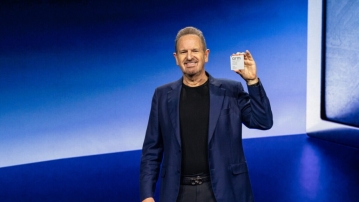
Arm has unveiled the 'Arm AGI CPU,' the first data center CPU that simultaneously secures cost-efficiency and scalability for large-scale AI infrastructure, marking a new turning point in artificial intelligence (AI) infrastructure as it targets the 'agentic AI' era.
2026.03.25by 배종인 기자
.jpg)
ETRI Develops Multimodal AI Technology That Retains Existing Information Even When Learning New Knowledge
한국전자통신연구원(ETRI)이 멀티모달 AI가 새 지식을 학습하는 과정에서 기존 정보를 잃어버리는 ‘치명적 망각’ 문제를 줄이는 기술을 개발했다. 이 기술은 이미지와 텍스트 정보를 분리해 저장한 뒤 필요할 때만 연결하는 방식으로, 기존 모델의 지식 손상을 줄이면서 복합 질문에 대한 응답 정확도를 높이는 데 초점을 맞췄다. 연구 결과는 인공지능 학술대회 NeurIPS 2025에 채택됐으며, 정책·법령, 제품 정보, 산업 데이터처럼 지속적인 업데이트가 필요한 분야에 활용 가능성이 제시됐다.
2026.03.24by 명세환 기자











