



[Editor's Notebook] The Reality of China's Semiconductor Rise Through IP Patents
 Published2015.11.23 17:20
One of the fastest ways to develop an industry is through mergers and acquisitions. The global semiconductor industry is holding its breath as "big player" China makes aggressive investments. Tsinghua Unigroup proposed acquiring Micron, the world's third-largest memory semiconductor company, with a $24 billion investment, and Summit View Capital Consortium acquired ISSI, a US design specialist, for $640 million. JECT is pursuing the acquisition of Stats ChipPac, the world's fourth-largest packaging company, and Taiwan-based DRAM companies Nanya, Winbond, and PowerChip have also appeared on China's acquisition list.

▲Drone product showcased at the China Hi-Tech Expo held on November 16. The price of this drone was introduced as 230 yuan (approximately $20). (Photo reference: China Hi-Tech Expo)
While attention is focused on corporate mergers and acquisitions, China's movements in the semiconductor technology field are also noteworthy. The Korean Intellectual Property Strategy Agency (KISTA) disclosed that the number of patent applications at China's patent office is on an upward trend, reflecting China's active semiconductor policies. It analyzed that the gap with the combined application numbers from Korea, the United States, Europe, and Japan is gradually narrowing. In 2009, the total applications were 10,388 from China versus 3,195 from others, but by 2013, four years later, the difference significantly narrowed to 8,845 versus 4,883 applications.
Application trends by nationality also showed high increases in applications from Chinese and Taiwanese nationals. In particular, Chinese nationals showed an increase rate exceeding 200% during the 2005-2013 period compared to the previous period. Chinese nationals are showing high application growth rates across all major categories. According to KISTA, the design field application growth rate between 2008-2010 and 2011-2013 was 116.2% for Korea versus 124.5% for China, while FAB process field applications were 58.3% for Korea and 283.6% for China. Additionally, equipment field applications were 97.6% for Korea and 205.7% for China, and materials field applications were 84.8% for Korea and 276.3% for China. This represents significantly higher growth rates compared to Korea.
As the Chinese semiconductor market expands, interest in the Chinese market is increasing. Looking at the interest of top applicants in the Chinese market, Samsung Electronics, Intel, Micron, and SK Hynix are showing increased interest, while IBM, Toshiba, Dongbu HiTek, and Tokyo Electron have shown declining interest. For example, Samsung Electronics' interest in the Chinese market was 21.71% from 2002 to 2013, but recently in 2011-2013 it increased to 30.19%, and Intel rose from 58.31% to 73.55% recently. This data shows how much effort Samsung and Intel are putting into the Chinese market.
The changes in Korean and Chinese market interest across the entire semiconductor field—design, FAB processes, equipment, and materials—are clearly evident. While interest in the Korean market decreased from 54.58% during the entire period (2002-2013) to 48.86% recently (2011-2013), interest in the Chinese market shows an upward trend, increasing from 44.36% during the entire period (2002-2013) to 46.58% recently (2011-2013). This reveals where the eyes of global semiconductor companies are turning.
Meanwhile, KISTA disclosed that IP patent applications in the semiconductor field from major semiconductor nations show a declining trend from the mid-2000s onward. Korea and Japan are experiencing declining applications, while the United States is recovering its application numbers. Looking at recent applications (2008-2013) from major applicants such as Samsung Electronics (-14.4%), SK Hynix (-57.1%), IBM (-17.2%), Toshiba (-18.9%), and Panasonic (-53.2%), application growth rates are declining, but only Intel shows a high growth rate of 55%.
Changes in China are also being detected in the semiconductor academic community that underpins the fundamentals of semiconductor technology. Professor Yoo Hoe-jun of KAIST, who served as overall program chair for ISSCC (International Solid-State Circuits Conference), the world's semiconductor Olympics, stated: "Every year, papers are submitted from companies and schools worldwide, and one-third are adopted. At the conference to be held next year, papers from the Far East account for 34% of acceptances." He emphasized: "The most noticeable recently is China. Although the number of Chinese papers accepted is still minimal, the number of submissions (about 40 papers from mainland) has increased significantly. In the past, they were not even at the level of making chips, but now the topics of papers are also diverse, covering supercomputers, healthcare, and wireless applications."
In this way, the expansion of China's semiconductor industry is occurring comprehensively, from foundational academic papers to corporate mergers and acquisitions. It has become clear that China's semiconductor rise did not happen overnight. At such a time, we must coolly monitor the underlying foundations of China's semiconductor industry.
Related news
Semiconductor Industry M&A Tsunami 'In Progress', Eyes Focused on China's Moves
After a wave of M&A tsunami swept through the semiconductor industry in the first half, how should the industry prepare for the second half and beyond into next year? Market research firm IC Insights has issued a diagnosis through its 185-page McClean Report, stating that the semiconductor industry in the first half faced a perfect storm unprecedented in the past five years, and this is merely a prelude to the shifting industry landscape that will unfold over the next five years. In this report, IC Insights analyzed the recent surge in M&A activities, including China's aggressive strategies to strengthen its position in the semiconductor industry.
2015.07.31by 명세환 기자
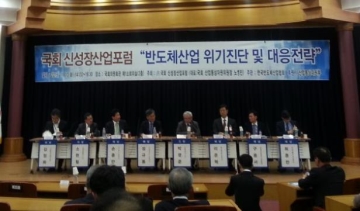
What are the countermeasures for Korea's semiconductor industry, which is currently being closely pursued by China?
On November 10, 2015, the National Assembly's New Growth Industry Forum held a session on "Semiconductor Industry Crisis Diagnosis and Response Strategy" at the National Assembly Members' Hall. The forum was organized to analyze the current state of Korea's semiconductor industry and to explore support measures for strategic industries capable of sustainable growth in the future.
2015.11.10by
[Reporter's Notebook] Do you know how to catch crocodiles in the Yangtze River?
The crocodile of the Yangtze River no longer refers solely to Alibaba. This Chinese crocodile, which has swallowed sharks, is now poised to devour semiconductors—the symbol of advanced industry—following smartphones, TVs, and displays. When did this crocodile of the Yangtze River become such a formidable entity that indiscriminately swallows everything in its path?
2015.11.17by 신윤오 기자

Intel Unveils Next-Generation 'Core Ultra Series 3' and vPro Platform for Enterprise PCs
Intel has officially unveiled the "Intel Core Ultra Series 3" for next-generation enterprise PCs and the latest vPro platform, addressing a wide range of demands from enterprise notebooks to high-performance workstations.
2026.03.26by 배종인 기자

ROHM Launches ESD Protection Diode Compatible with High-Speed Interfaces of 10Gbps or Higher
Semiconductor specialist ROHM has developed the 'RESDxVx series' of ESD (electrostatic discharge) protection diodes capable of responding to next-generation high-speed data communication environments exceeding 10Gbps, simultaneously enhancing both signal quality maintenance required in high-speed interfaces and IC protection performance.
2026.03.26by 배종인 기자











