



KT and the Ministry of Oceans and Fisheries are spearheading maritime safety through ICT.
 Published2015.12.08 12:42
KT will be the first domestic telecommunications company to jointly build a maritime safety communication network with the Ministry of Oceans and Fisheries, featuring the 'LTE SOS (Stand on Ship)' technology that enables LTE communication even in the sea far from land.
KT announced on the 8th that it signed a 'Business Agreement for Securing a Maritime Safety Communication Network' with the Ministry of Oceans and Fisheries. At the signing ceremony held at the East KT Gwanghwamun Building in Sejong-ro, Seoul, Minister of Oceans and Fisheries Kim Young-seok and KT Chairman Hwang Chang-gyu promised continued public-private cooperation to secure a maritime safety communication network. The main contents of this agreement are ▲Establishment of an emergency communication network to prepare for maritime distress accidents through public-private cooperation ▲Installation of satellite LTE SOS base stations on national fisheries guidance vessels, etc. ▲Expansion of maritime satellite communication capacity for smooth LTE communication ▲Technical support and maintenance of communication networks in collaboration with KT SAT ▲Development of maritime safety solutions utilizing the Internet of Things (IoT).
While telecommunications companies have made it possible to use call and data services in coastal waters via base stations on land and islands, the lack of radio coverage in open waters has hindered access to emergency communications. However, by installing the newly developed satellite LTE SOS base station on a ship, ships within a 10km radius can receive signals from KT SAT's Mugunghwa satellite, enabling calls. This solution represents a significant improvement over satellite LTE, which previously only supported onboard LTE.
The satellite LTE SOS base station converts satellite signals received via satellite antennas into LTE signals, providing LTE service across a wide maritime area. By leveraging KT SAT's satellite infrastructure, it can provide stable service across a wider area. Another great advantage is that you can use satellite services without any additional charges and still receive services with your existing plan.
To this end, KT has been piloting a satellite LTE SOS base station on a Ministry of Oceans and Fisheries fisheries guidance vessel since last September. This has enabled LTE communication within a 10-kilometer radius of the vessel, ensuring public safety in the event of an accident at sea. KT and the Ministry of Oceans and Fisheries plan to complete the installation of satellite LTE SOS base stations on a total of 21 fisheries guidance vessels by February of next year, enabling vessels to respond quickly to emergencies even in the open sea. Following the establishment of a maritime safety communication network based on the satellite LTE SOS base station, KT is also working with the Ministry of Oceans and Fisheries to develop maritime safety solutions utilizing IoT technology and advanced drones.
Securing golden time for victims of disaster using IoT technology and drones
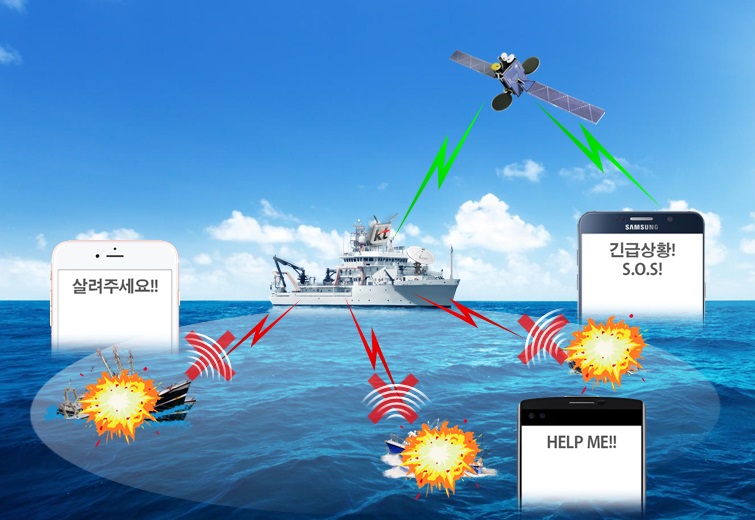
This solution periodically transmits the location of the victim to an LTE SOS base station via various communication devices attached to the life jacket. The IoT-powered life jackets are waterproof, feature a miniaturized dedicated modem, GPS, and a battery with a guaranteed lifespan of up to five years. In addition, when using drone LTE, signals can be transmitted to a wider area.
We anticipate that utilizing IoT technology and drones to quickly identify and transmit the location information of victims in distress will play a significant role in securing the golden time. We are currently working towards commercialization in the first half of next year, and plan to demonstrate its effectiveness through pilot applications in the near future.
KT Network Division Director Oh Seong-mok said, “KT has been making great efforts to expand communication coverage at sea,” and added, “This satellite LTE SOS base station is a representative example of public-private cooperation in thinking and working together for maritime safety. We will continue to take the lead in realizing national safety together with the government.”
Meanwhile, KT held a press conference in Pyeongchang on the 24th of last month regarding its selection as a pilot operator for the Disaster and Safety Communication Network and announced its plan to implement the network. At the event, it demonstrated key disaster response communication services, including backpack LTE, satellite LTE, and drone LTE, drawing keen attention from attendees.
Comments
Related news

KT Begins Full-Scale Management of Production, Consumption, and Transactions Through Energy Control Center
KT announced on the 1st that it has opened the KT-MEG Center (KT-Micro Energy Grid Center, an energy control center) in Gwacheon, Gyeonggi Province, the world's first integrated control center for energy production, consumption, and trading.
2015.12.01by 명세환 기자

[Technical Contribution] Mouser: "AI Agents Help Accelerate and Standardize Industrial Field Maintenance Operations"
Abhishek Jadhav from Mouser Electronics discusses how to leverage agentic AI for predictive maintenance in industrial automation.
2026.10.23by 편집부
Schneider Electric Unveils Modular Power Solution for AI Data Centers
Schneider Electric has launched prefabricated power modules and power skids for AI data centers, jointly developed with NVIDIA. Based on the GB300 NVL72 reference design, the solution applies standardized design and factory pre-fabrication methods to build power infrastructure in as little as 6 months. Galaxy VXL UPS technology is integrated, with capacity options ranging from 2MW to 2.5MW.
2026.10.23by 배종인 기자
Dassault Systèmes and Vertiv Announce AI Factory Design and Construction Collaboration
Dassault Systèmes and Vertiv announced their collaboration on AI factory design and construction. By combining the virtual twin-based 3DEXPERIENCE platform with Vertiv's infrastructure solutions, the entire system is validated in a virtual environment before actual construction. Through this approach, they aim to accelerate the design process by up to 10 times and reduce infrastructure construction timelines by up to 50%.
2026.10.23by 명세환 기자











