



The new field that personal devices must pioneer is 'emotion'
 Published2015.12.14 10:24
Gartner Inc., a global IT advisory firm, predicted that over the next five years, consumers will use more devices rather than consolidating multiple devices. By 2018, consumers in mature markets will use three or more personal devices per person on average.
Gartner projected that the total number of devices (wearables, mobile phones, tablets, and PCs) would reach 7.8 billion in 2016. It predicted that this trend would continue, reaching 8.3 billion in 2018.
"Anshul Gupta, a principal research analyst at Gartner, said, 'With high technology adoption rates, the commercialization of ultra-high-speed networks, and increasing reliance on real-time information for decision-making, the number of devices per user is expected to increase.'"
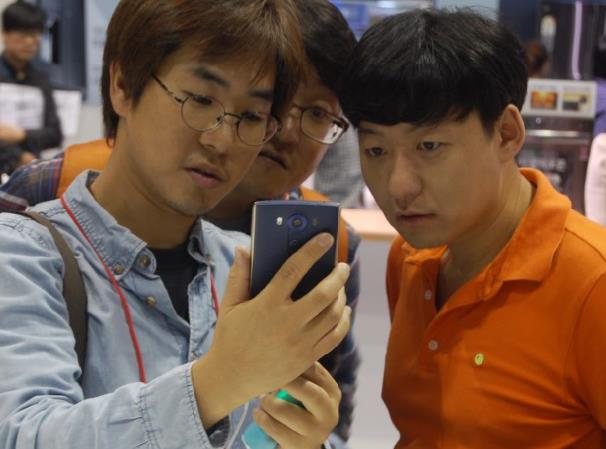
Visitors looking at smartphones at the Korea Electronics Show booth.
Gartner predicted that users in mature markets will use three to four personal devices, mixing 'mainstream' and 'niche' devices. Mainstream devices include smartphones, tablets, convertibles (two-in-one devices), and laptops. Users will use two or more of these mainstream devices on a regular basis. Niche devices will include smartwatches, health bands, and smart glasses, as well as new types of connected devices such as smart cards, e-books, and portable cameras.
In addition to this, Gartner released the following forecast for the future personal device market.
In 2018, one of China's top five smartphone manufacturers will be a non-traditional mobile phone manufacturer.
"Chinese internet companies have begun making active investments in mobile device hardware development, platforms, and distribution to secure a leading position in the smartphone market," said CK Lu, a senior research analyst at Gartner. "They are focusing on increasing user loyalty and engagement through partnerships and investments, and may divest their hardware businesses to increase net worth and profits."
As a result, competition in the smartphone market is becoming more intense and complex, and the methods of creating value are also changing. Senior Research Analyst CK Lu stated, "In the future, the smartphone market is expected to become more fluid than it is now, and entry barriers for new companies will be lowered." "Due to the entry of Chinese internet companies into the smartphone business, existing smartphone manufacturers will be under pressure to develop innovative products that go beyond their existing offerings in order not to fall behind in the competition," he added.
By 2019, 20% of personal devices will record users' emotions to provide personalized responses or crowdsourced analysis through systems.
"Wearable devices are already recording heart rate, blood pressure, sleep patterns, and step counts. The new field that personal devices must now pioneer is emotion," said Annette Zimmermann, a principal research analyst at Gartner. Gartner forecasts that 740 million wearable devices will be in use in 2016, a 20% increase from this year. It is predicted to reach 1.1 billion units by 2019.
Emotions can be measured using various types of sensors, such as recording functions, and human emotions can also be identified and analyzed by saving users' facial expressions via video or cameras. "Companies can transform voice analysis into training tools for customer service employees," stated Annette Zimmermann, a lead researcher. "Smartphones will be able to analyze conversations and provide feedback on how to improve customer interactions."
As the accuracy of devices tracking individual health and exercise status increases, it is expected that physical and mental health can be tracked more effectively. At the same time, companies will be able to check the stress and fatigue levels of employees working in dangerous environments or bearing heavy responsibilities, such as air traffic controllers, and take preventive measures if necessary.
In 2019, one-third of PC users will issue execution commands using voice or gestures.
With 3D cameras recently being installed in desktop PCs and laptops and support for the Windows 10 Personal Assistant feature, gestures and voice have begun to complement existing keyboard and touch functions.
According to Gartner, it was predicted that more than 60% of all PC installations would use Windows 10 in 2019. Lillian Tay, a senior researcher at Gartner, explained, "If at least half of Windows 10 users start issuing commands via voice or gestures, devices using this feature will account for 30% of the total."
"Voice and gestures will create new uses and boost productivity in the enterprise sector. For example, in collaboration, employees can access files and documents hands-free by turning pages with gestures. Similarly, at home, voice and gestures are well-suited for hands-free PC interaction scenarios. As another example, users could wave their hands to turn pages in a cookbook while cooking, or search for products via internet surfing and add items to a grocery cart whenever they feel like it," explained Senior Researcher Lillian Tay.
관련뉴스
Global PC Shipments Down 7.7% in Q3, Sales Slowing Due to Strong Dollar
데스크톱 PC의 출하량은 한 자리 수 감소율을 기록하며 지속적인 약세를 보였고 노트북 PC와 프리미엄 울트라모바일(맥북 에어, 마이크로소프트 서피스 프로 포함)은 데스크톱 PC 만큼은 아니지만 역시 한 자리 수 감소율을 기록했다.
2015.10.15by 신윤오 기자
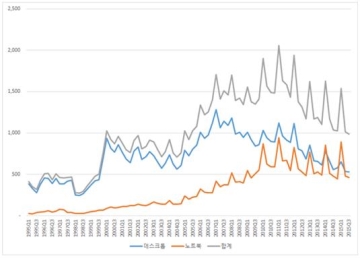
Will competition between ultra-slim laptops and tablets with detachable keyboards intensify?
According to a recent domestic PC market survey by Korea IDC, domestic PC shipments in the third quarter of 2015 reached 990,000 units, marking the first time in nearly 10 years since the second quarter of 2005 when 920,000 units were recorded that quarterly shipments fell below 1 million units. Desktop shipments totaled 530,000 units and notebook shipments reached 460,000 units, representing year-over-year declines of 5.4% and 3.7% respectively, while overall PC shipments decreased by 4.6%.
2015.11.18by
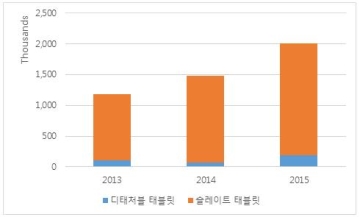
Expansion of educational tablet market, domestic tablet market projected to reach 2 million units this year
한국IDC(대표 홍유숙)의 최근 연구 결과에 따르면, 2015년 국내 태블릿 시장의 출하량은 200만 4천대로 전년의 147만6천대에 비해 35.8% 증가할 것으로 전망된다.
2015.12.08by 신윤오 기자

Ecolab and K-water Discuss Innovation Collaboration in Advanced Industry Water Management
Ecolab and the Korea Water Resources Corporation jointly discussed cooperation directions for maximizing water use efficiency in advanced industries such as semiconductors and data centers and establishing sustainable water circulation. The two companies agreed to gradually develop a long-term cooperation model that combines water resource infrastructure and water management technology to promote water efficiency optimization, water reuse, and carbon reduction.
2026.08.28by 명세환 기자

에이치에너지, 녹색기술인증 획득…솔라온케어 가동률 99.82%
에이지에너지가 태양광 발전예측 및 I-V커브 이상진단 기술로 중소벤처기업부 녹색기술인증을 획득했다. AI 기반 자산관리 플랫폼 솔라온케어는 전국 3,000개 이상 발전소에 적용되어 99.82%의 시스템 가동률과 3.7% 발전성능 개선을 달성했다. 실시간 데이터 분석을 통해 모듈 노화와 부분 음영 등 미세한 손실을 조기에 감지하고 관리함으로써 발전 수익을 보호한다.
2026.08.25by 명세환 기자











