



416.1 billion won investment needed over the next 5 years for smart manufacturing technology development
 Published2015.12.14 17:15
The Ministry of Science, ICT and Future Planning and the Ministry of Trade, Industry and Energy have finalized and announced the 'Mid-to-Long-Term Roadmap for Smart Manufacturing R&D' to strategically support the development of the eight major smart manufacturing technologies (hereinafter referred to as the “8 major technologies”), which are detailed implementation tasks of the Manufacturing Innovation 3.0 Strategy implementation measures.
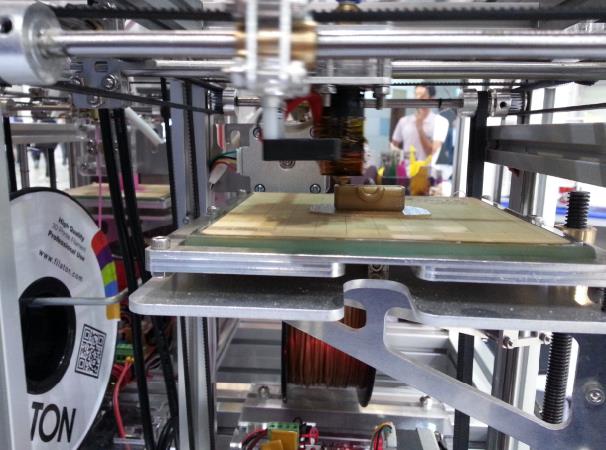
The eight major technologies (smart sensors, CPS, 3D printing, energy saving, Internet of Things, cloud, big data, and holograms) are core technologies for innovation in manufacturing, such as early development of new products, efficient prototyping, and the establishment of optimized mass production systems. Advanced manufacturing powerhouses, such as Germany's Industry 4.0 and the U.S. Advanced Manufacturing Partnership (AMP), are also accelerating the development of related technologies and their field applications.
Based on the shared understanding that the convergence of eight major technologies and demand-based inter-technology linkage development are essential for manufacturing innovation, the two ministries formed a Roadmap Promotion Committee (Chairperson: Lee Geon-woo, Dean of the College of Engineering at Seoul National University) consisting of 76 experts from industry, academia, and research institutes at the end of last April and have been operating it for seven months, with the Korea Institute for Industrial Technology Advancement (KIAT) and the Information and Communication Technology Promotion Center (IITP) supporting the establishment of the roadmap.
This roadmap envisions the future of manufacturing in 2020 and takes into account the needs of the manufacturing site from the planning stage by identifying areas requiring development for each of the eight major technologies to realize this vision and verifying feasibility by industry experts in a step-by-step manner.
To this end, considering the necessity of inter-company cooperation and on-site demand, a 2020 future vision (To-Be) was prepared in the form of a scenario for the eight major industries with high adoption potential for the eight key technologies, and to realize this,Key functions and application plans for eight major technologies to implement those functions were derived, and the direction of technology development for the next five years (~2020) was presented.
Through such demand-linked technology development planning, it is expected to contribute to achieving the vision of the 'Manufacturing Innovation 3.0 Strategy' to become one of the top four manufacturing powerhouses by 2020 by realizing successful cases of ICT technology convergence across major industries and improving the competitiveness level of the eight major technologies by 17% (from 71% to 88% compared to the average of the eight major technologies in advanced countries), and by promoting increased manufacturing productivity, reduced energy costs, and shortened product development periods.
According to the roadmap, it is projected that 416.1 billion won in investment will be required over the next five years for the development of smart manufacturing technologies needed for eight major industries. The Ministry of Trade, Industry and Energy and the Ministry of Science, ICT and Future Planning plan to specifically reflect the technology development content proposed in the roadmap, as well as its ripple effects on industries and urgency, into their R&D project planning and investment plans starting in 2016.
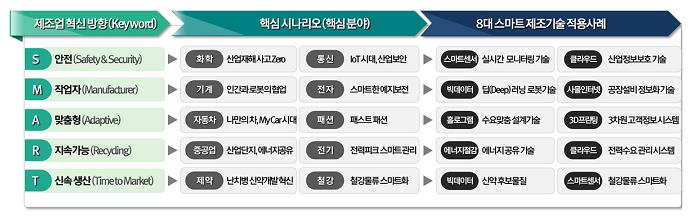
▲ 10 Key Scenarios and Technology Application Cases of the Smart Manufacturing R&D Roadmap
In addition, the demand for personnel in the eight major technology fields was projected to reach approximately 56,000 by 2017, with new hiring expected to account for about 25,000 (44.6%) of this total. It was predicted that there would be high demand for design and planning personnel, as well as convergence-type R&D personnel specialized in related fields such as security and commercialization.
In response to this manpower demand To address this, both ministries plan to continuously pursue initiatives such as expanding specialized workforce training programs in the relevant fields, strengthening linkages between regional engineering colleges and companies, and designating Human Resource Development Councils (SCs) for new technology sectors.
Chairman Lee Geon-woo stated, “Innovation must be driven for the convenience of people to induce greater innovation. In the process of establishing this roadmap for manufacturing innovation, we strived to ensure that the technology development planning was goal-oriented, taking into account the benefits of consumers and workers.”
관련뉴스
.jpg)
Moxa Delivers Smart Factory Solutions with 360° Network Reliability
2015.04.09by 명세환 기자
Nvidia invests $5 billion in Intel
NVIDIA and Intel, leaders in global AI computing technology, are now forging ahead in providing cutting-edge solutions through NVLink-based architecture integration. NVIDIA and Intel have officially announced a strategic partnership and stated that they will jointly develop customized data center and personal computing products to accelerate diverse applications and workloads ranging from hyperscale to enterprise and consumer markets, thereby laying the foundation for the next generation computing era.
2025.09.22by 배종인 기자
.jpg)
Applied Materials Launches Environmental Protection Campaign to Mark World Cleanup Day
어플라이드 머티어리얼즈 코리아(대표 박광선)가 ‘세계 청소의 날(World Cleanup Day)’을 맞아 동탄 신리천 일대에서 임직원 및 가족과 함께 환경 정화 활동을 펼치며, 기술 혁신을 넘어 지역사회와 함께하는 기업으로 거듭나고 있다.
2025.09.22by 명세환 기자
.jpg)
The combination of electrical and electronic technologies like AI, semiconductors, and electric vehicles with renewable energy will determine industrial competitiveness.
Professor Lim Chun-taek from Gwangju Institute of Science and Technology (GIST) stated in his keynote speech at the '2025 e4ds Tech Day' on the 9th, "Global energy investment is already shifting from fossil fuels to renewable energy, and the trend of electrification combined with electrical and electronic technologies is changing the industrial landscape."
2025.09.12by 배종인 기자











