

.png)

Let's use smart devices smartly by strengthening security.
 Published2015.12.15 19:04
Intel's Smart Usage Guide with Enhanced Security
Bustling shopping crowds, enticing advertisements—the holiday season is upon us once again. As always, people will be browsing the latest trends and contemplating gifts for family, friends, and loved ones. Among these, the latest toys and electronic devices that connect to the internet and other devices are particularly popular as seasonal gifts. These new features significantly contribute to a truly "smart" lifestyle. However, they also expose you to security threats in the online environment. The most popular holiday gifts can also be the most "hackable." To ensure that these precious gifts remain meaningful, let's explore security measures to ensure the safe use of these devices.
Safely using holiday gifts starts with a shift in awareness!
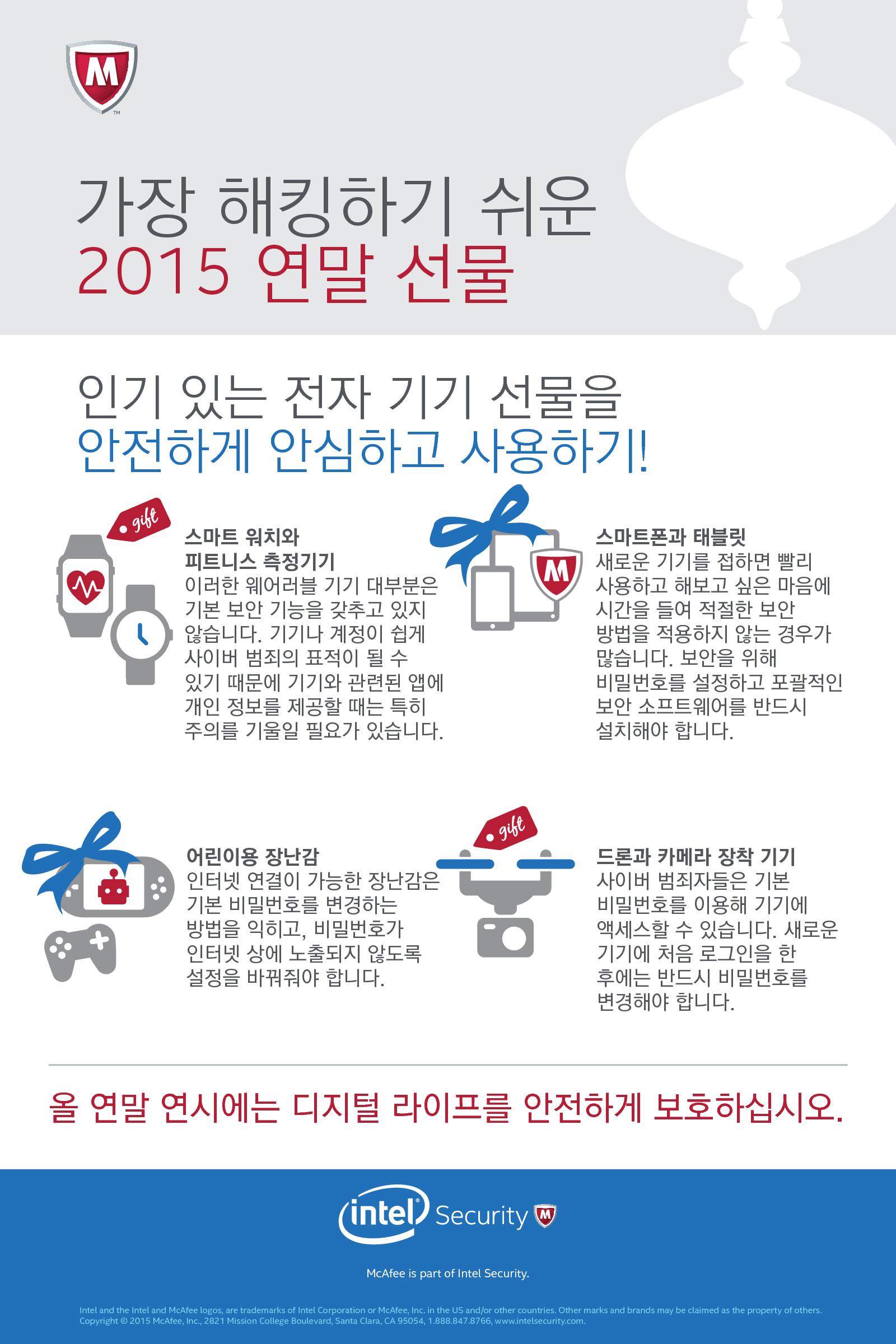
From wearable fitness trackers to smartwatches, action cameras, and drones, this year's wave of high-priced electronic gadgets is sure to grab everyone's attention. The problem is that these gadgets attract not only the attention of gift givers but also cybercriminals. Fortunately, a few simple steps can help secure these popular gifts. A good start is to consider potential security threats before use and be mindful of how to effectively protect your new gadget while in use. Let's take a look at some of this year's most hackable holiday gifts and how you can make them more secure and safe.
A list of easy-to-hack holiday gifts
1) Wearable devices such as smartwatches and fitness trackers
This year has truly been the year of wearables. Smartwatches and fitness trackers, the most exciting segment of consumer IoT, have become some of the most coveted holiday gifts. However, there's a caveat: wearables often lack adequate security features, making them easy targets for cybercriminals. While wearables themselves don't contain much data for cybercriminals to exploit, they often connect to other devices, such as smartphones or computers. Cybercriminals can exploit these connections to steal contact information from connected devices or, in extreme cases, install malware on them. Furthermore, many consumers tend to underestimate the amount of data their wearables collect. Therefore, consumers should be especially cautious about how much personal information they provide to apps associated with their devices, as this could lead to a compromise of their devices or accounts, potentially exposing their data.
Intel Security is also aware that cybercriminals can exploit Bluetooth vulnerabilities to steal data. Furthermore, some devices use simple passwords, such as 0000 or 1234, as default Bluetooth pairing passwords, making it easy for cybercriminals to pair devices and steal information. Cybercriminals can then use stolen usernames, email addresses, and other information to launch new attacks, such as spear phishing. Spear phishing attacks are attempts to steal sensitive data, including personal information, by sending emails impersonating companies or acquaintances we know.
2) Smartphones and tablets
When people receive a smart device as a gift, they often rush to use it and try it out, often failing to take the time to properly secure it beforehand. This applies to mobile devices like smartphones and tablets. For example, some people use simple passwords like 0000 or 1234 as the default Bluetooth pairing password for some devices. Cybercriminals can easily discover these passwords, pair them, and gain unauthorized access to the device. As with the aforementioned smartwatches and fitness trackers, cybercriminals can exploit this connectivity to steal users' contact information or spread malware on the device.
3) Drones and camera-equipped devices
Drones and remote-controlled cameras are also high on the list of popular holiday gifts this year. According to data from the Consumer Electronics Association (CEA), the U.S. consumer drone market is expected to reach $105 million in 2015 alone. However, remote-controlled cameras and drones can also be easy targets for hackers. Without proper security measures in place, these devices could lead to the sharing of personal information with individuals you wouldn't otherwise want to share it with.
Default passwords can leave your device vulnerable to cybercriminals. Most users forget or don't know how to change their password after logging in to a new device for the first time. However, you should always consult your device's manual or online guide to change the default password immediately.
4) Electronic devices for children
Toys and electronic devices gifted to children during the holiday season are now almost always equipped with internet functionality. This means parents need to be aware of how these toys, whether remote-controlled cars or dolls, can connect to the internet and interact with it. Therefore, parents should take steps to protect their home's online environment, such as learning how to change the default passwords on internet-connected toys and adjusting settings to prevent passwords from being exposed online.
The most basic and important security measures
So how can we make the devices we receive as gifts more secure? Let's take a closer look at some of the following methods. They're not difficult or time-consuming at all.
1) Change the default password: This is probably one of the best ways to protect your device this holiday season. Changing your device's password to a complex password of at least eight characters, combining numbers, symbols, uppercase and lowercase letters, and more, can dramatically improve security.
2) Continuous software updates: Smart devices require regular software updates. These updates typically include security improvements to protect users from cybercrime. Be sure to update your device as soon as updates become available.
3) Protecting Core Devices: If a drone or fitness tracker is hacked, it's important to prevent the intrusion of any connected devices, such as smartphones, tablets, or laptops. Security solutions like McAfee LiveSafe™ protect your digital life from malware and attacks, regardless of the device.
4) Turn off Bluetooth when not in use: Many devices use easy-to-guess default passwords when pairing a Bluetooth device with a smartphone. To protect against hacking threats, change the default password and turn off Bluetooth when not in use.
5) Use secure Wi-Fi: Always be cautious when using wireless hotspots in public places. Always use a secure network when accessing the internet from outside.
관련뉴스

The core of Intel's second platform for the IoT market is 'low-power silicon and a free OS'
인텔은 사물인터넷(IoT) 분야를 위해 가장 종합적인 제품 라인업을 제공하기 위한 노력의 일환으로 새로운 인텔 IoT 플랫폼 레퍼런스 아키텍처(reference architecture)와 하드웨어 및 소프트웨어 제품군을 출시했다.
2015.11.04by 신윤오 기자
Intel Expands Product Line Built on Network Intelligence
With the emergence of IoT and the proliferation of big data-centric services, the networking sector faces increasingly significant challenges. To comprehensively handle current and future devices, data, and services, an agile cloud-based approach is necessary. To facilitate this network transformation through the application of server, cloud, storage, and virtualization technologies and to build at faster speeds, Intel has launched three new product families that enhance network intelligence and bandwidth.
2015.11.12by

Intel Focuses on Building Ecosystem to Form 5G Network Foundation
인텔이 새로운 제온 프로세서 D 제품군 및 주요 기업들과의 협업 내용을 공개하며, 클라우드 방식 통신 네트워크(cloud-ready communications networks)로의 신속한 전환을 주도해나가겠다고 발표한 배경과 맥을 같이 한다.
2015.12.03by 신윤오 기자

Ecolab and K-water Discuss Innovation Collaboration in Advanced Industry Water Management
Ecolab and the Korea Water Resources Corporation jointly discussed cooperation directions for maximizing water use efficiency in advanced industries such as semiconductors and data centers and establishing sustainable water circulation. The two companies agreed to gradually develop a long-term cooperation model that combines water resource infrastructure and water management technology to promote water efficiency optimization, water reuse, and carbon reduction.
2026.08.28by 명세환 기자

에이치에너지, 녹색기술인증 획득…솔라온케어 가동률 99.82%
에이지에너지가 태양광 발전예측 및 I-V커브 이상진단 기술로 중소벤처기업부 녹색기술인증을 획득했다. AI 기반 자산관리 플랫폼 솔라온케어는 전국 3,000개 이상 발전소에 적용되어 99.82%의 시스템 가동률과 3.7% 발전성능 개선을 달성했다. 실시간 데이터 분석을 통해 모듈 노화와 부분 음영 등 미세한 손실을 조기에 감지하고 관리함으로써 발전 수익을 보호한다.
2026.08.25by 명세환 기자











