



[Contribution] The Concerns of Software Developers in the Age of Industrial Automation
 Published2015.12.15 18:53
Written by Warren Kurisu, Mentor Graphics
As the Internet of Things (IoT) continues to advance at an accelerating pace, countless possibilities are being realized through connected devices in our homes and workplaces. According to one industry report, there will be 50 billion intelligent devices connected to the Internet by 2020. While much attention is focused on how these connected devices will permanently transform our lives, one industry stands on the brink of profound change due to the IoT and the resulting interconnection of objects: industrial automation.
The advent of the “Industry 4.0” era
Industrial automation has been undergoing rapid technological change for several years. In fact, while industrial automation has steadily evolved since the early days of machine-to-machine (M2M) technology decades ago, this progress has primarily been limited to basic communications in production settings.
But with the advent of this new wave of industrial automation, often referred to as the Industrial Internet of Things (IIoT) or “Industry 4.0,” major industrial automation manufacturers like Siemens and General Electric (GE) are enabling interoperability not only between devices but also between open, remote facilities and operations.
Industry 4.0 is not just about how a few isolated devices are connected to the infrastructure; it's also about how they are connected. This new wave is driving increased interaction and data exchange across the entire industrial supply chain, from end-nodes (sensors, actuators, aggregators, etc.) on the factory floor to the entire IoT enterprise and ultimately to data centers in the cloud. As the cloud increasingly plays a crucial role in Industry 4.0, it's important to remember that cybersecurity is also becoming increasingly important.
Ongoing challenges
Needless to say, IoT and industrial automation have made significant strides. Many companies have improved cost efficiency and reduced form factors and energy consumption by mastering data collection and streamlining technologies. However, with the advent of Industry 4.0, the increasing complexity of embedded systems and the emergence of more sophisticated system-on-chip (SoC) architectures, we now stand at a critical crossroads.
To remain competitive, industrial automation manufacturers must address the following:
• Global Market : Competition in the global market is forcing companies to focus on reducing capital and operating costs.
• Security Issues : As connectivity between devices and local area networks (LANs) increases and the value of the data exchanged also increases, cyber-terrorism has become a very real concern, focusing attention on various security issues.
• Safety requirements : The increased cost of injuries in industrial automation environments is driving the need for enhanced safety requirements.
Problem solving
A reliable solution for industrial automation systems must not only address the aforementioned trends, but also enable industrial automation manufacturers to increase the competitiveness of their products, accelerate product development times, and minimize the effort and costs of implementing IIoT systems.
If these goals are achieved, ultimately a faster and more efficient time-to-market will be realized. Additionally, as companies transition from legacy systems to the IIoT, they seek to optimize software reuse and expand their industrial product lines by integrating their existing embedded designs, while reducing size and power consumption.
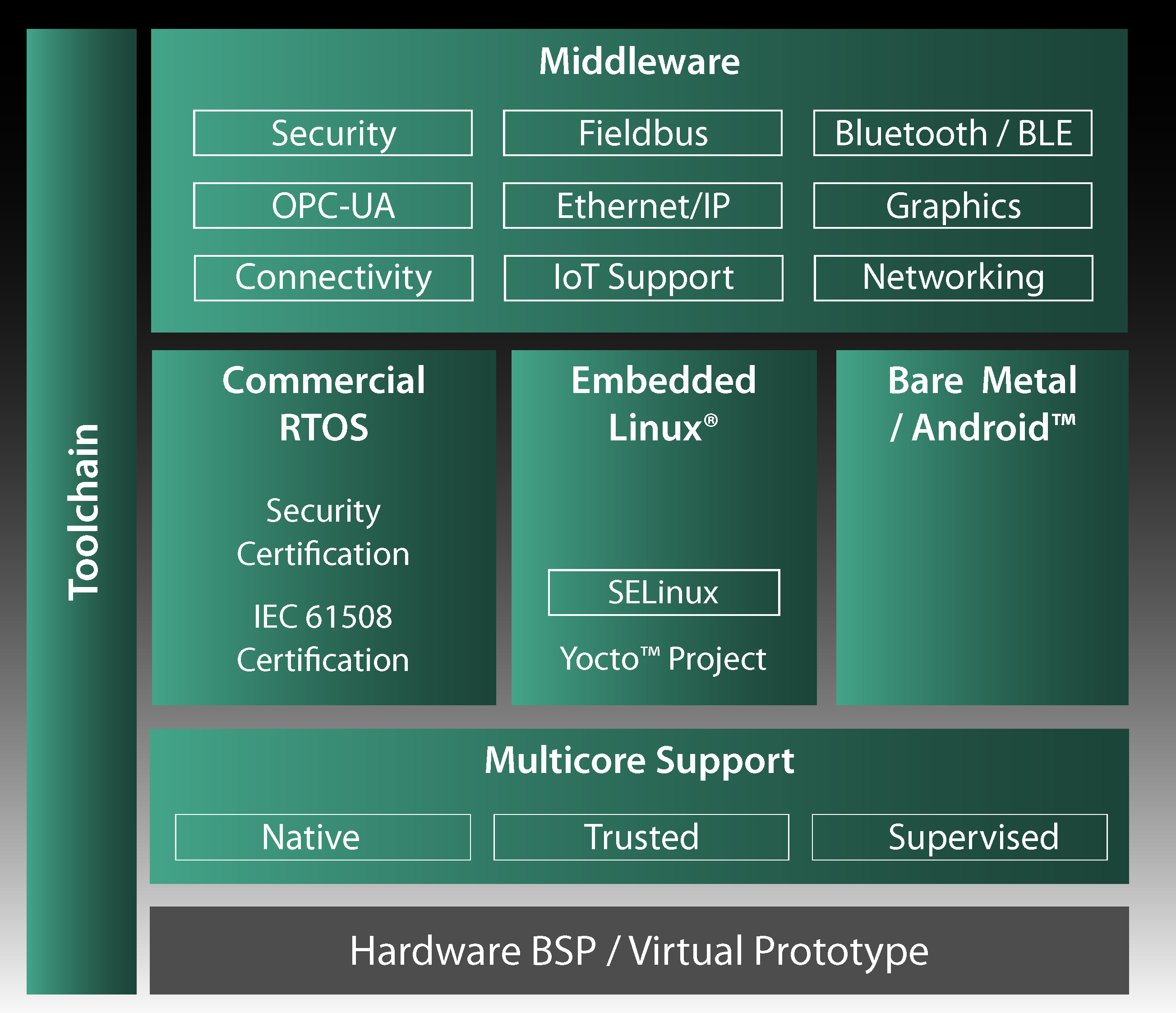
Figure 1 : Today's industrial automation solutions for IoT must be able to operate across a combination of operating system environments. These can include open source software (e.g., embedded Linux and Android) and commercial real-time operating systems (RTOSs), or they can operate on bare metal without any operating system. If a commercial RTOS is selected, it must also include the latest safety certifications.
Selection Requirements for Commercial RTOS
If the core of your industrial automation solution will run on a commercial real-time operating system (RTOS), it's advisable to select an RTOS that's scalable, fully optimized, and well-suited for a range of industrial automation devices and systems. A good RTOS should include a user-space process model to isolate applications, allowing for the isolation of specific applications that may require greater security.
Additionally, the RTOS should have a wide range of connectivity and security options, including the latest safety certifications, and should be certified to at least IEC 61508. In this context, we recommend building industrial control over cybersecurity by ensuring that RTOS is compatible with other types of communication certification.
Another important aspect of using an RTOS is ensuring that it runs on a cross-platform, open-source user interface (UI) development framework. A widely used UI development platform today is the Qt platform. Qt provides a library of visual display elements, allowing developers to build not only a high-performance, low-footprint RTOS, but also more localized and user-friendly UI graphics.
The need for open source software
When choosing an open-source software (OSS) platform like Linux, the Linux kernel must be commercially supported, extensible, and customizable. The Yocto Project is one example of a Linux development community that empowers users to launch their own Linux projects.
Such Linux platforms enable project teams to quickly and efficiently scale to production. For industrial automation products, Linux must be integrated with advanced tools and support features, such as PREEMPT_RT for real-time operation and SELinux for security. The chosen Linux platform should complement proprietary capabilities, including fast boot technology, tool instrumentation, and multicore support (enabling the development of multicore architectures).
The Importance of Multicore Support
A key element of any industrial automation solution is ensuring that the operating system supports multicore development. Multicore support allows developers to configure, deploy, and manage multiple operating systems and applications across multiple homogeneous and heterogeneous processes. Multicore development support helps manage many issues related to interprocess communication, resource management/sharing, and core management within heterogeneous multicore environments. Reliability is a key focus in all aspects of industrial automation, so software developers working within heterogeneous architectures must ensure that the failure of a subsystem does not cause failures or performance degradation in other parts of the system (or even the entire system).
Built-in connectivity and middleware
Another crucial element for any industrial automation solution is connectivity and middleware availability. A suitable platform must incorporate numerous connectivity and middleware capabilities to build a feature-rich industrial automation system. The platform must also incorporate IoT technologies to support the OEM's cloud strategy. These technologies include support for protocols such as CoAP, RESTful API support, and MQTT.
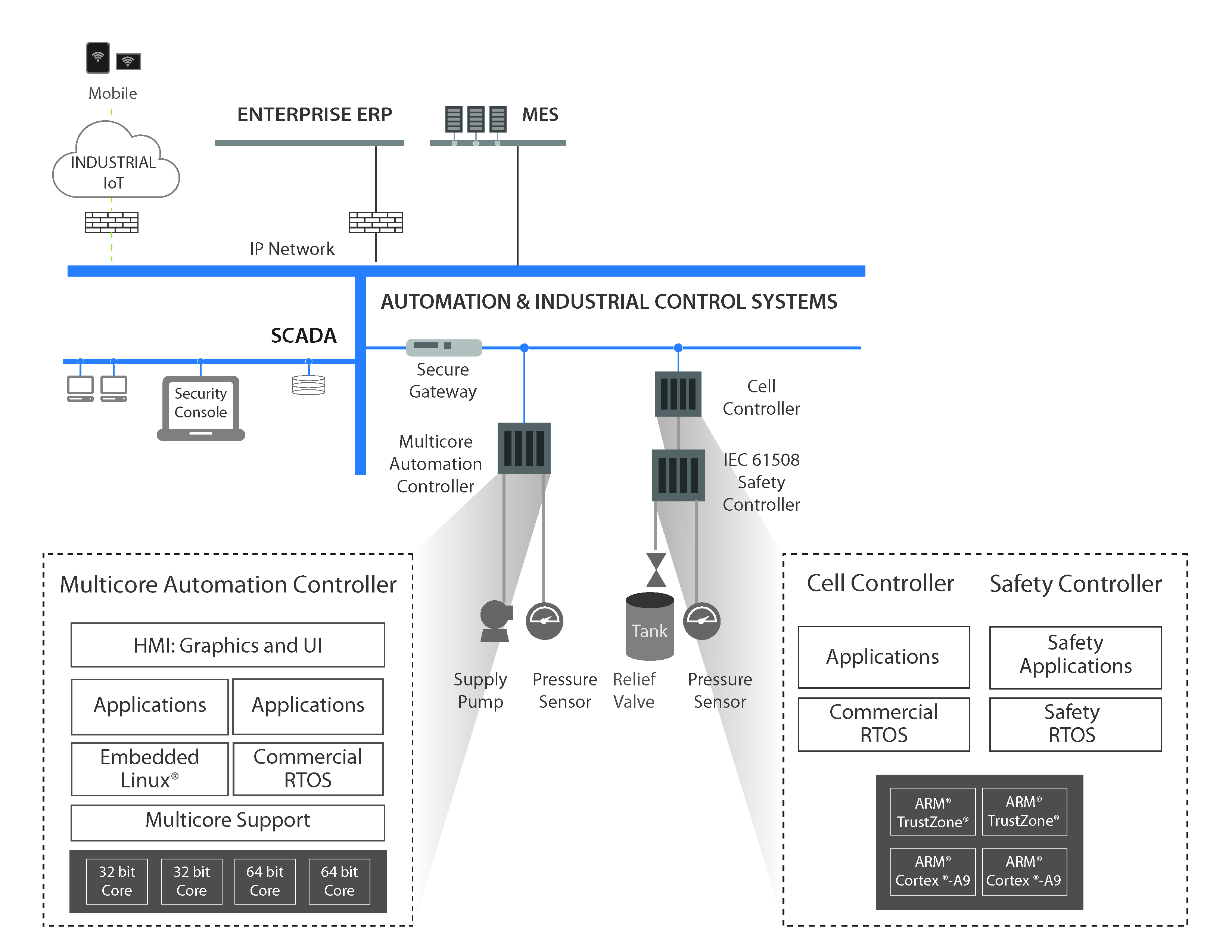
Figure 2 : A typical multiplatform solution enables industrial automation from end nodes (supply pumps, pressure sensors, relief valves, etc.) to the enterprise and ultimately to the cloud.
conclusion
What does this mean for industrial software engineers or company CFOs considering implementing IIoT solutions?
First, companies can achieve higher profitability through convergence. IIoT solutions suitable for industrial automation are comprised of numerous technological convergences that have been tested and proven. This results in faster uptime and reduced vulnerabilities.
This type of approach allows companies to focus more time on differentiating their products or markets. In other words, you can focus on differentiating your strategy and competitiveness.
Finally, by choosing a platform with multiple runtime environments, integrated tools, and third-party technologies, you can build industrial automation solutions that can easily add new product lines or features, extend product lifecycles, shrink product form factors, and reduce power consumption.
For embedded developers of industrial automation systems looking to leverage their legacy systems while minimizing risk, now is the time to harness the power of IoT and Industry 4.0.
### Author Bio:
Warren Kuris, Director of Product Management for Mentor Graphics' Embedded Systems Division (ESD), oversees the embedded runtime platform business for Nucleus, Mentor Embedded Linux, the Automotive Technology Platform, AUTOSAR, and virtualization technologies. With nearly 30 years of experience as an embedded developer and executive in a variety of embedded industries, including aerospace, networking, industrial, medical, automotive, and consumer, Warren Kuris holds a Master of Science in Electrical Engineering from the University of Southern California (USC) and a Master of Business Administration (MBA) from the University of California, Berkeley.

Comments
Related news

Xilinx Completes Development of All-Programmable Multiprocessor SoC Using TSMC's 16nm FF+ Process
Xilinx has announced the completion of development of an all-programmable multi-processor SoC (MPSoC) using TSMC's 16FF+ process, targeting embedded vision including ADAS and autonomous vehicles, industrial Internet of Things (IIoT), and 5G wireless systems. Using the all-programmable Zynq® UltraScale+™ MPSoC enables the development of various standards-based platforms with more than 5x system-level performance per watt, as well as the security and safety required for next-generation systems and ubiquitous connectivity.
2015.07.03by 명세환 기자
Mentor Unveils Pre-integrated and Comprehensive Platform Supporting Connectivity Between Automotive and Home Appliances
Mentor Graphics announced the launch of the Mentor Automotive Connected OS™ software platform, targeting next-generation automotive applications.
2015.11.02by 신윤오 기자
Intel Unveils Next-Generation 'Core Ultra Series 3' and vPro Platform for Enterprise PCs
Intel has officially unveiled the "Intel Core Ultra Series 3" for next-generation enterprise PCs and the latest vPro platform, addressing a wide range of demands from enterprise notebooks to high-performance workstations.
2026.03.26by 배종인 기자
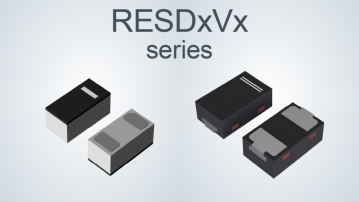
ROHM Launches ESD Protection Diode Compatible with High-Speed Interfaces of 10Gbps or Higher
Semiconductor specialist ROHM has developed the 'RESDxVx series' of ESD (electrostatic discharge) protection diodes capable of responding to next-generation high-speed data communication environments exceeding 10Gbps, simultaneously enhancing both signal quality maintenance required in high-speed interfaces and IC protection performance.
2026.03.26by 배종인 기자











