



Wind River Develops Carrier-Grade vBCPE Reference Design
 Published2015.12.17 19:27
Wind River has announced a reference design for virtual business customer premises equipment (vBCPE) through close collaboration with four NFV software partners.
The participating companies are Brocade, Check Point, InfoVista, and Riverbed. Wind River has showcased a fully functional multi-purpose vBCPE on its network functions virtualization infrastructure (NFVi) platform, Wind River Titanium Server™.
As communication service providers' interest in the benefits of NFV grows, vBCPE applications are emerging as a means to reduce operational costs. The virtualization of CPE functions, which were previously implemented as separate physical appliances, enables more efficient utilization of computing resources, increases agility in service implementation, and eliminates remote equipment update and maintenance costs, thereby reducing operational expenses. Additionally, the fact that operational cost reduction benefits can be guaranteed regardless of whether vBCPE functions operate on the customer's own servers or on the service provider's data center is becoming a significant highlight.
All VNFs to Continue Being Deployed Through Wind River Cloud
Wind River has included virtual network functions (VNFs) from Brocade, Check Point, InfoVista, and Riverbed in this vBCPE reference design. All these VNFs based on Wind River Titanium Server will continue to be deployed through partnerships in the Wind River Titanium Cloud ecosystem.
Charlie Ashton, Vice President of Business Development for Network Solutions at Wind River, stated, "The reference design developed with our VNF partners is a highly encouraging achievement. On an NFVI platform that guarantees carrier-grade reliability, we have demonstrated sufficient potential to integrate VNFs from multiple sources, each delivering individual functions into a single service chain for enterprise-grade vCPE solutions."
Michael Bushong, Vice President of Product Management for Software Networking at Brocade, said, "Through the accelerated virtual switch (vSwitch) on the Titanium Server platform, the Brocade 5600 Virtual Router has achieved optimal virtual routing performance. Routing performance plays a critical role in maximizing overall vBCPE subscription capacity and is one of the key factors in opening a new IP era for networking."
Alon Kantor, Vice President of Business Development at Check Point, stated, "We are pleased to supply market-leading network security technology to Wind River's NFV solution. Through the combination of next-generation security technology from Wind River and Check Point, we will provide innovative threat defense technology in a service-based model, enabling enterprises to safely protect their networks and data from the latest malware and zero-day attacks."
Ranga Thittai, Vice President of Strategic Technology Alliances at InfoVista, said, "InfoVista sees great potential in NFV service chains. Through the integration of InfoVista's application and routing control technology with Titanium Server NFV, service providers can effectively manage application SLAs and deliver optimal hybrid WAN services. This will enable customers to achieve application performance and user experience optimized for their business objectives."
Katie Colbert, Vice President of Global Technology Alliances at Riverbed, stated, "We are excited about developing an end-to-end next-generation NFV solution ready for market deployment through collaboration with Wind River. With over 27,000 customers worldwide and listed as a leader in the Gartner Magic Quadrant for WAN Optimization for eight consecutive years, Riverbed has implemented software-defined networks that guarantee optimal application performance across all types of networks through close collaboration with partners and service providers."
Choi Woo-young, Korea Network Director at Wind River Korea, said, "Domestic and international service providers can achieve rapid service deployment at levels previously possible in enterprise networks, as well as attain carrier-grade uptime and reliability meeting strict telecommunications network standards through Wind River's Titanium Server, which serves as the foundation for NFV software. Wind River Titanium Server, in particular, is based on designs optimized for open standards and Intel architecture, including carrier-grade Wind River Linux, real-time KVM (Kernel-based Virtual Machine), carrier-grade plug-ins for OpenStack®, and DPDK (Data Plane Development Kit), ensuring high performance and reliability meeting expectations."

Related news
Wind River Launches Free OS to Expand into the Cloud
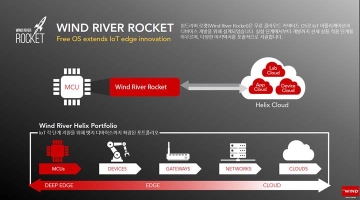
Wind River has a cloud product portfolio called Wind River Helix™ Cloud that simplifies and automates the development and operation of IoT solutions ranging from consumer appliances to industrial equipment. To build an ecosystem based on this, the company announced the launch of free operating systems Wind River Rocket™ and Wind River Pulsar™ Linux.
2015.11.05by

Huawei and Wind River Strengthen Network Function Virtualization Ecosystem
Huawei and Wind River announced that they have completed integrated testing of Network Functions Virtualization (NFV) network architecture in a multi-vendor environment through their partnership. The testing was conducted at Huawei's NFV/SDN Open Lab located in Xi'an, China.
2015.11.30by
Wind River Rises as Global Leader in 'Embedded Operating Systems'
Wind River announced that it has been selected as the leading company in the global real-time operating system (RTOS) and commercial embedded Linux market this year, citing a report published by market research firm VDC Research. This was disclosed through VDC Research's report titled "The Global Market for IoT and Embedded Operating Systems," in which VDC covered information on RTOS and non-real-time operating systems released to the market, as well as other bundled products and services.
2015.12.09by 명세환 기자
European Patent Applications Surpass 200,000 for the First Time… South Korea Maintains 5th Place, Led by Batteries and Telecommunications
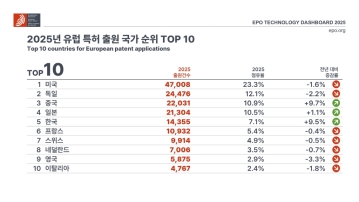
According to the European Patent Office (EPO)'s 'Technology Dashboard 2025', European patent applications last year reached 201,974, surpassing 200,000 for the first time. Korean companies and inventors filed 14,355 applications, representing a 9.5% increase from the previous year and maintaining 5th place by country. Battery, digital communication, and semiconductor technologies led the growth, with Samsung ranking as the top EPO applicant for the second consecutive year and LG reaching 3rd place. The presence of major domestic cities such as Seoul, Suwon, and Yongin was also confirmed. It was also revealed that Korea's European patent strategy is expanding beyond individual technologies to span the entire industry.
2026.03.24by 명세환 기자

SK Telecom First Applies AI-Based Network Operations at Gwanghwamun K-Pop Concert
SK Telecom announced that it applied an AI-based network operation system for the first time at a large-scale K-pop concert held in the Gwanghwamun area of Seoul on March 21st, managing communication quality throughout the event. Mobile data usage during the three hours before and after the concert reached 12.15TB, approximately doubling compared to the same time slot the previous weekend. SK Telecom monitored traffic using the AI system 'A-One' in five-minute and 50-meter units to respond to potential overload situations, while also operating temporary communication facilities and on-site personnel in parallel. This case is interpreted as confirmation of the practical applicability of AI-based autonomous network operation in an environment where demand from dense events and foreign users increases simultaneously.
2026.03.23by 명세환 기자











