

.png)

Development of a high-efficiency metafilm that generates steam instantaneously
 Published2016.01.04 14:56
Domestic researchers have developed a plasmonic black gold metafilm that absorbs most of the sunlight and collects it at the nanoscale level.
The Plasmonic Black Gold Metafilm is a gold-aluminum oxide nanostructure film that appears black by absorbing broadband sunlight. The Ministry of Science, ICT and Future Planning (Minister Choi Yang-hee) announced that a research team led by Professor Kim Kyung-sik of Yonsei University has developed a high-efficiency metafilm capable of instantaneously generating steam without a separate light-concentrating process.
Low cost, ease of miniaturization or large-area production, and mass production possible
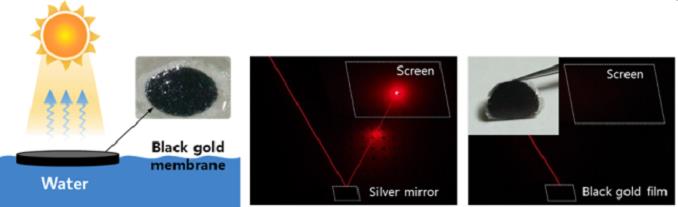
▲ Schematic diagram of the solar steam generation experiment from black gold metafilm.
The research team conducted research on improving solar steam generation efficiency through metal-dielectric nanostructures through the Basic Research Program (Mid-career Researcher Support Program) supported by the Ministry of Science, ICT and Future Planning, and the results were published on December 14 in Nature Communications, a prestigious journal in the field of natural science.
Professor Kim Kyung-sik ( pictured below ) explained the significance of the research, stating, “Metal metafilms are inexpensive and do not require separate complex systems, making them easy to miniaturize or produce on a large scale, and they possess the advantage of enabling mass production.” He added, “The results of this research can be widely utilized as an eco-friendly core technology to improve the efficiency and productivity of solar-powered steam power generation, steam sterilization, and seawater desalination devices, and are expected to contribute to solving the drought problem that has recently become an issue.”
 What was the motivation or background for starting this research?
Previously, heat generation due to light absorption was considered a loss, so research was conducted to minimize it. However, it was decided to maximize heat generation and utilize it in other applications, and a structure was developed that could boil water anywhere using sunlight without a complex power supply.
- An introduction to the research development process.
While researching structures for broadband absorption, it was discovered that this could be achieved through the plasmonic nanofocusing phenomenon, and a high absorption rate was obtained by coating gold based on the structure of anodized aluminum nanowires. Afterwards, a porous tape was found and applied to ensure a continuous supply of water necessary for steam generation.
What difficulties or obstacles did you encounter during the research? How did you overcome (resolve) them?
Although there were difficulties in finding a theoretical verification process for developing the black gold film and utilizing it in solar steam generation experiments, a clue to the solution was found through precise simulation verification and collaborative research and discussions with Professor Park Won-jang of the University of Colorado.
- What makes this achievement different?
It absorbs more than 91% of ultra-wideband wavelength light to convert solar energy into thermal energy with an efficiency of up to 57%, and can produce steam quickly and efficiently with minimal heat loss by floating it on water in the form of a thin film.
What are your most important goals and future research plans?
We intend to contribute to resolving the recent drought problem by utilizing the black gold metafilm developed in this study, and to research methods to produce it at a lower cost for industrial application.

관련뉴스

Intel Unveils Next-Generation 'Core Ultra Series 3' and vPro Platform for Enterprise PCs
Intel has officially unveiled the "Intel Core Ultra Series 3" for next-generation enterprise PCs and the latest vPro platform, addressing a wide range of demands from enterprise notebooks to high-performance workstations.
2026.03.26by 배종인 기자

ROHM Launches ESD Protection Diode Compatible with High-Speed Interfaces of 10Gbps or Higher
반도체 전문 기업 로옴(ROHM)이 10Gbps를 넘어서는 차세대 고속 데이터 통신 환경에 대응할 수 있는 ESD(정전기 방전) 보호 다이오드 ‘RESDxVx 시리즈’를 개발하며, 고속 인터페이스에서 요구되는 신호 품질 유지와 IC 보호 성능을 동시에 끌어올렸다.
2026.03.26by 배종인 기자

ST Launches 75V Drive IC Targeting 48V Industrial Motor Driving
ST마이크로일렉트로닉스가 48V급 산업용 구동 시스템 설계에 맞춘 75V 모터 드라이브 IC ‘STSPIN9P’ 시리즈를 공개했다. 새 제품군은 하프 브리지와 풀 브리지 구조로 구성돼 모터 종류와 출력 조건에 따라 설계를 확장할 수 있도록 한 것이 특징이다. 전원 회로와 보호 기능, 전류 감지 회로를 칩에 통합해 시스템 구성을 단순화했으며, 최대 500W급 애플리케이션까지 대응하도록 설계됐다. 회사는 레퍼런스 디자인과 데모 보드도 함께 제공해 산업 자동화, 로보틱스, 펌프, 팬, 조명, 섬유 기계 등에서 개발과 평가를 지원할 계획이다.
2026.03.26by 배종인 기자

Nordic supports security updates for the entire lifecycle of IoT devices at a single fixed cost
Nordic Semiconductor, a global leader in low-power wireless connectivity solutions, has unveiled a single fixed-cost licensing model that delivers FOTA (Firmware Over-the-Air) and device management capabilities throughout the device lifecycle via nRF Cloud, and introduced a new firmware update solution to prepare for the enforcement of the European Union's Cyber Resilience Act (CRA).
2026.03.26by 배종인 기자

Practical Training in Low-Noise, Low-Power Circuit Design All in One Place… Training Fee Support
고감도 아날로그 회로와 센서 기반 시스템 설계 역량을 강화할 수 있는 ‘2026 고급 엔지니어 실무 마스터 클래스’가 오는 4월16일 서울 가산동 e4ds 컨퍼런스 센터에서 열린다. 이번 과정은 온라인이 아닌 오프라인 유료 실습 교육으로 진행되며, 현장 중심의 심화 학습을 원하는 엔지니어를 대상으로 한다. 이번 교육은 텍사스 인스트루먼트(Texas Instruments)가 교육비를 지원해 정가 25만원에서 10만원 할인 된 15만원에 참가할 수 있다.
2026.03.26by 배종인 기자











