

.png)

Elastic resin film and material development suitable for clothing and the human body
 Published2016.01.04 18:10
Applicable to wearable devices, sensors, displays, robots, and more
Panasonic Corporation announced the development of soft and flexible elastic polymer resin film utilizing its proprietary elastic resin technology. Panasonic also plans to provide transparent electrode material and conductive paste along with this insulating film.
The newly developed material is an insulating film material that stretches and returns to its original shape. This is a characteristic rarely found in conventional elastic materials. This material can be applied to desired folding methods and various freeform surfaces, significantly reducing existing design constraints.
For example, it enables the configuration of flexible and elastic electronic products that can be applied to various forms such as clothing and the human body. The newly developed material can be utilized in a wide range of applications ranging from wearable devices to sensors, displays, and robots.
The newly developed film and materials will be exhibited through the "17th Printed Wiring Boards Expo" to be held at Tokyo Big Sight from January 13-15, 2016.
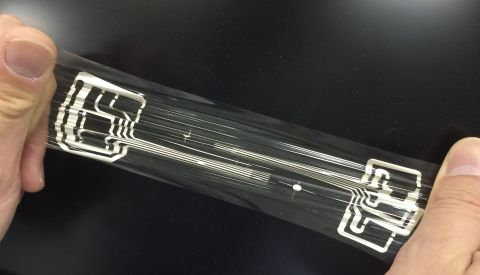 Outstanding elasticity, soft and stretchable, restores to original shape and enables repeated use
As various wearable devices are being developed, there is growing demand for designs that mitigate the bouncing sensation when wearing products and provide greater aesthetic satisfaction, as well as for smaller and thinner form factors. Polyurethane and rubber materials must overcome issues related to adhesion, heat resistance, and embrittlement, and there is high demand for suitable materials with excellent heat resistance, durability, and processability.
Panasonic focused on the proven performance of conventionally used thermosetting resins and applied its proprietary resin design patent technology that can impart outstanding elasticity to materials, developing insulating materials made from thermosetting resins. Its distinguishing features are remarkable flexibility and stretchability. This soft and elastic insulating film enables electronic products to be worn or installed at desired locations.
Devices attached to clothing or worn on the body must be made from materials that withstand repeated use, and their mechanical properties must not change even under repetitive stress deformation (stretching and recovery). Generally, materials exposed to repetitive stretching and recovery tend to experience weakened mechanical strength and recovery performance. Panasonic applied its proprietary resin design technology that optimally utilizes the three-dimensional crosslinked structure characteristics of thermosetting resins, going beyond simple softening.
The newly developed insulating material relieves internal stress generated by stretching, restoring it to its original shape and enabling repeated use. This material helps maintain electronic products in a wearable state for much longer periods.
Additional development of elastic transparent electrode material and conductive paste using insulating material
Devices attached to clothing or worn on the body must not only be made from elastic insulating materials but must also use soft and elastic conductive materials. Panasonic used elastic resin as a substrate to develop transparent electrode material and conductive paste that maintain conductivity even after repeated stretching and recovery.
The transparent electrode material consists of a thin conductive carbon nanotube layer formed from elastic resin as the base material. The conductive paste is created by combining elastic resin used as a binder with silver filler. This material is beneficial for implementing elastic display devices and sensors.
Related news

Where Are We in Core Sensor Element Development? ② “Development of 79GHz Automotive Radar Sensor to Preempt the Autonomous Vehicle Market”
Following last week's updates on smart motion sensors, metabolic rate measurement sensors, harmful gas sensors, and optical sensors, we introduce the following technologies: ▲automotive shunt resistance current sensors ▲lidar sensors for autonomous vehicles ▲automotive 79GHz radar sensor technology.
2015.11.23by 신윤오 기자
The Present and Future of the Wearable Business: Case Studies from Two Companies
Interest in wearable devices, regarded as the next major player in the post-smartphone era, is growing increasingly fierce. The wearable device market, which generally encompasses smart devices that are worn or attached to the body to input, output, and process information, is growing at a compound annual growth rate of 21.5%, with projections indicating it will expand to a 70 billion dollar market by 2024.
2015.12.21by 신윤오 기자
Development of a high-efficiency metafilm that generates steam instantaneously
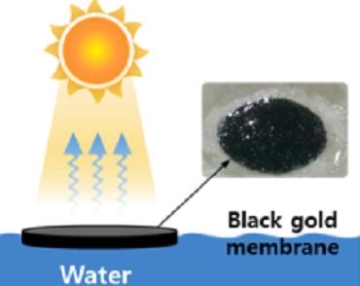
Plasmonic black gold meta film is a gold-aluminum oxide nanostructure film that appears black by absorbing broadband sunlight. The Ministry of Science, ICT and Future Planning (Minister Choi Yang-hee) announced that Professor Kim Kyung-sik's research team at Yonsei University has developed a high-efficiency metafilm that instantly generates steam without a separate light concentration process.
2016.01.04by 명세환 기자
The Problem with AI is Not Performance, but Trust
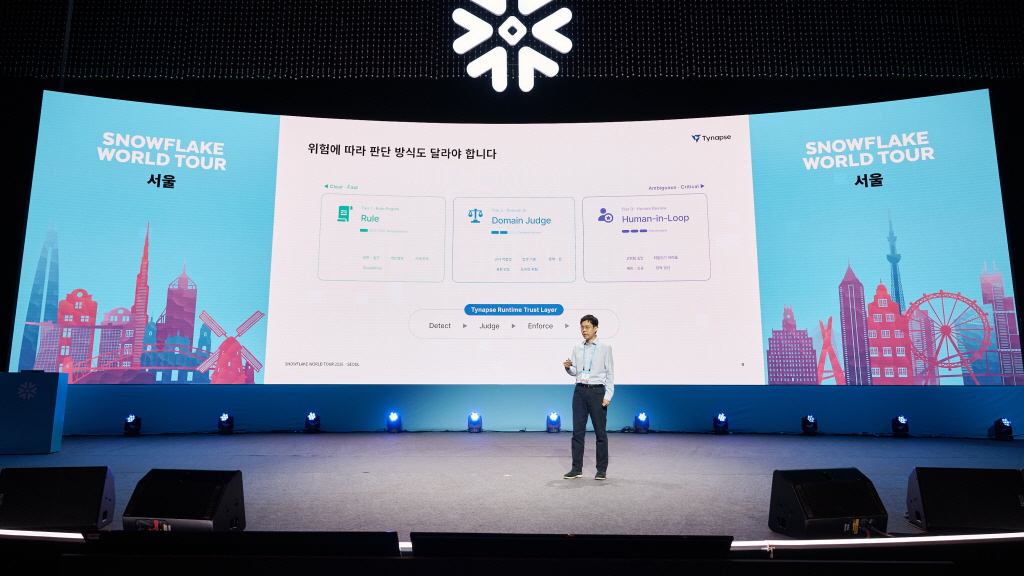
CEO Kang Min-seung emphasized at Snowflake's World Tour Seoul that generative AI has entered a phase where "trust" rather than accuracy becomes the key competitive advantage. As AI is applied to various tasks including consultation, risk management, and operational automation, incorrect data, erroneous responses, and bias are creating actual business risks. He pointed out that enterprises must build a trust layer above AI. To achieve this, accurate data management, semantic structuring, governance, and prompt security are essential. He explained that AI is not merely an automation tool but a technology that reorganizes the entire organization's workflows and decision-making systems. Snowflake provides a platform that supports this trust-based AI operation, emphasizing that enterprises should build "trustworthy AI" rather than "intelligent AI."
2026.08.28by 배종인 기자
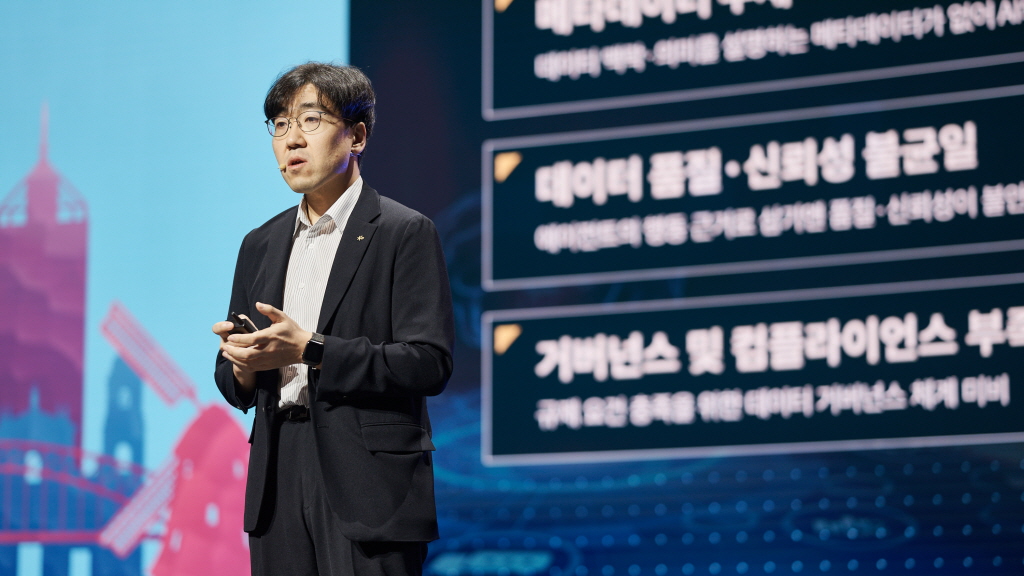
The Decisive Factor for AI Agents in Finance: "Trustworthy Data Infrastructure"
The key to spreading AI agents in the financial sector is establishing a trustworthy data system. KB Kookmin Bank is operating over 100 AI agents by 2025 and is promoting expansion to 300. AI is automating repetitive tasks across various areas such as consultation, risk management, wealth management, and relationship management. However, if data quality, governance, and semantic structuring are insufficient, errors and risks increase. KB is building an AI-Ready organization through a multi-model strategy of GPT, Gemini, and Claude, as well as a Snowflake-based data system. The bank emphasized that AI has entered a phase where it restructures not just simple automation but the entire work process and decision-making system.
2026.08.28by 배종인 기자











