

.png)

SK Telecom and Nokia Secure 5G Core Technology Beyond Wireless to Wired Infrastructure
 Published2016.01.11 16:22
SK Telecom announced on the 11th that it has successfully demonstrated wired infrastructure 5G technology for the first time in Korea at the '5G Global Innovation Center' located at the Bundang Comprehensive Technology Institute, in collaboration with Nokia, a global network equipment manufacturer.
Following their successful demonstration of the world's fastest speed of 19.1Gbps in October, SK Telecom has developed and demonstrated 5G technology in the 'core network,' the wired infrastructure, and has successfully established the nation's first end-to-end 5G technology lineup encompassing both wired and wireless services.
Core Network refers to the wired network system at the center of a mobile communication network that provides various value-added services including calls and internet to customers connected to the wireless transmission network.
Achievement within two months following 19.1Gbps demonstration
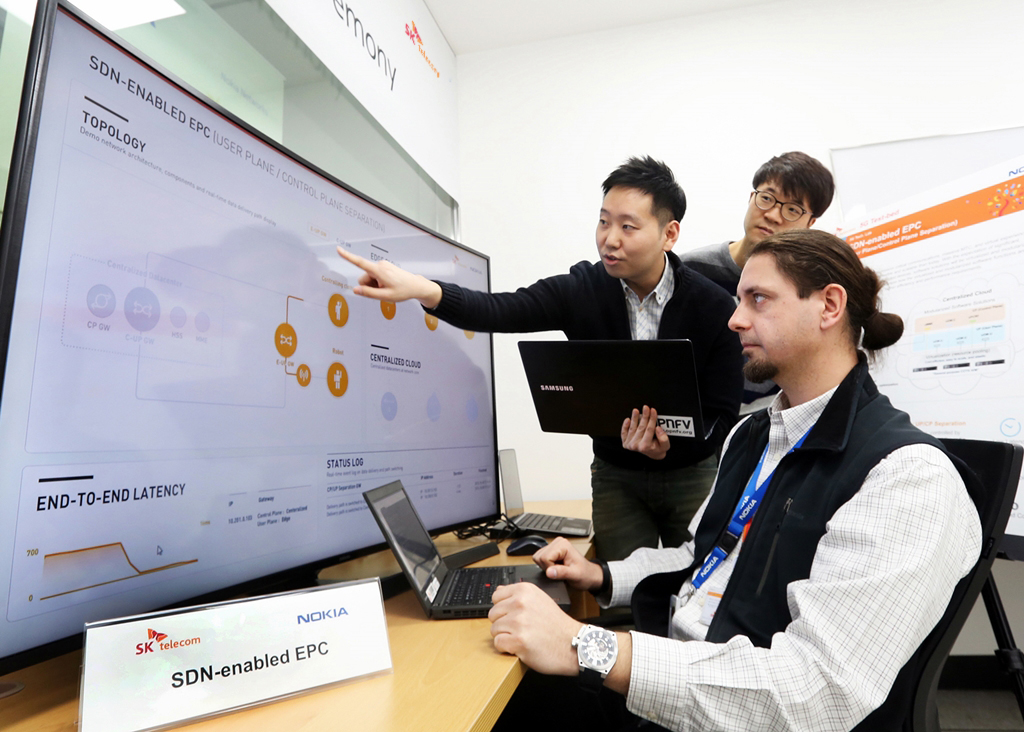
The 'core network' serves as the control tower of the mobile communication network and performs the foundational functions for providing mobile communication services such as customer authentication and data transmission. Accordingly, SK Telecom argues that since customers must access the internet through the 'core network' to utilize wireless networks, fundamental innovation of the 'core network' is essential for 5G commercialization.
Services such as calls, text messages, SNS, and internet requested by customers are processed only through 'central control centers' installed in major metropolitan areas. The 'core network innovation' that enables reduction of physical distance from customers through distributed placement of these 'central control centers' has been identified as one of the critical challenges that must be solved for the 5G era, where ultra-low latency transmission of large-capacity content is essential.
The 'core network distribution and redeployment' technology successfully demonstrated this time is a technology that can separate and redeploy the physical 'core network' through virtualization technology. When this technology is applied, virtual 'central control centers' can be established in major regions throughout the nation to immediately process service requests coming from those regions. By applying this technology, the limitation of physical distance between the 'core network' and some customers located hundreds of kilometers away can be overcome.
SK Telecom expects that this demonstration will receive interest and attention from mobile carriers and equipment manufacturers worldwide, as the 'core network distribution and redeployment' technology is being discussed in various 5G standardization meetings.
Park Jin-hyo, Head of SK Telecom's Network Technology Institute, stated, "Intelligence of the core network is essential to efficiently provide high-quality 5G services, and it is important to optimize the entire network to provide customized services through this," and added, "With the goal of providing differentiated 5G services, we plan to continue cooperation with Nokia on optimizing 5G network architecture and standardizing it."
Vesa Tykkylainen, Vice President of Nokia (VP, Liquid Core and MBB Liquid Core), said, "Through this demonstration with SK Telecom, we have verified the performance of 5G core technology that will form the foundation of the future hyper-connected era where all things are connected," and stated, "Going forward, both companies will continue cooperation on 5G technology standardization and commercialization."
Meanwhile, SK Telecom is participating in ONOS (Open Network Operating System), a 5G SDN (Software Defined Networking) core technology development project, and is making efforts to create a 5G ecosystem encompassing both wired and wireless by joining OPNFV (Open Platform for NFV), a network virtualization project group, in order to develop 'core network' technology.

Related news
Samsung Electronics demonstrates SDN, a next-generation distributed networking technology for telecommunications, in collaboration with SK Telecom
Samsung Electronics has successfully developed and demonstrated Korea's first distributed LTE switching system (SDN based Evolved Packet Core) based on next-generation communication technology in cooperation with SK Telecom.
2015.12.08by 신윤오 기자
SK Telecom Embarks on Comprehensive Cooperation with Qualcomm in Preparation for 5G Era
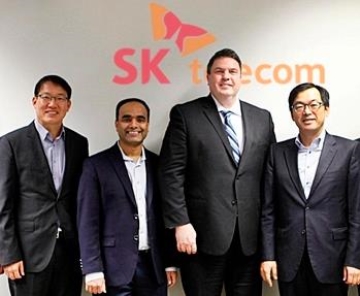
SK Telecom (CEO and President Jang Dong-hyun, www.sktelecom.com) is advancing comprehensive 5G technology research and development cooperation with Qualcomm (CEO Steve Mollenkopf, www.qualcomm.com), the world's largest telecommunications semiconductor manufacturer, including the development of 5G terminal prototypes.
2015.12.21by 명세환 기자
European Patent Applications Surpass 200,000 for the First Time… South Korea Maintains 5th Place, Led by Batteries and Telecommunications
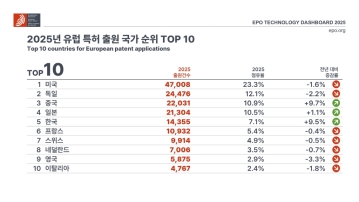
According to the European Patent Office (EPO)'s 'Technology Dashboard 2025', European patent applications last year reached 201,974, surpassing 200,000 for the first time. Korean companies and inventors filed 14,355 applications, representing a 9.5% increase from the previous year and maintaining 5th place by country. Battery, digital communication, and semiconductor technologies led the growth, with Samsung ranking as the top EPO applicant for the second consecutive year and LG reaching 3rd place. The presence of major domestic cities such as Seoul, Suwon, and Yongin was also confirmed. It was also revealed that Korea's European patent strategy is expanding beyond individual technologies to span the entire industry.
2026.03.24by 명세환 기자
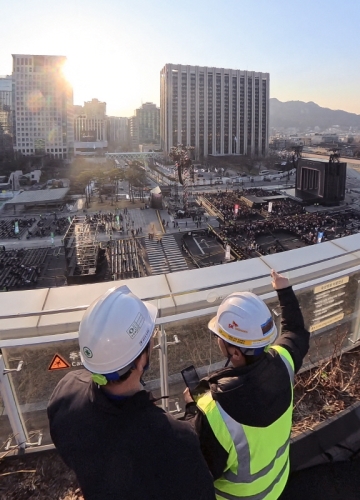
SK Telecom First Applies AI-Based Network Operations at Gwanghwamun K-Pop Concert
SK Telecom announced that it applied an AI-based network operation system for the first time at a large-scale K-pop concert held in the Gwanghwamun area of Seoul on March 21st, managing communication quality throughout the event. Mobile data usage during the three hours before and after the concert reached 12.15TB, approximately doubling compared to the same time slot the previous weekend. SK Telecom monitored traffic using the AI system 'A-One' in five-minute and 50-meter units to respond to potential overload situations, while also operating temporary communication facilities and on-site personnel in parallel. This case is interpreted as confirmation of the practical applicability of AI-based autonomous network operation in an environment where demand from dense events and foreign users increases simultaneously.
2026.03.23by 명세환 기자
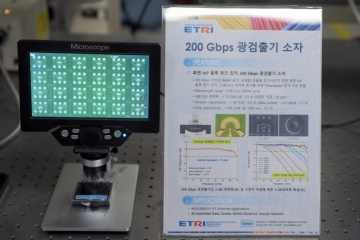
ETRI Develops 200Gbps Photodetector… Initiates Localization of Optical Receivers for AI Data Centers
The Electronics and Telecommunications Research Institute (ETRI) has developed a photodetector device that processes optical signals of approximately 200Gbps per channel for the first time in Korea. This device is a component that converts optical signals into electrical signals and determines the reception performance of AI data centers and 5G/6G communication networks. ETRI achieved bandwidth of 70GHz or higher and optical responsivity of 0.75A/W or higher, and integrated an indium phosphide lens on the rear of the chip to enhance optical reception efficiency and alignment convenience. The technology was presented at OECC 2025 and was recently published in the international academic journal 'Optics Express'.
2026.03.19by 명세환 기자











