


Domestic EMM Software Market to Grow at Average Annual Rate of 15.7% Through 2019
 Published2016.01.12 18:24
Customer Information Data Management in Service Industry Emerges as New Demand Sector
According to a recent report from Korea IDC (represented by Hong Yoo-sook), an IT market analysis and consulting firm, the domestic EMM (Enterprise Mobility Management) software market is projected to record 14.3 billion won in 2015, representing 14.1% growth compared to the previous year, driven by strong BYOD trends and increased corporate mobility utilization. Additionally, this market is forecasted to grow at a compound annual growth rate (CAGR) of 15.7% through 2019, forming a market size of 26 billion won by 2019.
As smartphone adoption enters a mature phase, corporate mobility utilization is expanding, and there is a growing trend of reviewing EMM software adoption as a mobility-based technology. While the proportion of EMM software in the enterprise mobility market is not large compared to the mobile device market size, it is expected to show meaningful growth figures. With device infrastructure in place, market interest is shifting toward mobility software.
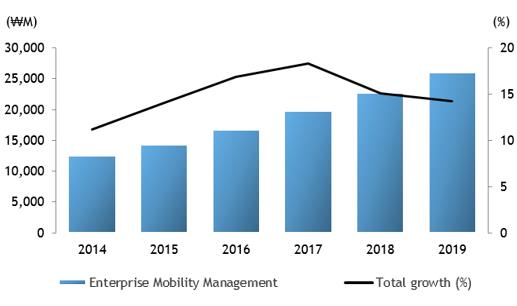
▲Domestic EMM Software Market Forecast, 2015-2019 (Unit: Million Won) Source: IDC, 2015
Lee Young-so, Senior Research Fellow at Korea IDC, stated, "With high adoption rates of mobile devices and the spread of BYOD, EMM software adoption among domestic companies will continue to increase." He added that for enterprise mobility strategy initiatives, companies will first purchase light versions of EMM standalone products that allow selection of necessary functions.
Lee explained that large enterprises that have already adopted and are using EMM, or those that have implemented various mobility solutions such as applications and security in their internal systems, will prefer integrated service forms such as mobility suites rather than selecting individual software like MDM (Mobile Device Management), MAM (Mobile Application Management), or MCM (Mobile Content Management) as standalone products.
Lee further noted, "In the early stages of EMM software market formation, focus had to be placed on MDM, which could distinguish and manage authorized users among various mobile devices flowing in due to BYOD, but such corporate demands began to change." He analyzed that starting from 2014, as mobile became a core channel in service areas at customer touchpoints such as O2O services in retail and mobile payment in financial sectors, the need to manage data related to customer information increased, expanding customer requirements for EMM software from MDM to MAM.
Concerns Over Supplier Revenue Decline Due to Excessive Competition
Meanwhile, the report suggested that despite expectations that mobile solutions, including EMM, will have positive impacts not only on corporate productivity and efficiency but also on business activation, without clear verification of ROI, companies will inevitably be reluctant to make new investments. Accordingly, it anticipated increased opportunities for entry into service sectors such as finance and distribution, where immediate returns can be expected from implementing mobile in business. Additionally, while the diffusion speed may be somewhat slower compared to the service industry, attempts to utilize mobile in production and operations within enterprises are expected to increase progressively. The report recommended that EMM software suppliers need to steadily secure technology and sales capabilities.
As various mobile devices flow into enterprises, each company is pursuing mobility strategies tailored to its systems and policies. EMM software has high growth potential as a gateway for enterprises to transition their core infrastructure to mobile. However, behind these expectations, there are demands for customization and management capabilities to meet diverse customer needs, and software price declines due to intensified competition are expected to burden suppliers.
Related news
.jpg)
The most actively applied technology in the software field is cloud computing.
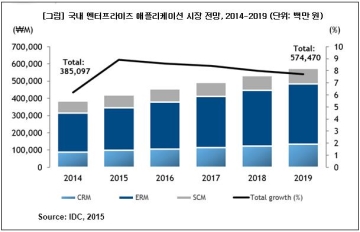
According to a recent report published by Korea IDC (CEO: Hong Yu-sook), a market analysis and consulting firm for the IT industry, titled "Korea Enterprise Application Market Forecast, 2015-2019," the domestic enterprise application market (including ERM, CRM, and SCM) grew 6.2% compared to 2013, reaching a market size of 385 billion won (based on software license standards) last year.
2015.09.30by 신윤오 기자
.jpg)
SalePoint Signs Multi-Year Partnership Agreement with AWS… Promoting Identity Security that Integrates Even AI Agents
Sailpoint has entered into a multi-year strategic partnership agreement with AWS and is moving forward with establishing an integrated governance system that manages both human and non-human identities together. The plan is to consistently manage access permissions in an environment where AI agents are increasing as work execution entities, while applying the principle of least privilege and automated policy enforcement. The two companies plan to jointly expand capabilities to manage the identities of various entities, including AI agents, within a single layer in the AWS environment. This collaboration is interpreted as a move to design security and governance together in corporate environments where AI adoption is expanding.
2026.03.26by 배종인 기자
.png)
Databricks Unveils Open AI Security Monitoring 'Lakewatch'
Databricks entered the security market on March 24 by unveiling LakeWatch, an open-source agentic SIEM. The core functionality of this product is to integrate and analyze security, IT, and business data in a single environment to support AI-based threat detection and investigation. The company explained that it reduces the limitations of existing security operations centers, which have had to forgo some data due to high cost structures, and enables large-scale data analysis and automation based on open formats and ecosystems. LakeWatch is currently offered as a private preview, with Adobe and Dropbox mentioned as early customers. Databricks also announced an expanded partnership with Anthropic as well as the acquisition of Antimatter and SiftD.ai.
2026.03.26by 배종인 기자
Ecolab Expands AI Data Center Cooling Business Through Acquisition of CoolIT
Ecolab has agreed to acquire CoolIT Systems, a liquid cooling company for AI data centers, for approximately $4.75 billion. The transaction is expected to close by Q3 2026, subject to regulatory approvals. CoolIT has been supplying direct-to-chip cooling-based coolant distribution units, cold plates, and manifolds, serving hyperscale data centers and colocation operators as customers. This acquisition is a measure to address the high-heat and high-density server environments created by AI proliferation. Ecolab plans to combine its water management and digital monitoring capabilities with CoolIT's hardware technology to expand its data center cooling business.
2026.03.26by 명세환 기자











