



Stratix V FPGA
 Published2011.10.27 14:43
Altera Corporation today announced the Stratix® V FPGA family, featuring the industry's widest bandwidth with 28-nanometer technology. The Stratix V FPGA, delivering up to 1.6Tbps (1.6 terabits per second – terabit equals one trillion bits) of serial switching capability, leverages numerous new technologies and state-of-the-art 28-nanometer process technology to significantly reduce cost and power consumption for high-bandwidth applications.
Manufactured on TSMC's 28nm high-performance process, the Stratix V FPGA family offers up to 1.11 million logic elements (LEs), 53 megabits of embedded memory, 3,680 18x18 multipliers, and integrated transceivers with industry-leading maximum operating speeds reaching 28Gbps.
These devices also feature industry-leading hardened hardware IP tailored for each application, improving system integration and performance without increasing cost or power consumption. The product family comprises four variants designed for diverse applications across wireless/wireline communications, military, broadcast, computing and storage, test, and medical markets.
Stratix V GT FPGA – The industry's only FPGA with integrated 28Gbps transceivers for 100 gigabit and beyond systems
Stratix V GX FPGA – Features transceivers ranging from 600Mbps to 12.5Gbps to support diverse applications
Stratix V GS FPGA – Contains transceivers ranging from 600Mbps to 12.5Gbps and optimized for high-performance digital signal processing (DSP)
Stratix V E FPGA – High-density FPGA ideal for ASIC prototyping, emulation, and high-performance computing applications
Vince Hu, Vice President of Product and Corporate Marketing at Altera, stated, "The density and I/O performance of our fifth-generation Stratix product family, our high-end devices, have increased dramatically, widening the competitive gap between ASIC/ASSP and FPGA." He added, "Altera will continue to pursue the challenging objective of steadily increasing bandwidth while meeting cost and power requirements. We have carefully considered every aspect from core to I/O to ensure Stratix V FPGA delivers the highest level of performance, density, and integration."
Stratix V FPGA Engineered for Bandwidth
Stratix V GX and Stratix V GS FPGAs feature 66 high-performance, low-power transceivers with maximum operating speeds reaching 12.5Gbps. Stratix V FPGA complies with all 3G, 6G, and 10G protocols and meets electrical standards such as 10G/40G/100G, Interlaken, and PCI Express® (PCIe®) Gen3, Gen2, and Gen1. These devices also provide direct interoperability with 10G backplane (10GBASE-KR) and optical modules. The 28Gbps transceivers in Stratix V GT FPGA are designed to satisfy the CEI-28G specification and consume only 200mW (milliwatts) per channel, dramatically reducing power consumption relative to bandwidth.
Beyond transceiver bandwidth, Stratix V FPGA features interfaces accommodating seven 72-bit DDR3 memory modules at 1.6Gbps speed and LVDS channels capable of operating at 1.6Gbps with ubiquitous I/O.
Altera has made several improvements to the core architecture of Stratix V FPGA to enhance logic efficiency, including the following items.
New Adaptive Logic Module (ALM) – The largest devices include up to 800,000 additional registers to maximize logic efficiency. ALM architecture is ideal for designs requiring extensive pipelining and registers.
Enhanced embedded memory structure with M20K blocks – Provides higher area efficiency and performance
Industry-first DSP blocks with variable precision floating-point arithmetic – Delivers optimal performance and efficiency across multiple precision DSP data paths
User-friendly partial re-configuration – Enables designers to reconfigure portions of the FPGA while keeping other parts operational.
Additional information on Stratix V FPGA architecture is available at www.altera.com/strarix5.
Stratix V FPGA integrates more hardened hardware IP than any other FPGA, increasing device capabilities without adding power consumption or cost. Hardened IP-integrated functions include PCIe Gen3, Gen2, Gen1, 40G/100G Ethernet, CPRI/OBSAI, Interlaken, Serial RapidIO® (SRIO) 2.0, and 10GBASE-R (10 gigabit Ethernet).

관련뉴스

Intel Unveils Next-Generation 'Core Ultra Series 3' and vPro Platform for Enterprise PCs
Intel has officially unveiled the "Intel Core Ultra Series 3" for next-generation enterprise PCs and the latest vPro platform, addressing a wide range of demands from enterprise notebooks to high-performance workstations.
2026.03.26by 배종인 기자

ROHM Launches ESD Protection Diode Compatible with High-Speed Interfaces of 10Gbps or Higher
Semiconductor specialist ROHM has developed the 'RESDxVx series' of ESD (electrostatic discharge) protection diodes capable of responding to next-generation high-speed data communication environments exceeding 10Gbps, simultaneously enhancing both signal quality maintenance required in high-speed interfaces and IC protection performance.
2026.03.26by 배종인 기자
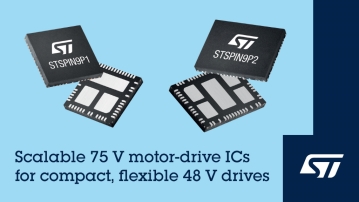
ST Launches 75V Drive IC Targeting 48V Industrial Motor Driving
ST Microelectronics has unveiled the 'STSPIN9P' series of 75V motor drive ICs tailored for 48V-class industrial drive system design. The new product family is characterized by half-bridge and full-bridge configurations that enable design scalability according to motor type and output conditions. Power supply circuits, protection functions, and current sensing circuits are integrated on-chip to simplify system configuration, and the devices are designed to support applications up to 500W maximum. The company plans to provide reference designs and demo boards to support development and evaluation in industrial automation, robotics, pumps, fans, lighting, and textile machinery.
2026.03.26by 배종인 기자

Nordic supports security updates for the entire lifecycle of IoT devices at a single fixed cost
Nordic Semiconductor, a global leader in low-power wireless connectivity solutions, has unveiled a single fixed-cost licensing model that delivers FOTA (Firmware Over-the-Air) and device management capabilities throughout the device lifecycle via nRF Cloud, and introduced a new firmware update solution to prepare for the enforcement of the European Union's Cyber Resilience Act (CRA).
2026.03.26by 배종인 기자

Practical Training in Low-Noise, Low-Power Circuit Design All in One Place… Training Fee Support
The "2026 Advanced Engineer Practical Masterclass" to strengthen competencies in high-sensitivity analog circuit and sensor-based system design will be held on April 16 at the e4ds Conference Center in Gasan-dong, Seoul. This program will be conducted as an offline paid hands-on training session, not online, and is targeted at engineers seeking on-site intensive learning. Texas Instruments will provide educational support for this training, allowing participation at 150,000 won, a 100,000 won discount from the original price of 250,000 won.
2026.03.26by 배종인 기자











