



February 9th is World Internet Safety Day. 5 Tips for Using the Internet
 Published2016.02.09 20:11
February 9th marks Safer Internet Day, a day celebrated by over 100 countries around the world to promote a safe and healthy internet environment. With smartphone ownership rates dropping and concerns about cyberbullying and harassment on social media growing, Facebook has released five tips for safe internet use that parents and children can practice together at home.
1. Set some rules before your child uses their first mobile device.
When children first begin using mobile devices, parents often worry about their children becoming overly addicted to them. Therefore, it's helpful to establish appropriate rules for their children's use before handing them a device. For example, rules regarding online time, such as "No texting after 10 p.m." or "No social media after 10 p.m.," can help prevent excessive internet use. It's important to remember that these rules should be established through conversation with your child, not imposed by parents. Parents should also be encouraged to participate in following these rules.

2. Smart parents who communicate with their children online
If your child has started using social media, it's an opportunity for parents to become "cool" mothers and fathers by joining Facebook or Instagram and interacting with them. However, monitoring or censoring their children's social media activity can diminish that "coolness." It's important for parents to proactively share their daily lives and demonstrate their use of social media, connecting with others.
3. Questions to consider before posting
It's easy to get caught up in the moment and post something on social media that you find amusing, even if it's a bit provocative. However, keep in mind that your words can hurt others or even backfire on you. Before posting, consider things like, "Do I really want people to see this? Could someone exploit my post to harm me or defame me? Could others be offended by my content? What's the worst-case scenario if I share it?"
Because any information I post could be shared in ways I didn't intend. For children, it's a good idea to ask yourself if it's okay to share your post with the entire school, and for parents, it's okay to share your post with people at work.
4. Be careful about who you share with, and only accept friends who you know.
When sharing posts, photos, or links on Facebook, always make sure you clearly select an audience. When uploading photos or videos, it's especially wise to carefully consider whether you want to make them "public" or only share them with "friends." Furthermore, Facebook also has a feature that allows you to share posts with specific individuals or groups of friends, so take advantage of it. When receiving friend requests, it's best to only accept requests from people you know.
5. Create a safe online environment through reporting.
If you encounter abusive content on your own or someone else's profile page on Facebook, you can report it. For example, hate speech, depictions of violence, and harassment are not permitted, and reporting such content will result in its removal. You can also report inappropriate pages, groups, events, or fake or impersonating profiles. Reports are anonymous, so no one will be able to identify you.
Facebook is committed to providing a safe service for everyone and developing products, policies, and educational programs to foster a healthy online environment. However, for these tools and rules to function effectively, user participation and responsible behavior are paramount. In celebration of Safer Internet Day, let's join in on small actions to create a more enjoyable and safe online culture.
관련뉴스

Facebook: Easily create and share videos using photos taken with friends
Facebook designated February 4th as "Friends Day" to commemorate its twelfth birthday, and introduced a new "Friends Day Video" feature that displays photos shared with friends on Facebook as a video.
2016.02.04by 신윤오 기자

The Problem with AI is Not Performance, but Trust
CEO Kang Min-seung emphasized at Snowflake's World Tour Seoul that generative AI has entered a phase where "trust" rather than accuracy becomes the key competitive advantage. As AI is applied to various tasks including consultation, risk management, and operational automation, incorrect data, erroneous responses, and bias are creating actual business risks. He pointed out that enterprises must build a trust layer above AI. To achieve this, accurate data management, semantic structuring, governance, and prompt security are essential. He explained that AI is not merely an automation tool but a technology that reorganizes the entire organization's workflows and decision-making systems. Snowflake provides a platform that supports this trust-based AI operation, emphasizing that enterprises should build "trustworthy AI" rather than "intelligent AI."
2026.08.28by 배종인 기자

The Decisive Factor for AI Agents in Finance: "Trustworthy Data Infrastructure"
The key to spreading AI agents in the financial sector is establishing a trustworthy data system. KB Kookmin Bank is operating over 100 AI agents by 2025 and is promoting expansion to 300. AI is automating repetitive tasks across various areas such as consultation, risk management, wealth management, and relationship management. However, if data quality, governance, and semantic structuring are insufficient, errors and risks increase. KB is building an AI-Ready organization through a multi-model strategy of GPT, Gemini, and Claude, as well as a Snowflake-based data system. The bank emphasized that AI has entered a phase where it restructures not just simple automation but the entire work process and decision-making system.
2026.08.28by 배종인 기자

Snowflake Presents Data Platform Roadmap for Agentic AI Era
Snowflake emphasized at the Seoul roundtable that the key to enterprise AI proliferation lies in "Agentic AI" and the integration of data and workflows. Bala Kasivisvanathan stated that AI is evolving beyond simple analytics to become the driver of task automation and operational optimization, and that organizations must strengthen their data quality, processes, and governance as prerequisites for this. CJ OliveNetworks introduced that it is currently expanding AI applications in logistics and operational automation. Snowflake stressed that companies need a strategic shift to connect AI adoption to tangible business impact.
2026.08.28by 배종인 기자
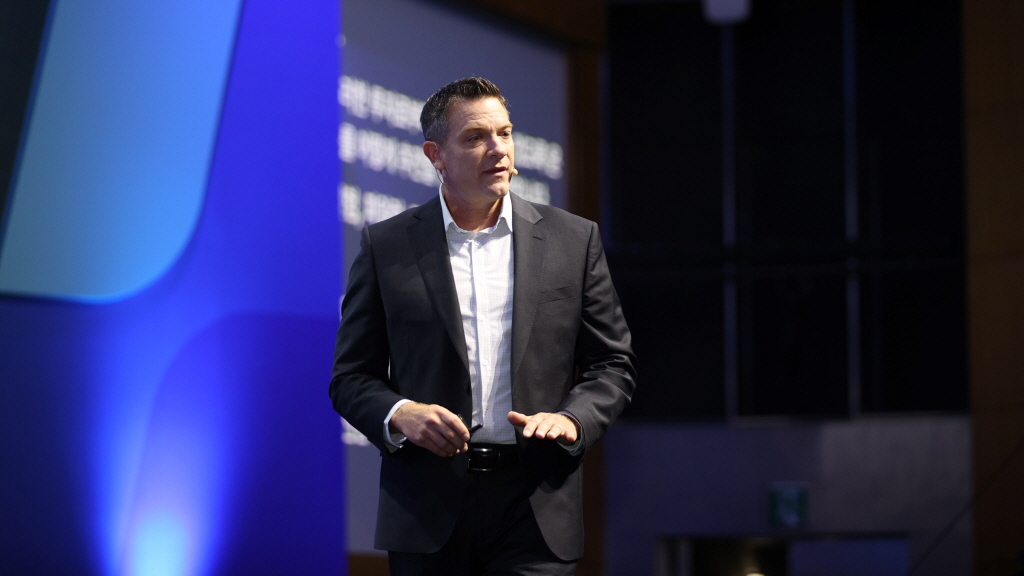
"All office workers will become agent managers"
At the Dell Technologies Forum 2026, Matt Dunfee, Senior Vice President at Dell Technologies headquarters, forecast that in the AI era, every worker will take on the role of managing dozens to thousands of agents, and emphasized that rather than simply adding AI to existing tasks, processes themselves must be redesigned. He pointed out that the success or failure of AI adoption depends not on technology itself, but on cost efficiency, data preparation, and AI economics, prototyping, and change management.
2026.08.28by 배종인 기자











