



TI Launches OMAP™ 5 Platform to Completely Change the Concept of Mobile
 Published2011.02.23 19:35
TI Launches OMAP™ 5 Platform to Completely Change the Concept of Mobile
- Creating groundbreaking mobile experiences with the new OMAP 5 platform
- TI's best-in-class application platform for mobile computing, 3D stereoscopic imaging, motion recognition, and CP
(computational photography) strengthening
- Sophisticated multicore processing including the ARM® Cortex™-A15 MPCore™ processor
– TI has launched the OMAP 5 mobile application platform, the next-generation product of the OMAP™ family. OMAP 5 Mobile
Application platforms have transformed how mobile devices, such as smartphones, tablets, and various mobile form factors, are used, making these products even more valuable in everyday life. (For more information on the OMAP5 platform, please refer to www.ti.com/wbu_omap5_pr_lp-kr )

Through TI's OMAP 5 platform, it will become possible to carry a mobile device as just a tool that provides PC-like computing performance at mobile power levels in the office, on the go, or at home. Furthermore, the same mobile device can be used to conduct S3D video conferences at work. During meetings, documents can be projected via this device, and the projected images can be edited simply by touching them. After work, the device can be transferred to a personal OS, allowing users to enjoy next-generation games on an HDTV via wireless display technology. These features are the primary capabilities that only the TI OMAP 5 platform can provide. (For more detailed information on the features of the OMAP 5 platform and to watch videos, please refer to www.ti.com/wbu_omap5_pr_v-kr )
Provides maximum performance and lowest power characteristics
The 28nm OMAP 5 application processors continue the OMAP family's tradition of significantly increasing performance and functionality while lowering power consumption compared to the previous generation. In particular, these processors provide up to three times the processing performance and five times the 3D graphics performance improvement compared to the sample user experience on the OMAP 4 platform, while reducing average power by nearly 60%. Furthermore, the software on the OMAP 5 platform is designed to maximize reusability, allowing for easy migration from the OMAP 4 platform.
Remi El-Ouazzane, Vice President of TI's OMAP Platform Business Unit, stated, "Devices are continuing to integrate and striving to become a single device capable of meeting all computing, entertainment, and daily needs and interests, so a revolution in mobile computing will take place over the next decade. Until now, nothing has enabled true mobile computing." “The OMAP 5 platform will be key to leading the mobile computing revolution by providing the best possible computing, graphics, and multimedia performance within the low-power budget required for mobile form factors,” he said.
Advanced Multi-Core Processing: Optimized for the Best User Experience
The OMAP 5 processor utilizes two ARM® Cortex™-A15 MPCores™, the most advanced and latest ARM architecture capable of supporting speeds of up to 2 GHz per core in the OMAP 5 implementation. With support for up to 8 GB of dynamic memory access and hardware virtualization capabilities, along with a 50% performance improvement over Cortex-A9 cores (under the same clock frequency conditions), the Cortex-A15 cores can support a true mobile computing experience.
The OMAP 5 architecture utilizes an intelligent combination of many diverse processing cores, each customized and power-optimized for specific functions, and is fully optimized to provide the best user experience. The OMAP 5 processor includes two Cortex-A15 cores as well as dedicated engines for video, imaging, vision, DSP, 3D graphics, 2D graphics, display, and security. Because the processor also includes two ARM Cortex-M4 processors, it can reduce the load on the real-time processing functions of the Cortex-A15 cores, thereby improving low-level control capabilities and responsiveness.
Mike Inglis, EVP and General Manager of ARM Processor Business Unit, stated, “ARM has consistently kept an eye on high-performance mobile devices, such as advanced smartphones and tablets, that require increased processor performance while remaining within limited mobile power consumption,” adding, “The OMAP 5 processor encapsulates the strengths of the ARM business model.” “This enables product differentiation by integrating low-power multi-core ARM with partner system-on-chip technologies such as power management, audio, and video processing. ARM is proud to contribute to the OMAP 5 platform, which enables manufacturing customers to leverage the extensive ARM software ecosystem to rapidly deliver innovative new mobile solutions,” he said.
Next-generation natural user interface
Natural user interfaces (NUI) are a way to interact with the world in an intuitive and natural way, and have advanced to a higher level through the advanced support features of the OMAP 5 platform for S3D, motion (including proximity sensors), interactive projection, etc.
The OMAP 5 processor can support up to four cameras in parallel, record and play back S3D video in 1080p quality, and convert 2D content to S3D at 1080p resolution in real time. Additionally, this processor can utilize 2D or S3D cameras to provide advanced short-to-long-range motion applications as well as full-body and multi-body interactive motion applications. It can also support interactive projection in conjunction with TI DLP® Pico™ projectors and cameras, allowing users to actually “touch and drag” images projected onto a table or wall.
In addition, the OMAP 5 processor can interface with and utilize a wide variety of sensor technologies, such as proximity sensors, capacitive sensors, and ultrasonic sensors, so it can support touchless detection.
CP (Computational Photography) – A New Frontier in the Industry
Although most mobile devices currently feature built-in cameras, photo and video quality has lagged behind standalone consumer electronics like DSLR cameras due to physical limitations. However, CPs are being used to bridge this quality gap and compensate for these limitations. The OMAP 5 processor includes hardware and software resources capable of supporting the development and implementation of algorithms such as video stabilization, motion blur reduction, noise reduction, high dynamic range, and face-based processing. Furthermore, this processor has advanced a step further by utilizing the same OMAP 5 hardware resources alongside vision algorithms that extract features and data from photos to implement applications such as face recognition, object recognition, and text recognition.

관련뉴스

Intel Unveils Next-Generation 'Core Ultra Series 3' and vPro Platform for Enterprise PCs
Intel has officially unveiled the "Intel Core Ultra Series 3" for next-generation enterprise PCs and the latest vPro platform, addressing a wide range of demands from enterprise notebooks to high-performance workstations.
2026.03.26by 배종인 기자

ROHM Launches ESD Protection Diode Compatible with High-Speed Interfaces of 10Gbps or Higher
반도체 전문 기업 로옴(ROHM)이 10Gbps를 넘어서는 차세대 고속 데이터 통신 환경에 대응할 수 있는 ESD(정전기 방전) 보호 다이오드 ‘RESDxVx 시리즈’를 개발하며, 고속 인터페이스에서 요구되는 신호 품질 유지와 IC 보호 성능을 동시에 끌어올렸다.
2026.03.26by 배종인 기자
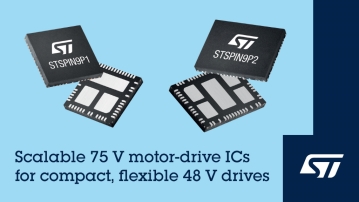
ST Launches 75V Drive IC Targeting 48V Industrial Motor Driving
ST마이크로일렉트로닉스가 48V급 산업용 구동 시스템 설계에 맞춘 75V 모터 드라이브 IC ‘STSPIN9P’ 시리즈를 공개했다. 새 제품군은 하프 브리지와 풀 브리지 구조로 구성돼 모터 종류와 출력 조건에 따라 설계를 확장할 수 있도록 한 것이 특징이다. 전원 회로와 보호 기능, 전류 감지 회로를 칩에 통합해 시스템 구성을 단순화했으며, 최대 500W급 애플리케이션까지 대응하도록 설계됐다. 회사는 레퍼런스 디자인과 데모 보드도 함께 제공해 산업 자동화, 로보틱스, 펌프, 팬, 조명, 섬유 기계 등에서 개발과 평가를 지원할 계획이다.
2026.03.26by 배종인 기자

Nordic supports security updates for the entire lifecycle of IoT devices at a single fixed cost
Nordic Semiconductor, a global leader in low-power wireless connectivity solutions, has unveiled a single fixed-cost licensing model that delivers FOTA (Firmware Over-the-Air) and device management capabilities throughout the device lifecycle via nRF Cloud, and introduced a new firmware update solution to prepare for the enforcement of the European Union's Cyber Resilience Act (CRA).
2026.03.26by 배종인 기자
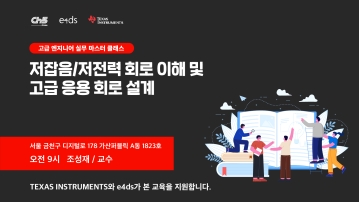
Practical Training in Low-Noise, Low-Power Circuit Design All in One Place… Training Fee Support
고감도 아날로그 회로와 센서 기반 시스템 설계 역량을 강화할 수 있는 ‘2026 고급 엔지니어 실무 마스터 클래스’가 오는 4월16일 서울 가산동 e4ds 컨퍼런스 센터에서 열린다. 이번 과정은 온라인이 아닌 오프라인 유료 실습 교육으로 진행되며, 현장 중심의 심화 학습을 원하는 엔지니어를 대상으로 한다. 이번 교육은 텍사스 인스트루먼트(Texas Instruments)가 교육비를 지원해 정가 25만원에서 10만원 할인 된 15만원에 참가할 수 있다.
2026.03.26by 배종인 기자











